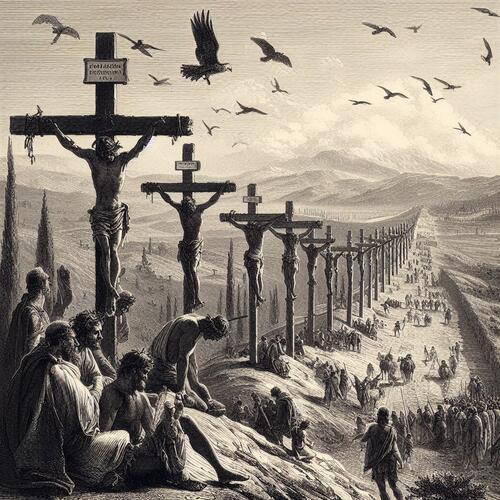
Why you should become a Bible-believing anarchist
who also believes the universe was created around 4004 B.C.
How can you be an anarchist if Romans 13 says the State is a divine institution which does so much good and you're supposed to honor it and pay every penny in taxes that it demands?
I have a whole website on Romans 13. It's called (simple enough) Romans13.com
That's a big seminary word for "rules of interpretation." What rules should we follow when trying to interpret a Bible verse? Here are a few:
Romans 13 says what Jesus says in the Sermon on the Mount. In fact, Romans 13 is a continuation of the message that began in Romans 12 (there were no "chapter" divisions in Paul's original letter). In Romans 12:14 Paul says "Bless those who persecute you." That does not mean that persecutors are a "divine institution," even though they "serve" God's purposes, and are, in this sense God's "servants" or "ministers" (from the Greek word deaconeo, "to serve," from which we get the ecclesiastical term "deacon").
It is "bad hermeneutics" to say that Romans 12:14 "authorizes" persecution. No, persecutors must repent. They are violating God's Commandments. They are sinning.
In Romans 12 Paul says leave vengeance to God. Do not return evil for evil. Overcome evil with good. Even . . . [turn the page to Romans 13] . . . the most evil thing on the planet: The Empire. The government.
Paul uses a word in Romans 13 -- the "powers" that be -- which means "demonic" or evil in every other verse in which he uses this word.
Jesus said "resist not evil" (Matthew 5:39). Not only "do not resist," but if the evil invaders wish to enslave you for one mile, let them enslave you for two miles (Matthew 5:41). "Resist not evil" does not mean evil is a "divine institution." There are many verses which instruct members of "the private sector" to "be subject to" members of "the public sector." Pharaoh, Caesar, Hitler, and Saddam Hussein were all evil but all "served" God's higher purposes. They were His "ministers" or "deacons." But that doesn't mean they did not need to repent of their evil policies. If the "public sector" thoroughly and completely repented of all its violations of God's Law, stopped doing things that everyone agrees are evil or sinful when committed by the "private sector," it would "go out of business." We would have what the Jewish economist Murray N. Rothbard called "anarcho-capitalism."
Romans 12-13 is a call to pacifism, not patriotism.
If everyone in "the government" repents of "governing" people (hurting them and taking their stuff), then everything human beings do will be done in "the private sector," with consent, under a contract. Not by archists who think they have a divine mandate to violate God's Commandments "in this case."
PATRIAGORA
πατριά - Patria | Family + Market | Agora - ἀγορά
The Family Creates a Free Market without “Church” or “State”
|
|
||
ROMANS 13The Most Disastrously Misinterpreted Scripture
|
||
|
|
||
"That's an insane thing to say."
First, because everyone knows that an "anarchist" is anti-Christian.
Second, because it's arrogant and uncouth to say someone is not a Christian. It's not socially acceptable to say that "public servants" are not good people.
On a scale of 1-10, where "10" is "a great idea that should be taught in public schools," and "1" is "a vile idea that should be suppressed, banned, censored, and de-platformed," you'll rank my claim at a "-3 below zero."
In just 60 seconds I can show you I'm not insane. You'll say, "OK, I can see how you came to this conclusion, but I'm not buying it."
In just 60 minutes I can make you raise your ranking from "-3 below zero" to "5," which means, "Is it possible this might be true? Why have I not been told this before? I need to study this some more."
But it may take me 60 weeks to get you to internalize the claim and be willing to defend it publicly. You'll have to read the entire Bible, every day for a year, and answer two 5th grade-level comprehension questions each day. I'm pretty confident you've never asked some very basic questions about what the Bible actually says and about the society in which you live.
You've landed on a webpage which is an intense wall of words. It will take you at least 5 hours to read the whole thing. As of , I'm trying to get this page edited down to a couple of hours.
Listen to an AI-generated debate: "Should You Read This Web Page?" 21m, 33s
The Bible is Actually an Anarchist ManifestoThere was a time in my life when I would never have been willing to waste my time reading anything that praises "anarchists." Back then I said I believed the Bible, but I did so only in some vague sense of family custom or conservative tradition. One day I became persuaded that the Bible is actually the Word of God, who has a right to be our Governor in every area of life, and the Bible is a textbook on every subject, including:
The Bible should be considered the ultimate authority in every area of of human thought and action: government, economics, education, and all and society, not just "religion."
I came to believe the Bible is a blueprint for a peaceful, prosperous society. I came to believe the Bible is more authoritative than any university professor or "expert."
The writer who changed my mind about the Bible was R.J. Rushdoony, Founder of a Christian think-tank called Chalcedon. Rushdoony wrote the following:
This is what John Adams, later second President of the U.S., wrote in his diary on February 22, 1756:
Like others of his day, Adams was a theonomist! |
The word "Theonomy" comes from two Greek words meaning "God's Law."
I'd like to take Adams more literally than he probably intended. In principle, Adams is advocating "Theocracy." That word comes from two Greek words meaning "God governs." Adams is saying we should be governed by God and His Law Book, the Bible. "We" as individuals and as a society.
In principle, John Adams is also advocating "anarchy." If the Bible is the only law book, it means there is no human legislature. This is a society without "The Government" and its many law books.
- Isaiah 33:22
- For the LORD is our Judge, ["Judicial"]
The LORD is our Lawgiver, ["Legislative"]
The LORD is our King; ["Executive"]
He will save us
No, Adams wasn't advocating "anarchy" self-consciously. Adams' purpose was just to praise the Bible and Biblical morality. He would probably say he was just using "hyperbole." But he wasn't afraid to say something nobody would say in our day.
The Bible as the "only law book?"
Nobody in government today would ever say what Adams said, not even in "hyperbole":
"We should take the Bible for our only law book."
Unthinkable. That's too "radical." That's "extremist." It's "homophobic." Or something. Only a "domestic terrorist" would say something like that.
Benjamin Rush signed the Declaration of Independence and served in the Presidential administrations of John Adams, Thomas Jefferson, and James Madison -- each of whom came from a different political party. And of what party was Rush? He answered,
I have been alternately called an aristocrat and a democrat. I am now neither. I am a Christocrat. I believe all power. . . will always fail of producing order and happiness in the hands of man. He alone Who created and redeemed man is qualified to govern him.
That's the goal of the Christian anarchist: abolish all human governments and replace them with a global "Christocracy." See Micah 4:1-7 below.
A Christian Theocracy -- "Christocracy" -- is very different from a Muslim theocracy. Different law books.
If you believe the Bible is the Word of God, I can convince you that the Bible is an anarchist manifesto. But you actually have to read the Bible.
If you're an atheist and don't believe the Bible is the Word of God, it may be because you've been deluged with propaganda from both church and state telling you that the Bible supports corrupt institutions like church and state. If I can convince you that the Bible is actually an anarchist manifesto, you might be willing to look at the Bible without archist-colored glasses.
One of the most liberating moments of my life occurred when I realized I was a victim of educational malpractice. At the same time I realized that there were resources available to me that would re-educate me and change my life. I would like to help you experience that same moment. But it will take a while.
Let me prove to you that you and I have been misled.
In 2026 America celebrated the 250th anniversary of the signing of the Declaration of Independence in 1776. This strikes me as an exercise in mass hypocrisy. It vividly exposes how Americans are victims of educational malpractice.
| In which country does the government prohibit teachers in government-run schools from teaching students that the Declaration of Independence (1776) is really
true: a. Iran b. North Korea c. Communist China d. The United States e. All of the above |
- That's correct:
|
That's what America's Birth Certificate -- the Declaration of Independence -- says.
None of these things can be taught as truth in a school controlled by the government of the United States.
If you endorse or try to promote these ideas in today's atheistic public schools, you will be accused of trying to "impose a Theocracy" on America.
I for one am against "imposing" anything on anyone.
But I support the "anarchy" and Theocracy found in the Declaration of Independence.
"Theocracy" is today's great boogeyman word.
I was trained to react with horror at the word "Theocracy." I now realize I was misled. The word "Theocracy" comes from two Greek words meaning "God governs." At the Constitutional Convention, Benjamin Franklin said "God governs" and quoted the Bible to remind America's Founding Fathers of what they already knew. If God is Governor over the government, then the government is "under God." From the very beginning, America was a nation "under God. The recognition that America is "under God" and God is over the nation makes America a "Theocracy." By definition.
But you're not allowed to say that.
My atheistic public school teachers (many of whom regularly attended church on Sunday, but were practicing atheists during the week at school) dutifully taught me that Theocracy was a terrible thing. Who wants to be governed by clergymen, like in Iran? I gradually learned that
The left uses the word "Theocracy" to scare us away from the Declaration of Independence and America's Christian history. "Don't even think about becoming a nation 'under God' again. That can only lead to THEOCRACY."
I now realize that the nation that made the Declaration of Independence in 1776 was a "Christian nation," and even a "Theocracy."
But things have changed from 1776. The United States is now an apostate Christian Theocracy.
The United States is now an atheistic theocracy, where every man is his own god, and the government is our collective god.
In 1892 the U.S. Supreme Court proudly boasted that America was a Christian nation. That case, and the Christian history it recounted, was flushed down the Orwellian Memory Hole after atheists and secular humanists captured "the Robes."
|
|
Capturing the Robes was the strategy of Antonio Gramsci, who spoke of "the noblesse de robe."
Noting that Western society was deeply religious, Gramsci believed that . . . the only way to achieve a proletarian revolution would be to break the faith of the masses of Western voters in Christianity and the moral system derived from Christianity.
Daniel Ajamian, "The Greatest Political Strategist in History"
The secularization of America's public schools began in earnest when I was in the first grade. Voluntary prayer was taken out of America's public schools by six unelected Justices of the Supreme Court. The next year the Bible was removed. Not a single person who signed the Constitution intended to give the Supreme Court that power. The Constitution is dead meat. Nobody cares. We live by myths.
The robes of the State secularized the robes of academia, supported by the robes in the church.
I think every signer of the Declaration of Independence would be horrified at what has happened to the nation they risked their lives, their fortunes, and their sacred honor to create. It has become the most evil and most dangerous terrorist regime on planet earth.
Years ago I would have thought that claim was unpatriotic, un-American, and evil. But I was a victim of educational malpractice back then.
The numbers don't lie. During my lifetime, the atheistic U.S. Federal Government murdered, maimed, or made homeless tens of millions of innocent non-white non-combatant civilians around the world, causing more human suffering than Nazi Germany did under Adolf Hitler.
The Bible says God hears the cries of the poor. In the last 50 years, the U.S. Federal Government has caused more people to cry than any other nation or terrorist group. God says He will not hear the cry of those who will not hear the cries of the poor. Was I a Christian when I voted for politicians who promised to do these evil things in the name of "national security?"
America has gone from a Christian nation -- so described by the robes of the U.S. Supreme Court in 1892, practiced in America's schools, led by the robes in churches -- to an atheistic nation that imposes homosexuality and abortion on weaker nations, who will suffer U.S. military aggression if they resist. The United States drops a bomb somewhere in the world every 12 minutes, on average.
None of us wants to think about America as a Theocracy in the past, nor do we want to think about the United States as a Nazi terrorist in the present. The Robes don't want us to think about the past and the present like this, because we might end up changing the future, which the Robes want to control.
The Great Commission (Matthew 28:18-20) requires us to make disciples of all nations, to teach all nations everything Christ commanded. Jesus said:
“All authority has been given to Me in heaven and on earth.
19 Go therefore and make disciples of all the nations, baptizing them in the name of the Father and of the Son and of the Holy Spirit,
20 teaching them to observe all things that I have commanded you; and lo, I am with you always, even to the end of the age.” Amen.
Will the Body of Christ succeed in making disciples of all nations? That's a question about "eschatology." I believe this Commission will be fulfilled in history, before any "second coming." I believe fulfilling this commission will result in the fulfilling of Micah's “Vine & Fig Tree” prophecy (below). That prophecy is the central concern of this essay, and the non-profit organization that sponsors this website. Fulfilling that prophecy will not come about by abolishing a tyrannical government by armed violent revolution and then creating a new government that turns out to be even more tyrannical. The only way to create the “Vine & Fig Tree” society is by fulfilling "The Great Commission" (Matthew 28:18-20): Making disciples of every nation by teaching them everything Christ commanded.
Was ancient Israel obligated to make disciples of all nations before the Messiah came? That's an interesting question, and I would say yes, but clearly it was not in God's plan for that to happen. Israel was faithless and rebellious.
We are commanded to teach all nations "to observe all things that I have commanded you." So what did Jesus command?
Most Christians who are not pacifists have a nagging fear that Jesus commands His followers to be pacifists. They don't want to be pacifists. We've all been taught there's something wrong with pacifists. They're "cowards." They would "let evil take over." This may be why some people don't take Jesus seriously. "Everybody knows" that Jesus commanded His disciples to be "pacifists." Among the commandments that we should be teaching the nations (and ourselves):
"Government" is the refusal to follow these commands. While Jesus commands that we be "subject" to those who refuse to obey these commands, we are certainly not commanded to institutionalize systematic disobedience to these commands by creating a "government."
The only path to civilization is Theocracy. That's what Tertullian was saying when he spoke of the contradiction between Jerusalem and Athens. "Theocracy" and "pacifism" in the Biblical sense are not just negative: not inflicting violence on contract-breakers, but positive: working six days a week (Exodus 20:9; Ephesians 4:28) to bring produce to a market, thus serving others. God's Law -- "Theonomy" -- leads to civilization, while autonomy -- self law, man as his own god -- did not bring civilization, and cannot sustain civilization in the long run.
The Great Commission requires us to teach these commandments to all nations.
The Bible is a pacifist manifesto, as it condemns violence, even the violent overthrow of sinful violent empires, no matter how sinful and violent they become.
But we don't want to be pacifists.
We don't like those commands, so we "spiritualize" them. We "privatize" them.
We search the Bible for verses which sound like they can excuse our desire for punitive retaliation.
Romans 13 is claimed to be such a verse.
We also like the idea of using the State to "redistribute income" and get "free" stuff.
The pacifist opposes violence, and every professor of political science in every university on planet earth will agree that the most fundamental definition of "Government" is a "monopoly of violence." You and I are not allowed to hurt people or take their stuff, but "the government" claims a monopoly right to do what the rest of us may not do.
So a consistent pacifist challenges not just personal violence, but national violence. And that means a logically consistent pacifist -- who says no human being on earth has a right to hurt people or take their stuff -- is an "anarchist" -- a threat to patriotic support for the government, which claims a "monopoly on violence."
Jesus commands His followers to be pacifists, and those commands of Christ are in conflict with the idea of "government," the institution of violence we use to get free stuff.
Putting these three commands into practice makes having a "government" impossible.
|
In fact, Christ commands His followers to be "anarchists."
An "archist" is someone who believes he has a right to impose his own will on others by force or threats of violence. Christ says His followers are not to be archists. We'll look at that claim in more detail below.
One of Jesus' commands was to teach the law and the prophets:
Matthew 5:17-19
17 “Think not that I am come to destroy the Law or the Prophets. I am not come to destroy, but to fulfill.
19 Whosoever therefore shall break one of these least commandments and shall teach men so, he shall be called the least in the Kingdom of Heaven; but whosoever shall do and teach them, the same shall be called great in the Kingdom of Heaven.
I interpret this as a command to teach all nations to beat their swords into plowshares (Micah 4:1-7) (among other things, of course).
If we fulfill this commission, and teach everything Christ commanded, all the kingdoms of the world will go out of business, leaving only the Kingdom of God, with Jesus as the Christ/Messiah/King. The "Great Commission" is therefore an "anarcho-pacifist commission."
That's obviously a very controversial opinion. No Bible college equips students to "beat swords into plowshares," to abolish governments by evangelizing dictators to repent and abdicate.
Augustine traced the history of the "City of God," while at the same time the "City of Man" was also growing. The concept of "civil government" is the product of the City of Man, not the City of God.
Beginning with Adam, and continuing through Noah, Job, and Abraham, all "government" functions were exercised in the context of "Patriagora." There was no institutional "church" or "state." At the same time, the line of Cain, Lamech, Nimrod, were building a rival City.
Genesis 26:4-5 says,
And I will make thy seed to multiply as the stars of heaven, and will give unto thy seed all these countries; and in thy seed shall all the nations of the earth be blessed;
Because that Abraham obeyed my voice, and kept my charge, my commandments, my statutes, and my Torah.
Scripture does not give us an account of God revealing His Torah and all these commandments to Abraham. Noah offered sacrifices after getting off the ark (end of Genesis 8) but we have no record of God revealing the requirements of the sacrificial system to Noah. Cain and Abel obviously knew of the requirement to make sacrifices, and perhaps this knowledge was passed down to Noah through the line of Seth, if not directly revealed to Noah.
Archists say "Taxes are the price we pay for civilization." Abraham would counter, "Obeying God's commandments is the price we pay for civilization." and Abraham had the complete blueprints for a peaceful, prosperous, and flourishing civilization. No institutional "church" or "state" needed to be added to "Patriagora."
Deuteronomy 28 and Leviticus 26 tell us that if we obey God's commandments, we will be blessed. "Blessing" is not just a warm feeling in your heart; it is a peaceful and prosperous civilization. We will be delivered from the City of Man and placed into a "Vine & Fig Tree" society.
Genesis 13:2 tells us that "Abram was very rich in livestock, in silver, and in gold." He engaged in peaceful commerce with his neighbors. This stands in contrast to the kings around him (Genesis 14). Those kings engaged in plunder. The exemplified Franz Oppenheimer's "Political Man," while Abraham exemplified "Economic Man."
We might imagine the kings of Genesis 14 saying to themselves, "We've got a pretty good thing going here." The Sicilian branch of the Mafia is known as "La Cosa Nostra." The "thing" of ours. "Our thing." A "protection racket." The "City of Man" is characterized by these "things." Oppenheimer's term "political man" is derived from the Greek word polis, "city." The first city was built by the murderer Cain (Genesis 4:17). Augustine says this is the beginning of the City of Man. We could call it "La Cosa Caino," or "Cain's Thing." The Bible is the history of "cosas" like "La Cosa Lamech," "La Cosa Pharaoh," "La Cosa Assyria," and "La Cosa Romana."
It is the City of Man, not the City of God, that functioned as the petrie dish for "civil government."
The Patriarchs went down to Egypt and were enslaved by the City of Man. By the time of the exodus 430 years later, Israel had developed a faithless slave mentality, and wanted to remain in the City of Man under Egyptian archists. Israel continually slid into idolatry, preferring creature-archists over the Creator. In 1 Samuel 8, God's Chosen People rejected the God who chose them, and wanted a king like those of the gentiles in the City of Man. Israel's idolatry led them into periods of domination, and God would send judges or deliverers/saviors (Nehemiah 9:27) to save them from pagan archists and save them into a "Vine & Fig Tree" society. But Israel continued to plunge into rebellion and idolatry, and suffered destruction and captivity at the hands of Assyria and Babylon. God sent a final Deliverer, Jesus. Jesus is the "Last Adam" (1 Corinthians 15:45) and we have been restored to Edenic fellowship with God, and we walk in the steps of Jesus (1 Peter 2:21). There is no justification for a human oligarchy (small number of archists rule over the larger population). Everyone should aspire to "Patriagora" like "sons of Abraham."
Abraham: Patriarchy as Theocracy
Andrew Torba, founder of a social media platform called "Gab," wrote a book called Christian Nationalism: A Biblical Guide to Taking Dominion and Discipling Nations. I agree with a lot in this book, but Torba would say I'm a heretic, and I guess I would have to say the same thing about him. In my view, Torba's "Nationalism" (which I regard as unBiblical) is related to his unBiblical eschatology.
Chapter 7 of Torba's book is called "The Time for Lukewarm Christianity is Over." Of course he is completely correct about this. Jesus says that being lukewarm makes Him want to vomit you out of His Mouth (Revelation 3:15-16). If lukewarm Christians aren't calling you an "extremist," you need to worry about what Jesus will call you. If the Pharisees aren't calling you a "heretic," then you need to check with Paul the Apostle and Heretic.
At one point in his life, Torba examined himself and asked
| How many of us are living according to God's Word and how many are living according to the ways of the world? In my early twenties I was calling myself a Christian, but I was living a very worldly life. God came secondary to my career and worldly desires. I wasn't attending church. I wasn't reading my Bible. I wasn't praying. What part of me was living a Christian life that could justify calling myself a Christian? That all changed a few years ago when the Holy Spirit moved my heart closer to God. I started attending church, got married, became a father, and humbled myself as the worst of sinners before an Almighty God. For many Americans, Christianity has become a rapidly deconstructed fragment of their actual identity. People refer to themselves as a "Christian" when asked about matters of faith, but you won't find them openly proclaiming Christ as their central identity. |
Great questions. Can you be a Christian if you're "living according to the ways of the world?" Torba correctly said No.
What is the mark of the true religion?
James 1:27
Pure and undefiled religion before God and the Father is this: to visit orphans and widows in their trouble, and to keep oneself unspotted from the world. (cf. also Matthew 25:31-46)James 4:4
Do you not know that friendship with the world is enmity with God? Whoever therefore wants to be a friend of the world makes himself an enemy of God.
The United States not only doesn't care for orphans and widows, it creates widows and orphans on a massive scale. By any Biblical measure, the U.S. is the enemy of God. But Christians are generally favorable toward this government, and completely closed-minded toward beating swords into plowshares, i.e., cutting the defense budget by even 10%.
The ultimate in being worldly is being an archist.
I'll concede that Torba has accomplished more admirable things in his 33 years on earth than I have in my 66. I've never been married. Never had kids. What a loser.
But at least I have repented of "nationalism," which has resulted in the murder of millions of innocent people, and the destruction of homes, schools, and hospitals around the world.
And I would contend that the heresy of "nationalism" is related to the heresy of "Adventism."
James 1:27 says that "true religion" is protecting widows and the fatherless. Nationalism creates widows and fatherless children by killing their husbands and fathers.
Micah 4 and Isaiah 2 say that in the age some call the "millennium" we will beat our "swords into plowshares." Adventists believe that we cannot and must not fulfill this prophecy until after the Second Advent of Christ. Until then, we must continue creating widows and orphans. People who object to killing fathers and traumatizing their widows and fatherless children by dropping bombs on their homes and hospitals are called "pacifists" or "anarchists," and are often denounced by nationalists and adventists as "heretics."
I would say that anti-pacifists have a different religion than pacifists. It's a different religion. It's time to "choose" which religion you should follow.
Was Andrew Torba a genuine Christian in his twenties? Was his thinking poisoned by a false religion? Was he missing the "pure religion" of James 1:27? He admits he was "worldly." Was he therefore an enemy of Christ (James 4:4)? Is a lukewarm person a genuine Christian, if Jesus would "vomit" him out of His Mouth?
These are obviously very serious questions.
Torba, a Calvinist, would say that even though he was "lukewarm" and "worldly," and even an "enemy" of God in his twenties, he was still one of the "elect." But he needed to repent.
Click here to see what a Bible-believing anarchist is like.
I hope you're beginning to see that there might be a completely different side to this issue you've never heard.
"You're not a Christian if you're not an anarchist." Can I make that claim sound reasonable?
Start your stopwatch. 60 seconds.
Is it possible you're not a Christian?
1. On multiple occasions, Jesus told people who thought they were going to heaven, "I never knew you."
2. The Apostle Paul says, "Examine yourselves as to whether you are in the faith. Test yourselves. Do you not know yourselves, that Jesus Christ is in you?—unless indeed you are disqualified (2 Corinthians 13:5 ).
3. True religion is protecting widows and orphans (James 1:27). The Day of Judgment revolves around whether you served "the least of these" by raising their standard of living (Mathew 25:31-46).
4. There came a point in my life when I realized I had voted for politicians who promised to lower the standard of living of widows and orphans after creating widows and orphans by killing husbands and fathers. Can anyone be a Christian without repenting of this kind of violence and false religion?
Is it possible you are commanded to be an anarchist?
5. Jesus prohibits His followers from being archists (Mark 10:42-5). That means Christians must be "an-archists." I graduated from college before I realized the implications of that verse. I'll talk more about this verse below.
6. There is no verse in the Bible that anyone can point to and say,
This verse gives me the right to be an archist: to
- take vengeance on my enemies (violating Romans 12:19),
- extort money from others (violating Exodus 20:15) to finance my acts of vengeance, and
- threaten violence against anyone who tries to compete with my monopoly system of "justice,"
and be assured God will not hold me guilty of sin for doing such things."
Donald Trump cannot say that. Vladimir Putin cannot say that. No human being on planet earth in our day can say that. If you take the Bible seriously, that claim has staggering implications. Can you find such a verse in the Bible that Putin can legitimately point to?
You can read those words in 60 second, but you may have to stop and think about them for a few minutes.
Am I insane? You might have thought so when you read the headline. Hopefully no longer. "Extreme," maybe. But not insane.
Jesus said His followers are to be peaceful, orderly, self-sacrificing non-archists. Jesus said the kings of the gentiles -- archists -- men like Pharaoh, Caesar, Putin, Netanyahu, Xi Jinping, and Donald Trump -- steal trillions of dollars and murder millions.
At one time I thought that if my son or daughter ever came home from school and said "Daddy! When I grow up I want to be an anarchist!" I would be horrified, and wonder where I had gone wrong as a parent, and "what the heck are they teaching at
school?"
Today, I would be shocked if my kid came home and said "Daddy! When I grow up I want to be an archist!"
Some claims made on this page:
|
Matt Kibbe wrote an introduction to libertarian philosophy entitled Don't Hurt People and Don't Take Their Stuff. It's a survey of the libertarian philosophy of non-aggression. It's probably a pretty good book on libertarianism, although I admit I haven't read it. But it's a great title. I love the title and refer to it all the time.
The title is also a pretty good summary of Christian social ethics. Everyone in "the private sector" knows you're not supposed to hurt people or take their stuff. But "the government" is based on violence. If government officials all agreed never to sin, government would "go out of business." It is a sin to be a "government." "The Public Sector" claims the right to do what everyone in the "private sector" knows is wrong to do.
On the one hand, it was saddening to realize I did not receive the kind of education America's Founding Fathers received.
On the other hand, I realized that there were many opportunities to become educated. As a fanatic participant in high school debate, I spent many hours
at nearby California State University Fullerton, which was an official "Government Depository" of government documents. In college, the large library contained many interesting volumes that nobody had
checked out for years. During my years at the Orange County Catholic Worker, I lived just a few blocks away from the Orange
County Public Law Library. I have always loved exploring information. While at the Worker I learned about the Internet. And now with AI, there's no excuse for being a victim of educational malpractice.
What is "The Government?" Does a peaceful society need a "government?" Does God in the Bible require every society to form and maintain a "government?"
George Washington is reported to have said,
Government is not reason, it is not eloquence — it is force. Like fire it is a dangerous servant and a fearful master. . . .
Sociologist Max Weber says "the State" is "a human community that (successfully) claims the monopoly of the legitimate use of physical force within a given territory."
It is important to realize this: every political scientist in human history agrees that if you do not have "taxation" -- money extracted by force without consent -- then you do not have "THE Government." By definition.
But taxation is theft. It is fundamentally immoral for a "majority" to "vote" to take money from the minority without the consent of the minority. For the minority, voting is "self-defense," not "consent."
"Consent" means "You have persuaded me with your facts and logic. I would voluntarily give you my money for your pet project even if you didn't threaten to lock me in a cage with a psychopath who will sodomize me."
"Taxation" is not voluntary. It is not consensual. Taxation is the moral equivalent of extortion. It is the moral equivalent of robbery.
St. Augustine, in his book City of God, wrote this:
Justice being taken away, then, what are kingdoms but great robberies? For what are robberies themselves, but little kingdoms? The band itself is made up of men; it is ruled by the authority of a prince, it is knit together by the pact of the confederacy; the booty is divided by the law agreed on. If, by the admittance of abandoned men, this evil increases to such a degree that it holds places, fixes abodes, takes possession of cities, and subdues peoples, it assumes the more plainly the name of a kingdom, because the reality is now manifestly conferred on it, not by the removal of covetousness, but by the addition of impunity. Indeed, that was an apt and true reply which was given to Alexander the Great by a pirate who had been seized. For when that king had asked the man what he meant by keeping hostile possession of the sea, he answered with bold pride, What you mean by seizing the whole earth; but because I do it with a petty ship, I am called a robber, while you who does it with a great fleet are styled emperor.
It is for this reason that libertarians do not trust "the government." Libertarians do not believe anyone, under any name or label, has the right to use force to impose his will on others.
Libertarians are often portrayed as being "anti-government." But it is this "anti-government" attitude that made America the freest and most prosperous nation in history.
How do libertarians respond to the accusation that they do not have enough trust in government? John Adams wrote in 1772:
There is danger from all men. The only maxim of a free government ought to be to trust no man living with power to endanger the public liberty."
Should libertarians have more confidence in their government? Thomas Jefferson, 1799:
Confidence is everywhere the parent of despotism. Free government is founded in jealousy, and not in confidence; it is jealousy, and not confidence, which prescribes limited constitutions to bind down those whom we are obliged to trust with power.… In questions of power, then, let no more be heard of confidence in man, but bind him down from mischief by the chains of the Constitution.
James Madison warned the people of Virginia (1799):
the nation which reposes on the pillow of political confidence, will sooner or later end its political existence in a deadly lethargy.
Madison added in Federalist No. 55,
[T]here is a degree of depravity in mankind which requires a certain degree of circumspection and distrust. . . .
Trusting government, having "confidence in government," is un-American.
The British historian Lord Acton put it this way:
Power tends to corrupt and absolute power corrupts absolutely. Great men are almost always bad men, even when they exercise influence and not authority; still more when you superadd the tendency or the certainty of corruption by authority. There is no worse heresy than that the office sanctifies the holder of it.
The exercise of political power is problematic. We should assume that "great men" -- that is, powerful men -- men who wield the force of "the government" -- are morally corrupt. This assumption should be considered confirmed if he increases his own power during his time of "public service."
Larken Rose writes:
Most people, looking at our troubled world with its long history of injustice and human suffering, will attribute social evils to the greed, ignorance, hatred, or lack of compassion of others.
Rarely does anyone consider the possibility that his own attitudes, perceptions, and beliefs may be the root cause of most of the world’s suffering.
But in almost every case, they are.
The vast majority of theft, extortion, intimidation, harassment, assault, and even murder – the vast majority of man’s inhumanity to man–comes not from the greed, hatred, and intolerance that lurks in our hearts, but from one pernicious and almost universal assumption, one unquestioned belief, one irrational, self-contradictory superstition that infects all races, all religions, all nationalities, ages, and income levels.
If humankind could give up this one false idea, even without otherwise acquiring another scrap of wisdom or compassion, the vast majority of injustice and oppression would instantly cease.
But this cannot happen until people are ready and willing to turn their judgmental eyes upon themselves – to objectively examine their own belief systems, to recognize and understand, and finally to abandon, the most dangerous superstition.
If you love death and destruction, oppression and suffering, injustice and violence, repression and torture, helplessness and despair, perpetual conflict and bloodshed, then teach your children that "government is an inescapable necessity, and teach them that obedience to government commands, even if immoral, is a virtue.
If, on the other hand, you value peaceful coexistence, compassion and cooperation, freedom and justice, then teach your children the principles of self-ownership, teach them to respect the rights of every human being, and teach them to recognize and reject the belief in “government” for what it is: the most irrational, self-contradictory, anti-human, evil, destructive and dangerous superstition the world has ever known.
Contrary to what nearly everyone has been taught to believe, “government” is not necessary for civilization. It is not conducive to civilization. It is, in fact, the antithesis of civilization. It is not cooperation, or working together, or voluntary interaction. It is not peaceful coexistence. It is coercion; it is force; it is violence.
It is animalistic aggression, cloaked by pseudo-religious, cult-like rituals which are designed to make it appear legitimate and righteous. It is brute thuggery, disguised as consent and organization. It is the enslavement of mankind, the subjugation of free will, and the destruction of morality, masquerading as “civilization” and “society.”
The problem is not just that “authority” can be used for evil; the problem is that, at its most basic essence, it is evil. It supersedes and destroys moral consciences, replacing them with unthinking blind obedience. It cannot be used for good, any more than a bomb can be used to heal a body.
"Government" is always aggression, always the enemy of peace, always the enemy of justice. The moment it ceases to be an attacker, it ceases to fit the definition of “government.” It is, by its very nature, a murderer and a thief, the enemy of mankind, a poison to humanity. As dominator and controller, ruler and oppressor, it can be nothing else.
• Why a Bill of Rights? | Walter Williams
• Why Bad Men Rule | Hans-Hermann Hoppe
"Good intentions will always be pleaded for any assumption of power. The Constitution was made to guard the people against the dangers of good intentions. There are men in all ages who mean to govern well, but they mean to govern. They promise to be good masters ... but they mean to be masters."
~ Daniel Webster
A well-governed person, who yearns for a well-governed society, wants to place firm limits on "the government."
But can there be too many limits on "the government?" What if the chains of the Constitution strangle "the government" or "the government" is abolished all together?
I believe this would be a good thing.
"But wouldn't that be anarchy?" some might ask.
If you equate "anarchy" with "lawlessness." then "anarchy" is a bad thing. But if you understand that "anarchy" means "the absence of archists," then your next question should be, "What is an archist?" Keep reading on this page if you want to learn more about "law" and "lawlessness," or click the link below to find out why good and moral people are against "archists."
My claim is that we don't need a "government," and it is sinful to have one.
|
Every Professor of Political Science in every college and every university on planet Earth will agree that the very essence of the institution we call "the State" is its claim to possess a monopoly on violence. The Right to Sin. Forbidden to "laymen," but a "right" of the state -- to do what would be a "crime" if you or I did it. Governments -- and only governments -- claim a right to do what the rest of the world knows is wrong.
Franz Oppenheimer: Economic vs. political
Economy: family + law | productivity + trade
Political: steal rather than produce
"Consent of the Governed" is a contradiction in terms. Suppose I offer to mow your lawn. We agree on a price. You and I consent to the transaction, and at common law we now have a valid enforceable contract in the "private sector." The "private sector" is based on consent.
If I offer to mow your lawn for $1000 and you refuse my offer, can I threaten harm to you if you don't let me mow your lawn so I can get paid? What if I said your ugly lawn is reducing property values in the neighborhood. You are not governing yourself properly. You did not consent to my offer, so you need to be governed -- by me (or people I approve of). I am going to perform a "public service" by mowing your lawn. It will benefit "the public weal" and improve the "general welfare." It will be for "the common good." If you refuse to pay me, I will lock you in my basement with a psycho who will sodomize you repeatedly. I am now your "governor" and we are operating in "the public sector." You and I now have a "social contract."
"Governing" people is a violation of God's Commandments. Threatening people with violence if they don't do what you want them to do is a sin.
There is no verse in the Bible which is directed to Nimrod, Pharaoh, Nebuchadnezzar, Caesar, Hitler, Trump, Netanyahu, Putin, or Xi Jinping or any human being at any time in history where God says "I hereby declare it to be morally legitimate for you to steal money from people without their consent and buy weapons and hire soldiers to hurt people and create widows and orphans. I won't condemn you if you do anything like this. You have my permission to do what people in the 'private sector' may never do: hurt people and take their stuff."
But defenders of the public sector say Romans 13 is that verse. Romans 13 is not that verse. They ignore the rest of the Bible. The Apostle Paul was writing to believers who knew their Bibles better than Americans in 2026 do. They knew that the Bible is filled with God's disapproval of people like Pharaoh and Caesar, just as we should know what the Bible says about Putin, Netanyahu, and Trump.
As a victim of educational malpractice, I was raised to believe that "anarchists" were bad people, and those who stood against anarchists -- logically these would be "archists" -- were the good guys. Then I realized this was The Biggest Government Lie of All Time. Did you know that Jesus commands Christians to be anarchists? Neither did I. This is found in Mark 10:42-45.
A little background.
The word "anarchist" actually comes from two Greek words meaning "not" + "archist."
An "archist," as everybody knows is . . .
. . . wait a minute. Nobody knows what an "archist" is.
Let's let Jesus define what an "archist" is. We'll discover that in the Bible, "archists" are the bad guys. Those who follow the commands of Christ are "an-archists."
Everybody knows (or thinks he knows) what an "anarchist" is: someone who creates chaos, lawlessness, and disorder by doing whatever seems right in his own eyes. We've all been taught that "anarchists" are evil.
The Bible says the exact opposite.
The Bible is not a strictly "religious" book. More pages of the Bible are about politics than any other subject. The Bible describes the utter failure of human "government" and empires. Not just "failure," but evil. Invasion, conquest, slavery, plunder, murder.
The Advent of the "Prince of Peace" made that clear. But the disciples did not understand this at first.
When Jesus told His disciples He was a pacifist and would allow Himself to be tortured to death by the government, Peter reacted like a defender of the Second Amendment:
Matthew 16:22
Then Peter took Him aside and began to rebuke Him, saying, “Far be it from You, Lord; this shall not happen to You!”
Jesus turned and said to Peter,
23 “Get behind Me, Satan! You are an offense to Me, for you are not mindful of the things of God, but the things of men.”
24 Then Jesus said to His disciples, “If anyone desires to come after Me, let him deny himself, and take up his cross [tool of government execution], and follow Me. 25 For whoever desires to save his life will lose it, but whoever loses his life for My sake will find it. 26 For what profit is it to a man if he gains the whole world, and loses his own soul? Or what will a man give in exchange for his soul?
A few weeks later, Jesus overhears His disciples arguing about who will be the greatest in the coming Kingdom. Who gets to be the Vice-Messiah? Who gets to be the Secretary of Defense? Who will sit at His right hand?
They didn't understand that Jesus' Kingdom was quite unlike the kingdoms of the world.
|
But Jesus called them to Himself and said to them, "You know that those who are considered rulers over the Gentiles lord it over them, and their great ones exercise authority over them. {43} Yet it shall not be so among you; but whoever desires to become great among you shall be your servant. {44} And whoever of you desires to be first shall be slave of all. {45} "For even the Son of Man did not come to be served, but to serve, and to give His life a ransom for many." |
The word translated "rulers" comes from the Greek word from which we derive our English word "anarchist."
"Lords," "rulers" and "great ones" are "archists."
So what is an "archist?" What exactly is the "archist" that the "an-archist" is not?
The "kings of the gentiles" believe they have a right to impose their own will on others by political force:
This is what "archists" do.
| The archist is a person who believes he has the right to impose his will on others by force or threats of violence. |
The "anarchist" is not an archist. The an-archist denies that anyone has the right to impose his will on others by force. The public school caricature of an "anarchist" (here) believes in using force to impose his will on others. He is therefore an "archist." Not an an-archist.
For "archists," "imposing" by "force" usually takes the form of
This is what "archists" do. (And for archists like Trump and Clinton, this character trait is especially manifested towards women, though not always with handcuffs.)
At first, Christ's disciples (and Jews generally in Jesus' day) believed that the predicted Messiah would be a great Warrior who would liberate the Jews from the Romans by massive force, greater than the force used by the Romans to invade, conquer, and subjugate the Jews.
But they didn't understand the Christ or the real nature of His Kingdom.
But here's the first point to get under your belt
An "archist" is someone who believes he has a right to
impose his will on others by force.
And Jesus says His followers are not to be "archists." We are not to extend the Kingdom reign of the Christ by the sword. We are at war -- make no mistake about that. But the weapons of our warfare are not made by Smith & Wesson (2 Corinthians 10:3-5)
Anarcho-Theonomy is obvious ("prima facie") but we've been brainwashed by church and state to believe in the moral legitimacy of archists. We are victims of many years of educational malpractice. Thousands of hours of archist brainwashing.
The goal of this website is to transform you into a Bible-believing Christian who, as a follower of Christ,
This is the 180° opposite of what most of us have been told is an "anarchist" in our archist-approved "public" schools.
If you believe the Bible, then your heart's desire should be to see "archists" repent and leave an archist-free world. A true "anarchist" does not seek to impose Christ's will on archists by force. We need to pray that archists will repent and stop trying to impose their will on others by force. This will not happen through armed revolution against "the government." We wait for God to regenerate archist hearts.
When I claim that Mark 10 prohibits Christians from becoming "archists" or conspiring to commit archism by "voting" for archists, I'm usually told that Jesus is prohibiting the abuse of the "office," not the office itself. Jesus is prohibiting an attitude of "lording over," not being a "lord."
First, what does it mean to be a "lord?" How does that "office" compare with the basic rights of the U.S. Constitution? (To say nothing of the Biblical prohibition of archism.)
| Feudal Lord | Constitutional Rights Violated | |
|---|---|---|
| Compulsory rents, feudal dues, tallages, taxes | Taking property without consent - "Thou shalt not steal" | |
| Compulsory labor/services owed to a lord | Involuntary servitude; 13th Amendment | |
| Military levies / compulsory military service | Forced service, sometimes forced killing | |
| Lord's court exercising jurisdiction over tenants | Government without modern independent judiciary; Due process / impartial tribunal | |
| Punishment without modern jury protections | 5th/6th Amendment problems | |
| Searches/seizures by officials without modern warrant requirements | 4th Amendment; Property/privacy | |
| Fines, forfeitures and confiscations | 5th/8th Amendment concerns; Theft/oppression | |
| Imprisonment and corporal punishment | 5th/8th Amendment concerns; no prisons in Biblical Law. | |
| Suppression of religious dissent in some times/places | 1st Amendment | |
| Suppression of political speech, sedition, heresy, etc. | 1st Amendment | |
| Warfare on behalf of one's lord | State-sanctioned killing/destruction |
Second, there's no evidence that the "archists" criticized by Jesus were "abusive." They were just doing what archists do. Mark says they were "accounted" to be archists. It was culturally accepted. Luke even says archists were applauded by their victims, who called their lords "benefactors," or "saviors." In America today we say taxes are too high but we also say "taxes are the price we pay for civilization." Bahnsen's thesis on self-deception is working here: we can deceive ourselves into truly and sincerely believing to be true something we know is false. "Abuse" is just part of the job. The point being made on this page is that you are either serving with consent or you are an archist in violation of Jesus' command. One penny in taxation is sinfully over the line.
It's important for us to understand the difference between the "private sector" and the "public sector." The difference is structural, not attitudinal. It's a matter of what they do (e.g., steal), not how they do it ("lording it over" people, rather than exhibiting "servant leadership").
What is government?
Economic Man vs. Political Man
Does a peaceful society (network of families) need a "government?" Does God in the Bible require every society to form and maintain a "government?"
My claim is that we don't need a "government," and it is sinful to have one.
|
Every Professor of Political Science in every college and every university on planet Earth will agree that the very essence of the institution we call "the State" or "civil government" is its claim to possess a monopoly on violence. The Right to Sin. Forbidden to "laymen," but a "right" of the state -- to do what would be a "crime" if you or I did it. Governments -- and only governments -- claim a right to do what the rest of the world knows is wrong.
James 1:27 says true religion is protecting widows and fatherless children, but when I was young I had voted for politicians who promised to create widows and fatherless children by killing husbands and fathers -- all part of a "strong national defense." All told, during my lifetime, the federal government of the United States has murdered, maimed, or made homeless tens of millions of innocent non-combatant non-white civilians around the world. The United States drops a bomb somewhere in the world every 12 minutes, on average. No other government, including Iran, North Korea, and Communist China, has been as evil and as dangerous as the U.S. Federal Government has in the last 40 years. You might say the government of North Korea is more evil, but it's not more dangerous to the rest of the world. Statistically speaking, the average human being on planet earth is more likely to have her "unalieanable rights" violated by someone on the payroll of the U.S. Federal Government than by someone from Russia, North Korea, Iran, Hezbollah, Hamas, or any organized crime syndicate ("Mafia," "Yakuza") or drug cartel (Los Zetas, Sinaloa, etc.).
America's Founders created a limited government, with "checks and balances," a "separation of powers," limited by a "Bill of Rights." But we no longer live in "America," but under "The United States," arguably the most powerful centralized government in the history of the human race. Pharaoh had the Israelites for slaves, but did not have the global reach the U.S. Empire has. And the U.S. does not promote Christianity. The opposite, in fact. Washington D.C. is the enemy of God and humanity. Russia under Putin does a better job of promoting "traditional morality" than the U.S. In fact, the U.S. opposes "family values" and seeks to impose the opposite on weaker nations around the world.
Public schools and churches do not want you to think about the world this way.
I believe the only law book we need is the Bible. The Bible is a textbook for every subject, not just religion. In our day, that's one of the most offensive things anyone can say. "Law books" are created by "governments." No governments, no law books. John Adams is advocating "anarchy."
The Bible says God is our Lawgiver, Judge, and King (Isaiah 33:22). That's all three "branches" of government under the U.S. Constitution. But the overwhelming majority of church-going Christians would be appalled at the idea of abolishing all earthly governments and submitting to the government of Jesus Christ, the Messiah-King. The Bible says Jesus is the only legitimate Governor. In the Bible, human governors are false gods. Human governments are idolatry. They take the place of God.
Our economy would prosper and human beings would flourish if we abolished false gods and allowed our society to be governed by "The Invisible Hand of Divine Providence."
This is why all governments eventually ban the Bible. Public school teachers are not forbidden to acknowledge that the Bible exists, but the U.S. Government will not allow public school teachers to teach the Bible the way the authors of the Bible would teach the Bible. The Bible can only be taught the way an atheist -- pretending to be "neutral" and "scientific" -- would teach the Bible. Which is to say the Bible as the Word of God has been banned from public schools. Deep down, every government on planet earth realizes that the Bible is an anarchist manifesto.
Your church collaborates with your atheistic government to warn you against taking God's anarchist Word seriously. Your church tells you we need human governors. "Bad government is better than no government." If you question the government, your church will set you straight in just two words:
To understand Romans 13, you must understand what Paul's readers understood when they finished reading the Bible all the way to Romans 12.
Here is a brief summary of what Paul and his readers knew -- what today's church and state won't tell you. (Details on these points will follow.)
The Bible says "Thou shalt not kill." You may not be a "Calvinist," but John Calvin was correct when he commented,
"The sum of this Commandment is, that we should not unjustly do violence to any one. [U]nder the word 'kill' is included by synecdoche all violence, smiting, and aggression."
Cited by R.J. Rushdoony, Institutes of Biblical Law, 219 (1973)
A Bible-believing Christian is non-violent.
If someone hurts you, the Bible says don't hurt those who hurt you, but leave vengeance to God (Romans 12:17-21; Leviticus 19:18).
The Bible says "Thou shalt not steal." In other words, "Don't Take Their Stuff."
If you take these two commandments seriously, you will be an "anarchist." The "archist" believes he has a right to hurt people and take their stuff. Jesus commands His followers to not be archists (Mark 10:42-45).
Romans 12 says we are to leave vengeance to God, and overcome evil with good.
Most people agree with this to some extent. But if you take those principles seriously and consistently, you cannot be a tax collector. Or an Emperor.
Augustine wrote a book called "The City of God." He drew a distinction between the "Heavenly City" and the "earthly city." But this is not the way the Bible describes it. Jesus said we are to pray "Thy Kingdom come, Thy will be done on earth as it is in heaven." The Kingdom of God is not just in heaven. The better contrast is between the City of God and the City of Man. The "City of Man" is the religion of Secular Humanism. The Bible sees it as The Society of Satan.
The great Jewish sociologist Franz Oppenheimer said there are two kinds of human beings: "Economic Man" and "Political Man." The word "economics" comes from two Greek words meaning "management of a home." The word "political" comes from the Greek word πόλις (polis, meaning "city"). Augustine gives a few pages in his book to the first city in the Bible: Cain, the murderer, in Genesis 4:17. This is the origin of "politics." "The City of Man" continues with names like Lamech, Nimrod, Pharaoh, Nebuchadnezzar, and Caesar. "Government" was invented by "the bad guys" in the Bible. You might be thinking, "What about [verse X, or verse Y]? I'll cover those verses, if you'll let me jog your memory about Cain and his successors.
Economy: family + law | productivity + trade
Political: steal rather than produce
Around 200 A.D. the church father Tertullian raised this question:
What indeed has Athens to do with Jerusalem? What concord is there between the Academy and the Church?... Our instructions come from “the porch of Solomon”.... Away with all attempts to produce a mottled Christianity of Stoic, Platonic, and dialectic composition! We want no curious disputation after possessing Christ Jesus...!
Tertullian, Prescription against Heretics (VII).
Jerusalem was the City of God.
Athens was the City of Man.
| City of God | City of Man |
| Jerusalem | Athens |
| Theonomy | Autonomy |
| private sector | public sector |
| economic man | political man |
| James 1:27 - True religion | the world |
| Pure religion and undefiled before God the Father, is this, to visit orphans and widows in their adversity, |
and to keep oneself unspotted from the world. |
They were all destroyed by God. That pretty much sums it up.
They served God's purposes, but then God destroyed them for doing what God ordained them to do.
They were His "servants"; His pawns.
The goal for human beings in the Bible is to get rid of all human governments. We are to beat swords ["the public sector"] into plowshares ["the private sector"]. The picture of a Biblical world is the stateless “Vine & Fig Tree” society.
"Consent of the Governed" is a contradiction in terms. Suppose I offer to mow your lawn. We agree on a price. You and I consent to the transaction, and now we have a contract in the "private sector." The "private sector" is based on consent.
If I offer to mow your lawn for $1000 and you refuse my offer, can I threaten harm to you if you don't let me mow your lawn so I can get paid? What if I said your ugly lawn is reducing property values in the neighborhood. You are not governing yourself properly. You did not consent to my offer, so you need to be governed -- by me (or people I approve of). I am going to perform a "public service" by mowing your lawn. It will benefit "the public weal" and improve the "common good" or the "general welfare." If you refuse to pay me, I will lock you in my basement with a psycho who will sodomize you repeatedly. I am now your "governor" and we are operating in "the public sector." You and I now have a "social contract."
"Governing" people is a violation of God's Commandments. Taxing one penny is theft. Threatening people with violence if they don't do what you want them to do is a sin.
Jesus prohibits us from resisting slavery (Matthew 5:41). When ordered to go one mile, Jesus says go two. The limitation of one mile was considered mild and "progressive" as empires go, but the demand at swordpoint was still sinful.
Jesus is not criticizing people who commit archism with a bad attitude. You become an archist when you take the very first penny in taxes (or smallest measurable unit of wealth), or compel even the first inch of forced labor (or smallest measurable unit of coercion). There is a clear binary difference between a servant and an archist. One penny, one inch. Jesus says, Do not cross that line.
Jesus didn't say "Don't be a bad archist, be a good archist." He said "Don't be an archist, be a servant." Private sector, not public sector.
The smallest measure of Athens/archism is sinful
There is no verse in the Bible which is directed to Nimrod, Pharaoh, Nebuchadnezzar, Caesar, Hitler, Trump, Netanyahu, Putin, or Xi Jinping or any human being at any time in history where God says "I hereby declare it to be morally legitimate for you to steal money from people without their consent and buy weapons and hire soldiers to hurt people and create widows and orphans. I won't condemn you if you do anything like this. You have my permission to do what people in the 'private sector' may never do: hurt people and take their stuff."
But defenders of the public sector say Romans 13 is that verse. Romans 13 is not that verse. The Apostle Paul was writing to believers who knew their Bibles better than Americans in 2026 do. They knew that the Bible is filled with God's disapproval of people like Pharaoh, Putin, and Trump. They knew "the powers that be" were a beast (Revelation 13). Pro-state theologians ignore the whole of the Bible and spin Paul's injunction against resisting evil into praise for evil.
In Mark 10, Jesus spoke of "the kings of the Gentiles."
In 1st Samuel 8, Israel demanded a king "like all the nations." ("Nations" and "Gentiles" are translations of the same Hebrew/Greek word.)
Most church-goers are not familiar enough with "the nations." That's a major part of the Bible. God wants us to know about "the nations."
|
The nations outside Israel were rebels against God.
"The nations" were "political," from the Greek word "polis" meaning "city" or "city-state."
examples
No "civil government" under Patriagora.
Nowhere do we find:
"God creates a ministry of civil government."
The pattern is:
"Ye shall be as gods"
They hurt people -- people who won't give them their stuff.
|
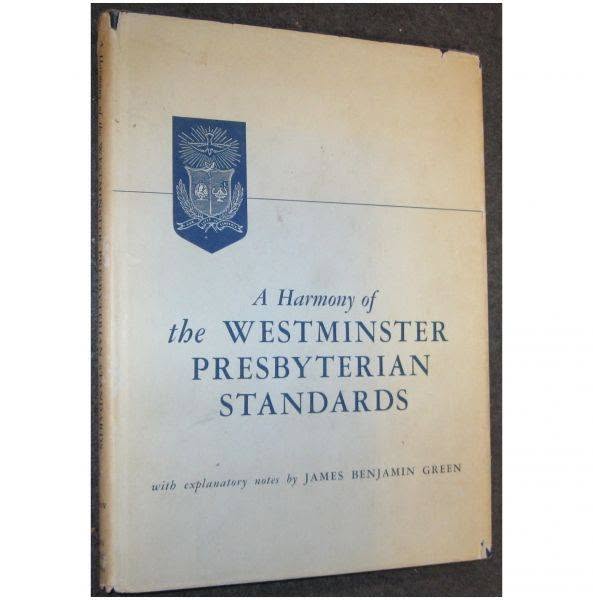
James Benjamin Green compiled a Harmony of the Westminster Standards, including the Confession of Faith, the Larger and Shorter Catechisms. In his exposition of Chapter XXIII on the Civil Magistrate in the Westminster Confession of Faith, Green correctly observes (concerning Romans 13:1),
"It is not meant that God directly ordained the state by saying to man, Thou shalt set up a government or organize a commonwealth."
Whose idea was the State? The first polis was built by Cain after he murdered his brother (Genesis 4:17). His successors are Lamech (Genesis 4:23-24); Nimrod (Genesis 10:8-12); Pharaoh (Genesis 12:15,20; 37:36); Chedorlaomer (Genesis 14); “the Kenite, the Kenizzite, the Kadmonite, the Hittite, the Perizzite, the Rephaim, the Amorite, the Canaanite, the Girgashite and the Jebusite” (Genesis 15:19-21). Just keep reading the Bible: nation after nation, empire after empire. Evil men, influenced by demons, conquering, murdering, enslaving. It's really horrible, and nobody likes reading the violent Old Testament.
On the other hand, nobody likes the New Testament either, because it says we have to "be subject" to all these evil governments, pay their taxes, and obey their laws. We like our government when it persecutes "the bad guys" and takes their stuff and gives it to us, but we don't like it when the government says WE are the bad guys and starts persecuting US. And we don't like when Jesus says Give them what they want. The Bible would be a better book if it were OUR word instead of God's Word.
Genesis 10 is known as the "Table of Nations." It is also the table of empires. These empires are all in rebellion against the God of the Garden.
Which nations epitomize imperial creature-worship? Babel (Genesis 11:1-9); Egypt (Exodus 1:8); Israel (1 Samuel 8 – “like all the nations”); Greece, Rome (Daniel 2:44); The Third Reich; U.S.S.R.; U.S.A.
At no point in the Bible's history of mankind did God "institute" something called "civil government." God never gave anyone permission to tax others. There's no "God-ordained office" that anyone can legitimately aspire to. All the governments of the history of the world as seen in the pages of the Bible were organized crime syndicates in rebellion against the God of the Garden. They were not morally legitimate. They were not "ordained" by God in the sense of having a morally legitimate social function, but they all "served" God's purposes, and none of them -- even the most savagely violent and perverse -- did ever bear the sword "in vain." Because God was using them for His purposes. All human governments are rebellious and criminal.
But God is sovereign over the demons and the nations. He uses them to accomplish His purposes. Despite their rebellion, despite their desire to be their own gods, they are the unwitting servants of the Most High God. They don't want to hear that; they want to be as gods (Genesis 3:5). But
All of the evil nations chronicled in the Old Testament were
In Daniel chapter 2, we have a dream interpreted by Daniel. It is a statue that represents the great empires of the pre-Christian world. Rome is the last empire on the statue. During this empire, The Messiah would come, and crush this empire to powder. The prophecy has been fulfilled, and we're making progress on cleaning up the mess that was Rome. That final leg of Daniel's statue brings us to Paul's letter to those who were still under the boot of Rome.
This page is a wall of words that will take hours to read. I advocate "anarchy." You won't read anything about "anarchy" if you think I'm a crack-pot "anarchist." I may be a crackpot, but not like you think when you hear "anarchist."
R.J. Rushdoony was an author I came to admire. He taught me that the Bible is the Word of God; that our Creator communicates with His Image-bearers by writing letters, contained in the Bible, and His law applies to every area of life, including economics and all social issues. Millions of Americans will say "The Bible is the Word of God," but they spend more time watching TV (back in my day) or scrolling phones (today). As a nerd and Bible-thumping fanatic, I try to take the Bible seriously.
And doing so made me an anarchist. You've been trained to react in horror to that word, just as you've been trained to react in horror to the word "theocracy." "Anarcho-Theocracy" means God governs, not man.
I didn't want to go to college. I wanted to be "the next Rushdoony." But Rushdoony (and my parents) insisted that I go to college. It was a waste of time. But while commuting to college every day, an hour each way, I consumed thousands of lectures by R.J. Rushdoony on cassettes. This was the foundation of my education. Rushdoony drew a stark contrast between the Kingdom of God and the kingdoms of man. Rushdoony championed "Christian Reconstruction." He opposed secular government, and advocated "Theonomy" (from two Greek words meaning "God's Law"), and what most people would call "Theocracy." Rushdoony founded an organization in California called Chalcedon. Rushdoony's writings helped create "The Moral Majority" and get Ronald Reagan elected President in 1980. In 1982, reflecting on the "Reagan Revolution," Newsweek magazine identified Chalcedon as the "think-tank" of the religious right. Compared to Rushdoony, Reagan was a liberal, and Rushdoony did not vote for Reagan, and while leaders of the religious right read Rushdoony, their followers never heard Rushdoony's name, because he was a theological "hot potato." Before I graduated from college I became a "Chalcedon Scholar" and started writing a monthly column in Chalcedon's flagship periodical.
I eventually became more radical than Rushdoony. I think I was becoming logically consistent with the Bible and Rushdoony's version of a Bible-based society.
Rushdoony authored a book called Institutes of Biblical Law [read] [buy], explaining how the Bible had been used as a law book in John Adams' day (and throughout the history of Christendom), and how the Bible could be used today to make society a "Christocracy." Rushdoony's "law book" is not the same kind of "law book" as those found in a law library, containing statutes and decrees of government, enforced by violent earthly enforcers. Rushdoony's book explains how to take the Bible as our only law book. Rushdoony uses only persuasion, not violent coercion.
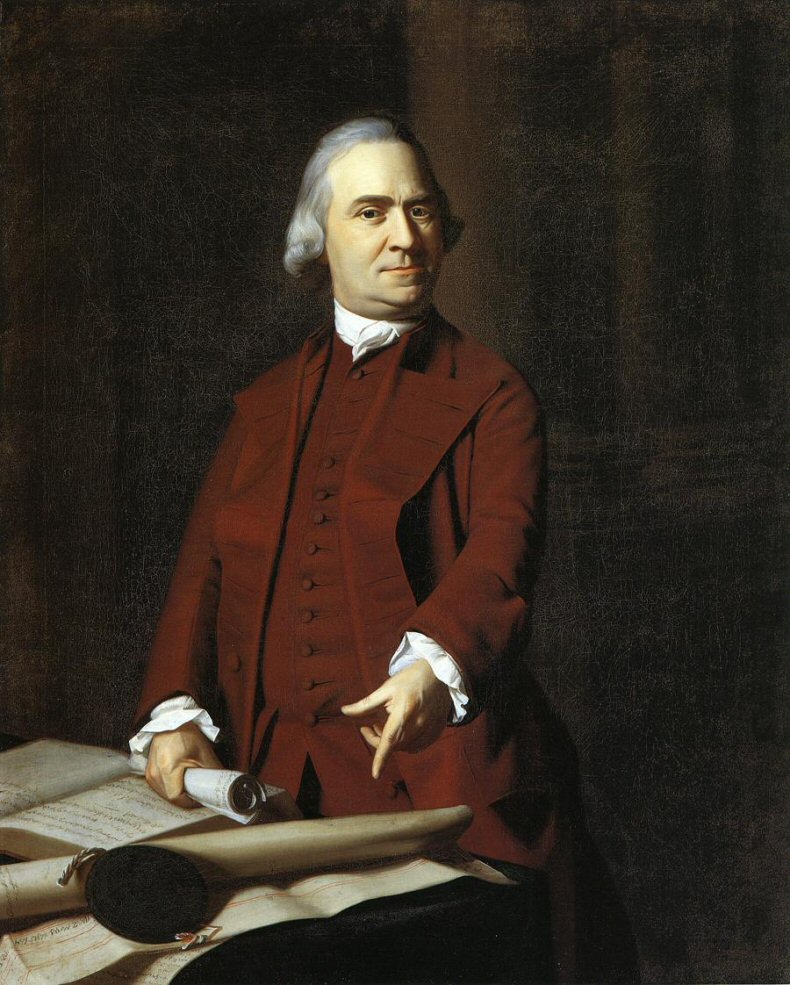
Adams graduated from Harvard, a university established by Calvinist Theocrats like R.J. Rushdoony. Abolishing all law books except the Bible, and making the Bible the legal blueprint for society, is a radical idea. You could call me a Calvinist Theocrat, like John Adams, John Hancock, Samuel Adams, and other graduates of the older Christian Harvard University. If these men could travel through time to our day, our current government would call them "domestic terrorists." Abolishing all government codes of law will get you called an "anarchist," even if you want to replace those statute books with the Bible, which gets you called a "Theocrat." In the late 1970's I took a college class on Political Philosophy taught by Libertarian Party Presidential Candidate John Hospers. One of the texts in his class was Murray N. Rothbard's book For A New Liberty. Rothbard was an anarchist. He advocated a stateless society. Hospers was a "minarchist," a libertarian who believed in the necessity of a (very small) government. Rushdoony's criticisms of the secular State had already made me an anarchist, though Rushdoony despised that word. Rothbard gave me permission to use that label in public.
Like other "Christian Reconstructionists," I had thought of myself as "TR" -- "Truly Reformed": following the Protestant Reformers more consistently than other Protestants. But in the early 1980's I learned more about the Anabaptists of the 16th century. They were put to death by Calvinist Theocrats. I concluded that in many respects the Anabaptists were better Theonomists than the Calvinists. Anabaptists are considered to be Protestants, because they weren't Catholics, but are more likely to "beat swords into plowshares" than the other Protestant Reformers, called "Magisterial Reformers" because of their collaboration with the civil magistrate ("The State"; the "sword"). I eventually concluded that God's Law ("Theonomy") commands pacifism. I read about anti-war activist Dorothy Day, who was mentored by a French philosopher named Peter Maurin. Maurin was an advocate for the poor, and might also be called the first "Christian Reconstructionist," "reconstruction" being a favorite word of his. As Jim Wishloff wrote, "Peter Maurin considered both liberalism and conservatism and concluded that neither was adequate to effect a reconstruction of the social order." Dorothy Day sought to implement Maurin's Program. Day converted from left-wing socialism to Catholic Christianity, and began publishing an answer to the Communist Party's newspaper, The Daily Worker, with a periodical of her own, The Catholic Worker. I spent the better part of the next decade in the Catholic Worker movement, helping run a homeless shelter. Maurin envisioned a radical right-wing movement, but today's Catholic Worker movement is considered left-wing. They don't care too much about the Bible and theological orthodoxy, so they became the only movement that would let me in. The conservative groups I used to be affiliated with were shocked by my radical Biblicism (anarcho-pacifism), and excommunicated me.
The Airbus A380 is larger than a Boeing 747. The A380 can carry nearly 1,000 passengers.
Imagine you're on an Airbus with 800 other passengers, and the plane is forced to land on an island in the pacific that no government even knows exists. We are starting a new society, under the jurisdiction of no government.
We are having a "national" debate on what kind of government (if any) we are going to have in our new island nation.
Obviously the democratic socialists are not going to get their way. Christians constitute more than 51% of the population, so (presumably) the island will not go socialist. But some of the Christians are anarchists, bringing the total of pro-government Christians to less than 49%.
So what kind of government will the island inhabitants agree on?
Debating this issue will undoubtedly shift the numbers. Good, honest, thoughtful debate. Perhaps some of the socialists will repent and join one of the other camps.
[Great commission cut from here and moved]
The Christians on the island will agree on the need to "make disciples" of the socialists, but some Christians (Theonomists) will see a need to "make disciples" out of the anarchists. Did Christ command His disciples to create governments, or is anarcho-capitalism a morally legitimate Christian option?
Pro-government Christians say God wants us to have a archists (extortion-funded vengeance-takers, apparently negating Romans 12), while "Mark 10" Christians say we must not be archists, or vote for archists.
Atheists don't take the Bible seriously, but they might vote for an explicitly Theocratic anarcho-capitalism if they see that as being in their best interests, even though they reject the Biblical basis for that system. Mamby-pamby evangelicals will probably not be as energetic and committed to lobbying for their system (they tend to not even have a political system: too "worldly") as nationalists, socialists, and anarchists.
Pro-government Christians say that Numbers 35 and Deuteronomy 17 (among other passages) require us to have archists, and prohibit us from having an anarcho-capitalist society.
Will those passages convince 51% of the island population to reject anarcho-capitalism and create a "monopoly of violence?" Or will the Great Commission prevail and create a stateless "Vine & Fig Tree" society?
Too many Christians reduce the Bible to a few slogans. In debates they throw these bite-sized slogans around. Like planting a flag and claming territory. "I said the magic words; I've done my duty." They equate "anarchism" with chaos and lawlessness.
What I propose we do is read through the Bible verse by verse and take the texts seriously, asking if they were intended to be a blueprint for society in our day. I should note that I wholly approve of seeing the Bible as a social blueprint:
But the Biblical blueprints have been modified by the advent of the Messiah. The Mosaic blueprints have to be seen in the context of the Patriarchal ideal that preceded Moses and the Messianic ideal predicted by the prophets and inaugurated by Christ. See the comments of Prof. John M. Frame here:
Frame, very sympathetic to Theonomists, argues that Moses did not create a "perpetual" system that should be a model for today.
Whenever I'm challenged with a claim that "Verse X requires us to have a government," I'm always willing to look at that passage and see if I may have been mistaken. This is the work that has to be done before the island inhabitants should vote to create a "civil government."
Based on my own experience in the "Christian Reconstruction" movement, the scholars did this work, and quietly admitted the complexity, but the supporters in the general public were more often spouting slogans and soundbites that were designed to shut down the opponent and end the argument rather than initiate a careful Berean study.
I invite you to be a judge and compare their slogans with the Bible when read cover-to-cover and looking for that verse which gives people in the "public sector" the right to do things which are sinful when done by people in the "private sector."
Be a judge. Listen to both sides. Here are four reasons why you should learn to be a judge, from four important Bible verses:
|
Now these [The Bereans] were more noble than those in Thessalonica,
in that they received the Word with all readiness of the mind,
searching the Scriptures daily, whether these things were so.
Check out those three links.
The Bereans appeared to be like modern libertarians, with their bumper-sticker that says "QUESTION AUTHORITY." The Apostles gave them the Gospel of Jesus Christ, but the Bereans didn't just take the Apostles' word for it, but checked what they were told by "clergy" against a higher authority: the Scriptures. The Bereans are more dogmatic authoritarians than those who mindlessly accept the word of clergy or creeds. Clergy don't often appreciate uppity laymen in their pews.
Additionally, the Bereans studied the Bible "daily." The verses on that link show that daily engagement with the Bible is an imperative.
|
Proverbs 18:17
"The first to state his case seems right until another comes forward and examines him."
What you learned in "public school" seems right to you.
What you learned in church seems right to you.
Wait until you compare it with what you'll be exposed to at Vine & Fig Tree University.
Wait
until you compare everything with what the Bible says.
Proverbs 25:2
It is the glory of God to conceal a thing:
but the honour of kings is to search out a matter.
There are over 30,000 verses in the Bible. Most church-goers know John 3:16. The rest of the Bible hasn't been dusted off in years, or is just a fog. It's a good thing to question what you know by learning more about the Bible. Even if you're already right in what you know, you'll know it better when you test it, and cross-examine the sources of your present belief.
|
Mark 8:15
And Jesus cautioned them, saying, “Watch out; beware of the leaven of the Pharisees and the leaven of Herod.”
The Pharisees were "the church"; Herod was "the State." Beware of both. See also the quote from the "church father" Tertullian, below. Beware "the Academy." "A little leaven leavens the whole lump" (Galatians 5:9). I hope to show you a new leaven, and give you the ability to discern the difference for yourself. "Let us therefore celebrate the festival, not with the old leaven, the leaven of malice and evil, but with the unleavened bread of sincerity and truth" (1 Corinthians 5:8).
This attitude of cautious inquiry makes one a better Christian, as seen in our Fourth Text.
|
Just as iron sharpens iron,
friends sharpen the minds of each other.
My goal in this university is to be your "friend." I hope you'll be my friend as well, and challenge my thinking in a loving way.
I often criticize clergy, politicians, and professors, but I am not against "authorities" or "experts." If they know more about a certain subject than I do, I rely on them and quote them, even if they disagree with the “Vine & Fig Tree” worldview. An "expert" can be your friend and sharpen you, but you might have to pay the expert ("mentor," "professor" "seminary"). This website is free. May you be sharpened. May we be friends.
The Bible encourages study of the Bible. The Bible discourages letting it accumulate dust on the shelf. My goal is to drive you to the Bible, to learn the Bible, love the Bible, and live the Bible.
This website looks at two very flawed but frequently invoked and admired documents, and compares them to another frequently-invoked writing, Romans 13.
In 2026, America celebrated the 250th anniversary of the signing of the Declaration of Independence.
This was an exercise in mass hypocrisy on a national scale. Why? Because the Declaration of Independence proves that America was once a Theocracy.
But not a consistent Theocracy. Jesus said "Render unto Caesar," but the Declaration of Independence symbolizes the willingness of the colonists to murder Caesar's tax collectors ("The Red Coats). Jesus commanded His followers to love their enemies, not get their muskets out and kill their enemies.
"America" is an ideal: "Liberty Under God."
"The United States" -- The Military-Industrial-Congressional-Financial-Academic-Pharmaceutical Complex -- is at war with "America," the ideal.
In order to save "America," we must abolish "The United States."
"The United States" is not a force for peace, but of endless wars.
I believe this deadly militarism began on July 4th, 1776.
Independence Day is about the overthrow of the government through violent armed revolution. This is first cousin to the idea of "national defense." These two ideas are either the parents or the children of the idea of "The State." This website argues that this whole mess is an idolatry and a false religion. And yet Christians and even Christian clergymen have risen to defend them all.
Here is a well-researched article by David Barton: The American Revolution: Was it an Act of Biblical Rebellion? The article proves that America's Founding Fathers were not -- in their own minds -- rebelling against the Bible when they embarked upon armed revolution. They justified their violent overthrow of the government with Biblical citations. They were Theocrats. As noted above, it is "unconstitutional" to teach public school students that the Declaration of Independence is objectively true, because the Declaration is a Theocratic document. America was originally a Theocracy. The word literally means "governed by God," or turned on its head, "Under God." America was always a nation "under God."
But we can fool ourselves. Greg Bahnsen has written about "the apparent paradox of self-deception": that a person can exercise his mind to sincerely and genuinely believe something he knows deep down is not true. America's Founders knew the Bible better than most people today. But they also knew the "classics." They convinced themselves that they could harmonize the two. They tried to blend "Jerusalem and Athens."
America's militarism goes back beyond July 4th, 1776. It goes back to Rome, Athens, and Babylon.
The United States is living proof that you can't serve two masters. A four-hundred year-long experiment.
The willingness of Christians in America to get out their muskets and
kill Christians from Britain in 1776
in order to accomplish "regime change"
(replacing the British government in the colonies with a new government
more
favorable to American colonial leaders)
is directly related to
the willingness of Americans to get out their nuclear weapons and
kill millions of Christians in Russia and Ukraine in 2025
in order to accomplish "regime
change"
(replacing the Putin government in Russia with a new government
more favorable to the U.S. "Deep State")
and
the willingness of Americans to support
mass murder of gentiles in Palestine.
Why would Jesus celebrate the murder of Christians? The British "Red Coats" were Christians.
But this question raises other questions. Would Jesus celebrate "Memorial Day" or "Veterans Day?"
Americans killed some of those Christians.
Joe Biden wants to kill some of those Christians, using Ukrainian soldiers as proxies.
Why do Christians in America vote for "leaders" who kill Christians in other nations?
Why do Christians in America vote for "leaders" who kill non-Christians in other nations?
Why do Christians in America celebrate "Independence Day?"
The answer to these three questions is simple, but requires un-learning a lot of propaganda we have all imbibed.
The religion of Christianity is in conflict with the religion of Washington D.C. And yes, Washington D.C. has a religion. That religion may be your religion. Or, you may be trying to combine that religion with the religion of Jesus Christ.
It can't be done.
The purpose of this website is not just to argue about historical facts. The purpose is to change your entire religion.
Even if you're a church-going Christian.
The Declaration of Independence tries to combine Jerusalem and Athens:
I agree with #1: every nation should be a Christian nation. Every society should be a Christian society.
I disagree with #2: "Thou shalt not kill" is God's command for every human being. "Render unto Caesar." "Resist not evil."
It may be the peak of hypocrisy to celebrate a document that nobody believes any more. In fact, the federal government says public school teachers cannot teach students that the Declaration of Independence is true, because
Astounding hypocrisy.
Maybe that's why America is not as enthused about this patriotic celebration as we were in 1976 for the bicentennial. I don't get out much, so I asked Google about this, and it confirmed my suspicions:
So right off the bat I've championed two unpopular beliefs: Theocracy and Pacifism.
The Declaration of Independence says we can kill tyrants and their tax collectors.
I think the Bible says tyrants should repent and abdicate, but until they do, we are commanded to be pacifists. "Render unto Caesar." Give Caesar's soldiers an extra mile of forced
labor. "Resist not evil" (Matthew 5:39-44).
This essay advocates carrying out "The Great Commission" (Matthew 28:18-20), which commands us to teach all nations to obey everything Christ commanded. If we teach politicians to obey Christ, they will become pacifists, and that will require them to stop hurting people and taking their stuff.
I am unreasonably optimistic.
I believe Christians will succeed in carrying out "The Great Commission," and this will bring about the fulfillment of Micah's “Vine & Fig Tree” prophecy (Micah 4:1-7).
Many will say I have no reasonable basis for being so optimistic. They say the world is going to get worse and worse until the "second coming" of Christ. Even more people will say that my conception of a “Vine & Fig Tree” society is utterly unreasonable.
I believe I can prove the following with Sufficient Evidence from the Bible or reputable authorities, and I don't believe there is Biblical evidence to the contrary.
Our purpose in this essay is to prove that
These are controversial claims, but can be supported by voluminous testimony from Scripture.
In opposition to these claims is patriotic propaganda and a few misused passages of Scripture.
There are 30,000 verses in the Bible, and most Christians have only thought about a handful of them. This essay will require you to look at the rest of the Bible.
Given the choice between reading lots of Bible verses and believing a few patriotic slogans and bumper-stickers, most Americans today will choose the bumper-stickers.
This debate 's simple (obvious) but not easy. It's easy to understand, but will take time to internalize. You are a victim of educational malpractice in 12 years of tyrannical and despotic government indoctrination camps ("public schools"). It will only take 12 months to reverse-brainwash you, if you work for 30 minutes a day.
It will take thought. Most Americans don't want to have to think. They want their leaders to tell them what to think.
Before we dig deeper into the reasons Jesus would not celebrate Independence Day, let's review highlights from the document we celebrate on that holiday. You may not have read it since high school. Or ever. In three words, the goal was "Liberty Under God."
When we dig deeper into the reasons Jesus would not celebrate Independence Day, we're going to see that America's Founders were
But they were also infected with a false religion, just as you are.
Samuel Adams orchestrated the Boston Tea Party (1773) and signed the Declaration of Independence. He agitated Americans by sending letters through a network of communication known as "The Committees of Correspondence." In the first letter he sent to America's Town Halls, Adams exhorted the colonists to become
• Extraordinary Americans,
• Extraordinary Christians,
• Extraordinary Human Beings.
Adams coached America toward Independence, and became known as "The Father of the American Revolution."
If Samuel Adams could travel through time from 1776 to 2026 and sit down in your living room and have a conversation with you -- and if I were to be there and share with Adams the contents of this website -- Adams would say you are
Adams -- and every Signer of the Declaration of Independence -- would say you're a victim of educational malpractice. For 13, 17, 20 or more years, you've been taught
More than a decade of atheistic education in public schools can be reversed in just 12 months of study, but it takes tremendous moral courage to make the transition. It takes "fanatic" resolution and willingness to be an "intolerant" "extremist."
Bookmarks
Romans13.com — Full Page Outline
Introduction 1776 and educational malpractice: archists good, anarchists bad
Two Kingdoms / Two Cities / Two Ways of Life
1.The City of God
Great Commission = Great anarcho-pacifist tradition
Great Commission leads to Pacifist Patriagora
2 The City of Man - Public sector
3. overthrow of the City of Man
day/night dark/light
I am a geezer, born in the year of Sputnik -- the Soviet Satellite that kicked off "The Space Race," which was part of "The Cold War," a "war" that should have ended with the end of the Soviet Union in 1991.
On 8 December 1991, the Russian, Ukraine and Belarus presidents signed the Belavezha Accords, declaring the Soviet Union dissolved and replaced by the looser Commonwealth of Independent States (CIS) in its place. This was followed up on 21 December 1991, when the representatives of all 15 Soviet republics (including the Baltic States and the Asian Muslim "stans") except Georgia signed the Alma-Ata Protocol, confirming the accords.
On the western Christmas Day, December 25th, 1999, General Secretary Mikhail Gorbachev, head of the Union of the Soviet Socialist Republics (USSR) and the head of the Communist Party, resigned, officially dissolving the Union of 293+ million people which spanned 9 time zones, and freeing another 100 million+ people in "satellite" countries (such as Poland and Czechoslovakia) formerly behind the "iron curtain" in Eastern Europe. The following day, the Supreme Soviet, the highest governmental body of the Soviet Union, dissolved itself. A brutal story of a failed trans-national totalitarian empire spanning nearly 70 years had come to an end.
How the Soviet Union Committed Suicide | Gary North
Back in 1976, Mao Zedong died, Deng Xiaoping came to power, and the Chinese people embarked on millions of "marginal revolutions," privatizing their farms and businesses and transforming China into a semi-capitalist nation.
Communism was dead. The Union of Soviet Socialist Republics was dead. But soviet socialism was alive in the United States, a government that had adopted most of the planks of The Communist Manifesto. The U.S. government was determined to avoid the fate of Russia and China. The U.S. did not want to lose power and control. But with the Cold War enemy lying in a coffin, how could the State-run Military-Industrial Complex be kept alive?
The answer was a "War on Terror."
A part of this war was an invasion of Iraq. Like Putin, Saddam Hussein, the leader of Iraq, was a thug. But Saddam allowed Christians to meet freely, and even to evangelize Muslims in public. (Doing so in Saudi Arabia -- a U.S. "ally" -- would result in decapitation.) As a result, Iraq had the largest Christian population in the Arab world. But the U.S. murdered, maimed, and made homeless hundreds of thousands of Christians, and replaced the secular government of Iraq with an Islamic Theocracy under Shariah Law.
During my lifetime, the communist/socialist government of the United States has murdered, maimed, and made homeless tens of millions of innocent, non-white non-combatant civilians around the world, making the United States the most evil and dangerous criminal enterprise on planet earth. You might counter, "No, the government of North Korea is more evil than the government of the United States." You might be right, but North Korea is not more dangerous than the United States. Statistically speaking, the average human being is more likely to have her "unalienable rights" -- with which she was "endowed by our Creator" -- infringed by someone on the payroll of the U.S. federal government than by someone on the North Korean payroll, or any other government, or any drug cartel, organized crime syndicate, or terrorist organization, including ISIS and Al-Qaeda. Some have estimated U.S.-inflicted casualties at close to 100 million during my lifetime. You may say that's an exaggeration. Maybe. But how many millions of people would you say were actually murdered, maimed, or made homeless by the United States? Is your revised figure acceptable to Jesus Christ, the "Supreme Judge of the World?"
I admit I voted for some of the Congressmen who appropriated funds to this paroxysm of global murder and destruction. Even though I called myself a Christian. Even though these Congressmen may have called themselves Christians.
Ukraine
After the fall of the Soviet Union, the United States was the world's sole "superpower." Many U.S. influencers want the world to stay that way. They do not want a world where the U.S. is just one player along with Russia, China, India, Brazil, and other growing nations. Many U.S. leaders believe the U.S. must rule the world. "Hegemony." "Uni-polar."
In July of 2026, the United States is using Ukraine as a puppet to wage war ("regime change") against Russia. The U.S. is willing to kill a million people in Ukraine in order to use Ukraine as a weapon against Russia, to keep Russia from competing with the U.S. This has been in the works for decades.
The war has already cost the lives of 500,000 Ukrainians, and if the war escalates into a nuclear exchange, millions of people will be murdered. Neoconservatives don't care. The Council on Foreign Relations doesn't care. Joe Biden doesn't care.
- Throughout his entire career, Biden has served the military-industrial complex. He has relentlessly promoted NATO enlargement and supported America’s deeply destabilizing wars of choice in Afghanistan, Serbia, Iraq, Syria, Libya, and now Ukraine. He defers to generals who want more war and more “surges,” and who predict imminent victory just ahead to keep the gullible public onside.
- Moreover, Biden and his team (Antony Blinken, Jake Sullivan, Victoria Nuland) seem to have believed their own propaganda that Western sanctions would strangle the Russian economy, while miracle weapons such as HIMARS would defeat Russia. And all the while, they have been telling Americans to pay no attention to Russia’s 6,000 nuclear weapons.
The Real History of the War in Ukraine: a Chronology of Events and Case for Diplomacy — Jeffrey D. Sachs
"Syncretism" is a fancy-sounding word which describes an attempt to combine two contradictory religions. The most basic conflict in all of human history is God's religion ("Love the Lord with all your heart") and Satan's religion ("Ye shall be as gods" Genesis 3:5). Augustine described this conflict as "The City of God" vs. "The City of Man." We could also speak of the clash between "Theonomy" (God's Law) vs. Autonomy (self-law). The prophet Elijah saw the conflict between the Lord God of Israel vs. the false lord of the pagans ("Baal" means "lord"):
1 Kings 18:21
And Elijah came to all the people, and said, “How long will you falter between two opinions? If the Lord is God, follow Him; but if Baal, follow him.” But the people answered him not a word.
You believe in Baalism, which you were taught in U.S. public schools:
What is Baalism?, by James B. Jordan
Matthew 6:24
No man can serve two masters: for either he will hate the one, and love the other; or else he will hold to the one, and despise the other. Ye cannot serve God and mammon.
You serve "mammon."
As Dorothy Day may have said, “Our problems stem from our acceptance of this filthy, rotten system,”
1 Corinthians 10:21-22
Ye cannot drink the cup of the Lord, and the cup of devils: ye cannot be partakers of the Lord's table, and of the table of devils.
Devils teach our children in public schools. Those that are not devils are not as wise as serpents (Matthew 10:16), and don't resist the devils (James 4:7; Ephesians 4:27; Ephesians 6:11-12; 1 Peter 5:8-9; Revelation 12:9-11). These teachers go to church, and they mean well, but they follow the devil's instructions.
2 Corinthians 6:14-16
Be ye not unequally yoked together with unbelievers: for what fellowship hath righteousness with unrighteousness? and what communion hath light with darkness? And what concord hath Christ with Belial? or what part hath he that believeth with an infidel? And what agreement hath the temple of God with idols? for ye are the temple of the living God; as God hath said, I will dwell in them, and walk in them; and I will be their God, and they shall be my people.
The "Public Sector" should be called "The Infidel Sector." It dominates "the Private Sector."
| “Private Sector” | “Public Sector” |
| Non-“Government” Sector | “Government” Sector |
| Competitive Sector | Monopoly Sector |
| Persuasive Sector | Coercive Sector |
| Peaceful Sector | Violent Sector |
| Productive Sector | Parasite Sector |
| Servant Sector | Archist Sector |
| "Economic Man" | "Political Man" |
Revelation 3:15-16
I know thy works, that thou art neither cold nor hot: I would thou wert cold or hot. So then because thou art lukewarm, and neither cold nor hot, I will vomit thee out of My mouth.Joshua 24:15,23
And if it seem evil unto you to serve the LORD, choose you this day whom ye will serve; whether the gods which your fathers served that were on the other side of the flood, or the gods of the Amorites, in whose land ye dwell: but as for me and my house, we will serve the LORD. 23 Now therefore put away, said he, the strange gods which are among you, and incline your heart unto the LORD God of Israel.1 Samuel 7:3
And Samuel spake unto all the house of Israel, saying, If ye do return unto the LORD with all your hearts, then put away the strange gods and Ashtaroth from among you, and prepare your hearts unto the LORD, and serve him only: and he will deliver you out of the hand of the Philistines.James 1:7-8
For let not that man suppose that he will receive anything from the Lord; 8 he is a double-minded man, unstable in all his ways.James 4:8
Draw nigh to God, and he will draw nigh to you. Cleanse your hands, ye sinners; and purify your hearts, ye double minded.
America's Founding Fathers were double-minded. They wanted to serve Christ and Greco-Roman Baals.
Their minds were more set on Christ and the Scriptures than anyone in Washington D.C. today, but they were also diligent students of "the Academy."
The purpose of this website is to prove these dreary facts to you, and show you how to become
• An Extraordinary American,
• An Extraordinary Christian,
• An Extraordinary Human Being.
Scenes from coming attractions:
James 1:27
Pure and undefiled religion before God and the Father is this: to visit orphans and widows in their trouble, and to keep oneself unspotted from the world.
We are going to see that the tyrannical woke regime in Washington D.C. is not only indifferent to orphans and widows in their trouble, the United States inflicts trouble on widows and orphans around the world. In fact, the U.S. empire creates more widows and orphans -- by murdering husbands and fathers -- than any other government, terrorist organization, drug cartel, or organized crime syndicate. This will be proven below.
America's Founders -- to their credit -- would have been horrified and angered at the government they created. But they created it. They set the wheels in motion. They leavened the loaf (Galatians 5:9; 1 Corinthians 5:6-7; Luke 12:1; Mark 8:15).
This website will suggest that you are living your life day today under a false and impure religion. Your thinking is "spotted by the world." You will be asked to convert to the true religion of the Bible.
On the 4th of July, I no longer celebrate armed revolution and the creation of the United States. I look back and wonder how I could have so boldly defended mass murder when I was younger. How could I "support the troops" when other Christians did not, and even Muslims like Muhammad Ali denounced the killing and destruction of innocent people's homes?
Cornelius Van Til said, "There is no alternative but that of theonomy and autonomy." Theonomy is the standard of perfect righteousness. Autonomy is perfect rebellion. Nobody I know is 100% consistent with either of these standards. Every day that I study God's Law I learn more about the perfect standard of righteousness by which we will all be judged, and I ask, "How could I have missed that? How could I have been living so inconsistently? Was I even saved?" If not, then today is the day: "Behold, now is the accepted time; behold, now is the day of salvation." 2 Corinthians 6:2
I don't want to walk into the thorns of theological dispute over "assurance of salvation" and "election" and doctrines like that. A member of a dangerous authoritarian cult can still be "elect," but someday he's going to repent and get out of the cult.
J. Gresham Machen, Founder of Westminster Seminary and the Orthodox Presbyterian Church, said that mainline "liberal" Christianity -- Methodists, Episcopalians, Presbyterians -- you know the crowd -- was not a species of Christianity, but was a completely different religion. Machen was defrocked by the mainline Presbyterian church. May I suggest that affirming the Virgin Birth is just as much a different religion from liberalism as not celebrating violent revolution is from most conservative or postmil churches. Perhaps Augustine would join Machen in saying that these are the two competing religions in history
May I suggest that if you do not advocate disarmament of the City of Man, you are presently an adherent of a false religion, and not an adherent of Biblical, Theonomic Christianity?
Would you be willing to be examined (Proverbs 18:17), sharpened (Acts 17:10-12), and
forced to search the Scriptures (Acts 17:11) to see if this is true?
Jesus said there would be many people surprised to find they didn't have the true religion:
Matthew 7:21
“Not everyone who says to Me, ‘Lord, Lord,’ shall enter the kingdom of heaven, but he who does the will of My Father in heaven. 22 Many will say to Me in that day, ‘Lord, Lord, have we not prophesied in Your name, cast out demons in Your name, and done many wonders in Your name?’ 23 And then I will declare to them, ‘I never knew you; depart from Me, you who practice lawlessness!’
What is the mark of the true religion?
James 1:27
Pure and undefiled religion before God and the Father is this: to visit orphans and widows in their trouble, and to keep oneself unspotted from the world. (cf. also Matthew 25:31-46)James 4:4
Do you not know that friendship with the world is enmity with God? Whoever therefore wants to be a friend of the world makes himself an enemy of God.
The United States not only doesn't care for orphans and widows, it creates widows and orphans on a massive scale. By any Biblical measure, the U.S. is the enemy of God. But Christians are generally favorable toward this government, and completely closed-minded toward beating swords into plowshares.
After the fall of the Soviet Union, the "Cold War" was replaced with "The War on Terror." During these wars, "my" government in Washington D.C. murdered, crippled, or made homeless tens of millions of innocent, non-combatant, non-white civilians around the world, creating millions of widows and orphans by murdering their husbands and fathers, and further traumatizing them by bombing their homes, schools, factories, and roads. This is all so far over on the side of "Autonomy" and so far away from the side of "Theonomy" that you'll excuse me if I speak in very absolutist -- if not hysterical -- terms.
The Vietnam war exacted an enormous human cost: estimates of the number of Vietnamese soldiers and civilians killed range from 966,000 to 3 million. The U.S. dropped more tons of bombs on Laos and Cambodia than it did on the entire world during World War II, killing approximately 800,000 people in each country, destabilizing Cambodia, which led to the rise of Pol Pot and the murder of 1/3 of the Cambodian population. Nobody today says the war in Southeast Asia served some long-lasting Christian purpose. It was evil. Horribly, shockingly evil. But as a conservative, I said those who opposed the war were "insane."
I was wrong. Ali was right. Why did Ali get it right and so many Christians got it wrong? I dismissed the anti-war protesters as "anti-American" and "a buncha commies." Maybe they were, but shouldn't conservative Bible-believing Christians have been giving a truer alternate public witness in support of the millennial goal of "swords into plowshares?"
Christians in Iraq arguably had more religious freedom under Saddam Hussein than Christians in the U.S. do under Joe Biden. Saddam never sent his secret police to arrest Christians who sang hymns at abortion clinics, to be imprisoned for a decade or more. (Correct me if I'm wrong; I admit Saddam was a thug.) If you walked up to a Muslim in Saudi Arabia and said, "Hello Mr. Muslim, may I preach the Gospel and show you how to become a Christian?" you would have your head removed. Not in Iraq under Saddam Hussein. This is why Iraq boasted the largest community of Christians in the Arab world.
The U.S. military-industrial complex overthrew Saddam's government, murdering, crippling, and making homeless hundreds of thousands of Christians, replacing this secular, non-Muslim "Ba'athist" government with an Islamic Theocracy under Shariah law, where Christian churches are burned to the ground with impunity.
I would argue that this is not just sinful, but even abominable. It's horrible. America's "Representatives" spend $8 trillion on the "War on Terror." The money spent, the lives lost; it should shock the conscience. But churches "support the troops." (Or at least they supported the troops back then. Today, most people quietly admit the invasion and destruction of Iraq was based on lies. Why weren't Bible-believing conservative Christians denouncing the lies and the murder and the destruction? Were they viewing the world through the lens of a false religion? I'm not saying I wasn't or they weren't Christians. But somehow they believed and advocated horribly unBiblical ideas. Jesus Christ would not have approved, no matter how merciful He is.
Audio review: Provoked, by Scott Horton
Conspiracy Theory: The atheistic, pro-abortion, pro-homosexual U.S. government is willing to risk killing millions of people in a nuclear war for the cause of "regime change" in Russia because Vladimir Putin publicly promotes Christianity and opposes the LGBT agenda. Change my mind.
Those are just a couple of wars the U.S. has waged. Don't forget Afghanistan, Libya, Yemen, Syria . . . the list goes on:
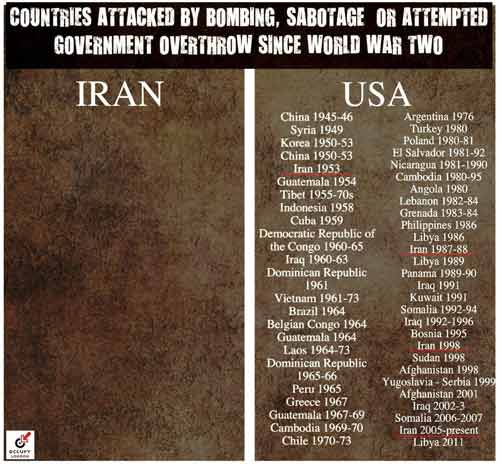
This is all really really evil. How could I have supported it? What causes this kind of blindness?
You will say I'm a heretic for being a pacifist. But if I'm right, what would the authors of Scripture say about you, who vote for politicians that drop bombs (weapons of mass destruction) all over the world? They would say you're the heretic, and you're a member of a cult.
The Apostle Paul admitted he was a "heretic":
Acts 24:14
But this I confess unto thee, that after the way which they call heresy, so worship I the God of my fathers, believing all things which are written in the law and in the prophets:
The word "heretic" comes from the Greek word for "choose." (Word Study)
Everybody is a "heretic" in someone else's eyes. Joshua said "Choose ye this day whom you will serve." Elijah told the people, "How long halt ye between two opinions? if the Lord be God, follow Him: but if Baal, then follow him." Elijah was a heretic in the eyes of the prophets of Baal.
The Bible lays on us a moral obligation -- a duty -- to choose; to become a "heretic." Either a "heretic" like Paul, Joshua, and Elijah, or the kind of heretic that chooses Baal, the world (James 4:4), or the city of man rather than the City of God.
We must choose between the Word of God and the word of man.
The Declaration of Independence in 1776 spoke of the moral imperative to risk "our Lives, our Fortunes and our sacred Honor" -- our reputation and acceptance by society, our mortgaged home and video games, and even our life.
There was a man named John Nelson Darby. He invented a doctrine called "dispensational premillennialism" in the early 1800's. As this doctrine spread, other doctrines, like Marxism (Karl Marx, born: May 5, 1818, Trier, Germany), also spread. Other men have been saying similar things for centuries. They have not been saying what the Bible says. If you believe what these men say, then you're not believing what the Bible says.
I believe Darby's doctrine is a "heresy." The "institutional church" does not agree with me. The "institutional church" teaches many parts of Darby's heresy.
Andrew Torba, founder of a social media platform called "Gab," wrote a book called Christian Nationalism: A Biblical Guide to Taking Dominion and Discipling Nations. I agree with a lot in this book, but Torba would say I'm a heretic, and I guess I would have to say the same thing about him. In my view, Torba's "Nationalism" (which I regard as unBiblical) is related to his unBiblical "futurist" eschatology.
Chapter 7 of Torba's book is called "The Time for Lukewarm Christianity is Over." Of course he is completely correct about this. Jesus says that being lukewarm makes Him want to vomit you out of His Mouth (Revelation 3:15-16). If lukewarm Christians aren't calling you an "extremist," you need to worry about what Jesus will call you. If the Pharisees aren't calling you a "heretic," then you need to check with Paul the Apostle and Heretic.
Torba writes:
For many Americans, Christianity has become a rapidly deconstructed fragment of their actual identity. People refer to themselves as a "Christian" when asked about matters of faith, but you won't find them openly proclaiming Christ as their central identity.
How many of us are living according to God's Word and how many are living according to the ways of the world?
In my early twenties I was calling myself a Christian, but I was living a very worldly life. God came secondary to my career and worldly desires. I wasn't attending church. I wasn't reading my Bible. I wasn't praying. What part of me was living a Christian life that could justify calling myself a Christian?
That all changed a few years ago when the Holy Spirit moved my heart closer to God. I started attending church, got married, became a father, and humbled myself as the worst of sinners before an Almighty God.
I'll concede that Torba has accomplished more admirable things in his 33 years on earth than I have in my 66. I've never been married. Never had kids. What a loser.
But at least I have repented of "nationalism," which has resulted in the murder of millions of innocent people, and the destruction of homes, schools, and hospitals around the world.
And I would contend that the heresy of "nationalism" is related to the heresy of "Adventism."
James 1:27 says that "true religion" is protecting widows and the fatherless. Nationalism creates widows and fatherless children by killing their husbands and fathers.
Micah 4 and Isaiah 2 say that in the age some call the "millennium" we will beat our "swords into plowshares." Adventists believe that we cannot and must not fulfill this prophecy until after the Second Advent of Christ. Until then, we must continue creating widows and orphans. People who object to killing fathers and traumatizing their widows and fatherless children by dropping bombs on their homes and hospitals are called "pacifists" or "anarchists," and are often denounced by nationalists and adventists as "heretics."
I would say that anti-pacifists have a different religion than pacifists. Pro-revolution Americans have a different religion than those who say we should "be subject" to "the powers that be" (Romans 13). It's two different religions. It's time to "choose" which religion you should follow.
Was Andrew Torba a genuine Christian in his twenties? Was his thinking poisoned by a false religion? Was he missing the "pure religion" of James 1:27? He admits he was "worldly." Was he therefore an enemy of Christ (James 4:4)? Is a lukewarm person a genuine Christian, if Jesus would "vomit" him out of His Mouth?
These are obviously very serious questions.
Torba, a Calvinist, would say that even though he was "lukewarm" and "worldly," and even an "enemy" of God in his twenties, he was still one of the "elect." But when God called Torba's attention to the gap between God's commands and Torba's life, Torba needed to repent.
Torba is not an anarchist. He is a "Christian nationalist." Maybe he needs to repent. Again.
You might be one of the elect, but you would not say you are an anarchist. Maybe this webpage is God's way of calling attention to the gap between God's commandments and your life. Maybe you need to repent. If you do need to repent, and if you are one of the elect, you will repent.
• No Christian is a "Christian Nationalist"
I.Q. stands for "intelligence quotient." You don't need a high I.Q. to understand this website.
M.Q. stands for "morality quotient." It means knowing the difference between right and wrong, and standing for right against wrong. I don't know if there's
actually a thing called "M.Q." I just now made it up to make the point that this website has a simple argument: Jesus says it's wrong to hurt people and take their stuff. It's especially wrong to kill people.
There are people with very high I.Q.s who invent new ways to kill people, and invent intelligent-sounding scholarly "theories" to justify killing people. Sometimes people with a low I.Q. (but an average M.Q.) know that killing people is wrong, but they're fooled by intelligent-sounding theories and rationalizations for killing, and low-I.Q./average M.Q. people can vote for killers, or go along with the killing. Sometimes because they want to be "patriotic."
It's time to stop going along with the killing.
That's the point of this website.
This is a very controversial website. It's also a HUGE website. It backs its controversial claims with mountains of evidence. It is designed for thoughtful people. Most Americans today don't want to think too much, and are content with bumper-stickers and "memes." Americans today are victims of educational malpractice.
| KC |
| Concerning the following three passages:
Please let me know what impact you see the three passages that follow have in this conversation. Are they "slam-dunk" arguments against "Anarcho-Theocracy," or only curious questions that haven't been answered? |
|
Opponent: 1. Numbers 35 and Deuteronomy 17's court structure. I don't think you've shown me how a Rothbardian market-courts reading survives "thou shalt not decline from the sentence... to the right hand, nor to the left" and death for contempt of a single, non-optional forum. You pivoted to a fair internal critique of inconsistent theonomists, and to the Lex Mercatoria as a possible righteous implementation — but neither of those is an argument that Deuteronomy 17 itself describes a competitive market of courts rather than one binding tribunal. This is still the biggest hole I see. |
The Nationalist-Theonomists on the island might agree with you. They might see a justification for creating a "civil government" in those passages. I would argue those passages cannot serve as a social model.
Numbers 35 seems to be inherently Levitical and "ceremonial law" rather than "moral law" or even "civil law." More discussion of these texts here. |
|
Opponent: 2. 1 Corinthians 6:4. Both readings of that verse assume a real distinction between "in the church" and something believers are told not to resort to outside it. I don't think that's been addressed at all, and it's a fairly direct textual problem for "no church/state distinction ever existed." |
| During the Old Testament, the "church" was a failure, and Israel wanted "civil government" like the gentile City of Man. So in Paul's day there existed a "New Jerusalem" (Hebrews 12:22) (meeting
house to house) and also the old Athens. Paul commands believers to stay away from Athens. That command certainly precludes our island inhabitants from duplicating an Athenian system rather than Theocratic "Patriagora."
More discussion of this text here |
|
Opponent: 3. The diakonos wordplay I raised early — Paul calling the ruler "God's servant" using the very word Jesus commends in Mark 10:43 — never got picked up. I don't know which way you want to run it, but I don't think it can just sit unaddressed, because it's sitting at the exact center of your founding text. |
| In Mark 10 Jesus says "rulers" are accounted to be "archists," but Jesus' followers are to be accounted as "servants." In Romans 13, Paul says demonic archists are
"servants." Does Paul mean that the path to Christian servanthood is conquest and plunder through a "monopoly on violence?" Or is Paul saying what Isaiah and the prophets said: that empires
are servants of the God of Abraham, despite their own claims to be autonomous and divine. Jesus seems to be saying not to rule over people; Paul (on this account) is saying . . . ruling is the path to service?
More discussion of Romans 13 here |
| The question is whether these three passages of Scripture preclude "Patriagora" or "Anarcho-Theocracy" and justify any human claiming a monopoly right to be an archist over a society which is "under God." |
The word "democracy" comes from two Greek words:
If "the people" [demos (δῆμος)] are not allowed to take vengeance (Romans 12), who chooses the vengeance-takers? If "the people" "democratically" choose someone to take vengeance, how does that differ morally from any individual hiring a mafia hit-man to take vengeance?
Theocracy ("God governs") is inherently anarchistic. "The people" are to leave vengeance to God. God used demonically-animated agents from the City of Man to be "the rod of My anger" (Isaiah 10:5), and then judges them for doing what He "ordained" or "commanded" (Isaiah 13:3) them to do.
To say "the people" or "the congregation" should choose judges seems to me to open the door to anarcho-capitalism, where disputants choose their judges, no longer bound by "place, priests, or judges" oligarchically appointed.
This passage very plainly instructs Christians not to have pagan archists resolve their disputes. If follows that Christians must not create an archist system of dispute resolution, since they are precluded from resorting to it to resolve their disputes. Disputes were resolved "in the church," but I don't believe that means that only clergymen could resolve disputes. Churches met house-to-house, and heads of households like Noah, Job, Abraham, and Stephanas, of whom it was said he "ordained himself" to the ministry (1 Corinthians 16:15; same Greek word as Romans 13:1). If two farmers have a dispute over wheat, a clergyman might be less able to render an informed verdict than another farmer like Abraham.
Under the Mosaic system, the priest-led system of dispute adjudication was not precluded from hearing so-called "civil" disputes, and were not limited to so-called "religious" or "ecclesiastical" disputes. Priests adjudicated all manner of "civil" disputes, up to and including murder. Cases were not divided up into "civil" and "religious" and farmed out to different justice systems.
Israel's government was "Theocratic" -- the word "Theocracy" coming from two Greek words meaning "Governed by God."
Rome was a rival theocracy, a government under a rival god.
Seeking justice or salvation from a rival god is an act of
idolatry and apostasy.
The Christians on our island should not create a "secular" justice system, that is, a system based on the religion of secular humanism, a form of theocracy in which every man is his own god, and collective man is deified in "The State," and remove cases from Christian dispute adjudicators and give those cases to the "secular" "justice system."
The Roman government discussed in 1 Corinthians 6 was slated for destruction by the Messiah (Daniel 2:33-35; 44-45). There is no Biblical basis for re-creating the system that Paul told Christians to avoid.
Mark 10 says Christians are to be "servants," not "archists," but Caesar the archist is said to be a "servant" (Romans 13:4)
Romans 13:3 For rulers are not a terror to good works, but to evil. Do you want to be unafraid of the authority? Do what is good, and you will have praise from the same.
The word "rulers" is the Greek ἄρχων. from the word-family that gives us "anarchist" and our unfamiliar term "archist." Jesus says His followers are to be "servants" and not to be like the "rulers," but Paul says "rulers" are "servants."
Clearly the word "servant" is being used in two different ways. Christians self-consciously and deliberately serve God and their neighbors, while archists only serve God unwittingly and unintentionally, by sinfully committing acts of violence which God uses to bring judgment on other archists.
The conversation recorded in Mark 10:42-45 was undoubtedly longer than we have recorded. The record of the conversation recorded by Matthew and Luke contains information not recorded by Mark. Matthew recalls
| Matthew 20:25 | But Jesus called them to him and said, “You know that the rulers (archontes | ἄρχοντες | nom pl masc) of the nations lord it over them, and their leaders exercise authority over them. |
Jesus also used the infinitive verb:
| Mark 10:42 | And calling them to him, Jesus said to them, “You know that those who are accounted to rule (archein | ἄρχειν | pres act inf ) over the Gentiles lord it over them, and their leaders domineer over them. |
Luke records:
| Luke 22:25 | So Jesus said to them, “The kings (basileis | βασιλεῖς | nom pl masc) of the nations exercise lordship over them and those in authority over them call themselves ‘benefactors.’ |
Another verse of interest:
| John 12:42 | Nevertheless, many even of the authorities (archontōn | ἀρχόντων | gen pl masc) believed in Him, but for fear of the Pharisees they would not confess it openly, lest they be expelled from the synagogue. |
The high priest could be a "ruler:
| Acts 23:5 | And Paul said, “I did not realize, brothers, that he was high priest; for it is written, ‘You shall not speak evil about the ruler (archonta | ἄρχοντα | acc sg masc) of your people.’” |
Paul quotes from Exodus 22:28, which reads in the LXX,
28 You shall not verbally abuse the gods, and you shall not speak badly of the rulers of your people.
The priest was considered a "ruler."
Paul speaks of rulers:
| 1 Corinthians 2:6 | However, we do speak wisdom among those who are mature, although it is not the wisdom of this age or of the rulers (archontōn | ἀρχόντων | gen pl masc) of this age, who are doomed to perish. |
| 1 Corinthians 2:8 | None of the rulers (archontōn | ἀρχόντων | gen pl masc) of this age understood it, for if they had, they would not have crucified the Lord of glory. |
In Romans 13:1, Paul identifies these rulers as demonic:
In verse 2, he tells us his purpose in writing about these rulers: he wants his readers to avoid the temptation -- existential in their day -- of engaging in resistance or the violent overthrow of these demonic rulers.
Paul describes the daily life of Christians under Roman domination:
Romans 8:35
Who shall separate us from the love of Christ? shall tribulation or anguish, or persecution, or famine, or nakedness, or peril, or sword?
36 As it is written, For thy sake are we killed all day long: we are counted as sheep for the slaughter:
It's not "good" to have tribulation and persecution imposed on you at the point of a sword. It's not "good" to be killed all day long. But God works all these things together for our good (Romans 8:28; 13:4).
To that end -- not to the end of giving Caesar a pass on conquering and oppressing, but to the end of quashing resistance among the oppressed -- Paul joins Peter in counseling godly living and subjection to tyrants. Peter and Paul teach us to honor tyrants as if they were Christ Himself.
A careful and prayerful study of 1 Peter 2 and Romans 13 gives no basis whatsoever for saying that our little island nation has a moral obligation to create what political scientists call "a monopoly of violence," which are extortion-funded vengeance-takers.
The collapse of the violent pagan government which Paul in 1 Corinthians 6 said Christians should have no part in, was not a time for sadness, even though defenders of the empire said the collapse meant "anarchy!" Similarly, the absence of "government" in our little island nation is no obstacle to the creation of a peaceful and prosperous Christian society.
If America really believed what the Declaration says, we would abolish our current atheistic government. After all, that's what America's Founding Fathers did: they abolished a pro-Christian government, one relatively small and limited in power, compared to "our" government today (stepping out of our island scenario for a moment).
John Quincy Adams, in an “Oration on the Life and Character of Gilbert Motier de la Fayette,” Delivered at the request of both Houses of the Congress of the United States, before them, in the House of Representatives at Washington, on the 31st of December, 1834, recalled:
The war was revolutionary. It began by the dissolution of the British Government in the Colonies; the People of which were, by that operation, left without any Government whatever.
"Anarchy!"
J. Q. Adams was exaggerating. America was not "left without any Government whatever." Americans had "government" -- self-government. James Madison, "the Father of the Constitution," is reported to have said this:
We have staked the whole future of American civilization, not upon the power of government, far from it. We have staked the future of all of our political institutions upon the capacity of each and all of us to govern ourselves ... according to the Ten Commandments of God.
(The Signers of the Declaration of Independence would be highly disappointed that Trump's January 6 "insurrectionists" really had no intention at all of discharging their duty to abolish a tyrannical anti-Christian regime. They were just sight-seers. The Declaration says abolishing a tyrannical government is a "duty," not just a "right.")
Americans were always well-governed not because they had laws, statutes, executive orders, tens of thousands of pages of bureaucratic regulations, and Supreme Court opinions from a "civil government," but because they had the Bible. Recall John Adams, father of John Quincy Adams, describing this state of "anarchy" in his diary on February 22, 1756:
Suppose a nation in some distant region should take the Bible for their only law book, and every member should regulate his conduct by the precepts there exhibited! Every member would be obliged in conscience,
• to temperance, frugality, and industry,
• to justice, kindness, and charity towards his fellow men; and
• to piety, love and reverence towards Almighty God.
What a Utopia, what a Paradise would this region be.
The only "law book" we need is the Bible. It leads to paradise and utopia.
The Bible as the "only law book"?? Horrors!
There are many books in a law library with expert advice on how to resolve disputes. They can certainly be useful. They are sometimes examples of sound judicial reasoning. But the "lawbooks" Adams is talking about are books which prescribe vengeance and violence against offenders. The cost of creating and maintaining systematic vengeance -- a monopoly of violence -- is greater than the cost to society of the crimes themselves. In 1 Corinthians 6 Paul says it is better to suffer injustice than to seek justice through a civil government.
Let's look carefully at 1 Peter 2 and Romans 1, and not reduce those passages to pro-state slogans.
• Jesus repeated the command "Thou shalt not steal." Matthew 19:18
• Paul commands us to leave vengeance to God (Romans 12).
• He previously said God creates "vessels for dishonor" (Romans 9:21-23). In Romans 13 he says God takes vengeance
through demons (verse 1, exousiai) who prod "vessels for dishonor" to be the "rod of My anger" (Isaiah 10:5). I'll say Romans 12-13 says we are commanded to leave vengeance to God and His "vessels of vengeance."
• No clear-thinking Christian
should want to be a "vessel of vengeance" since God always destroys these vessels of vengeance when they are finished being His unwitting "servants," because taking vengeance is a sin.
• If however, Jones should want to disregard Romans 12-13 and take
vengeance instead of leaving it to God, he cannot rob Smith to fund his vengeance-taking action, even if he calls his theft "taxation."
• "The State" as an institution does not exist without taxation, by definition.
• Therefore "the State"
is precluded as a morally legitimate option.
Even if my opponent rejects my unusual reading of Romans 13, I can force a separate question: what gives Jones the moral right to take Smith's property by threat of force in order to finance Jones's allegedly righteous activities? Calling the taking "taxation" cannot itself answer the moral question. If Matthew 19:18 applies to Jones, the defender of archism needs some positive biblical warrant showing why this taking is not theft. Christians are explicitly commanded, "Avenge not yourselves," but to "give place unto wrath," because "Vengeance is mine; I will repay, saith the Lord" (Rom. 12:19). Therefore someone claiming a Christian vocation of deliberately administering vengeance needs to explain how Romans 13 reverses or qualifies the command Paul gave only a few sentences earlier.
Romans 13 need not constitute such a reversal. Scripture repeatedly shows God using wicked powers as His instruments of judgment without thereby morally authorizing their wickedness. Isaiah's Assyria is the paradigm.
That's where Romans 9, Isaiah 10, and our reading of Romans 13 belong.
But the second argument is theft, and importantly, it doesn't depend upon winning the first one:
Suppose, arguendo, Jones is morally entitled to take vengeance. That still doesn't establish Jones's right to take Smith's money to finance it.
"Fine. You're allowed to wield the sword. Who authorized you to make me buy the sword?"
If taxation is indispensable to the institution my opponent calls the State, he needs to establish both:
Wherever the State claims the right to compel Smith to surrender his property without his consent, that particular act requires a moral justification.
And then the Christian challenge is devastatingly simple:
If Jones did precisely the same thing without calling himself "the government," would it violate "Thou shalt not steal"?
If yes:
What verse changes the moral character of Jones's act when Jones acquires political office?
Christ forbids theft. Paul forbids personal vengeance. Scripture demonstrates that God can providentially use wicked vengeance-takers without morally approving them. Romans 13 therefore need not create a morally privileged class exempt from Romans 12. And even if it does authorize someone to wield the sword, that still doesn't establish a right to compel innocent third parties to finance the sword.
I would like to persuade you to adopt my new religion as Your New Religion.
I'm being a bit facetious. No, I don't think I'm another Moses, Jesus, Paul, Buddha, Muhammad, or even Martin Luther. (I would be OK being likened to J. Gresham Machen, but he was a far better scholar than I am. Don't know who Machen was? We'll get to him in a minute.)
But I'm actually being a bit serious, and I'd like to pose some life-changing questions based on my experience and study.
I claim to be a Bible-believing Christian. I've been told I'm not a Christian (details below). OK then . . . so I must have invented a "new religion." (I think it's just taking the old religion seriously). If you claim to be a Bible-believing Christian, I would like you to take your religion so seriously that people who don't will say you're not a Christian.
There have been many new religions in history.
When I say "I would like you to make my new religion Your New Religion, there are two responses:
1. No thank you, I like my current religion
2. No thank you, I don't have a religion and I don't want one.
If your response is #2, I would like to move you to #1 by proving that you do have a religion.
Paul Tillich was one of the five highest ranking professors at Harvard University. He defined "religion" as "ultimate concern." In this sense everyone is religious, though some people live out their religion with passionate devotion, and other people are just duds. Many people in America today are duds. Maybe they're clinically depressed. Many people work a boring job, watch boring TV, then go to bed, to repeat the same thing the next day. They don't seem very "concerned" about their "ultimate concern," but there is an "ultimate" concern, and Prof. Tillich says that's their religion. The "ultimate concern" of the video game player, six hours a day, is a religion by one description, an "addiction" by another. Maybe the game itself is not the "ultimate concern," maybe it' the feeling, the adrenaline. But everyone has a "concern" that is "ultimate," according to our Harvard Professor and the Apostle Paul.
|
The Apostle Paul begins his letter to Christians in Rome by saying there's no such thing as an atheist. Everyone knows God exists. All humans are created in the Image of God, and we can read the facts of nature and know that we are not meaningless accidents, the product of random collisions of molecules. We were created. There is a Creator. But the Creator is also a Lawgiver (Isaiah 33:22), and we may not want to obey His laws. So we suppress the facts of nature.
Obviously, evolutionists deny Paul's claim. Celebrity evolutionist Richard Dawkins claims
there is at bottom no design, no purpose, no evil and no good. Nothing but blind, pitiless indifference. DNA neither knows nor cares. DNA just is, and we dance to its music.
On this philosophy, there is no difference between a nurse and a serial rapist/murderer. Both do what they "like" to do, and both "like" to do what their DNA programmed them to enjoy. Shake up two cans of soda, and put them on the table. Pop the tops. They fizz. The cans of soda are not having a "debate" or a "relationship." They just fizz. The evolutionist says a rape is just a collision of two collections of atoms, just like a mother's tender kiss of a baby. It's all just meaningless fizzing. It's just the laws of chemistry and biology.
If you object to the claim that rape is no different from love, then you agree with the Apostle Paul. You agree with the Declaration of Independence (1776) which says we are morally obligated to obey the laws of nature's God, and will one day be held accountable for our actions by "the Supreme Judge of the World." America was built on the Bible, and became the most prosperous and admired nation in history. Then the Bible was banned, and evolution was substituted in its place, and prosperity was transformed into bankruptcy and admiration into loathing and ridicule.
If you say you have no religion, my goal is to persuade you to adopt the Christian religion that gave birth to the Declaration of Independence, and abandon Darwin's religion of denial and meaninglessness.
If I can do that, you'll be at Position #1 above, content with your American/Christian religion, but not interested in making my new religion Your New Religion.
I understand that. I'm pretty confident that if I were to go back in time to 1776, there isn't a clergyman in North America who would let me become a member in his church. My new religion would be considered unorthodox, or a heresy. More on that in a minute.
Here's where I begin defining my new "religion."
James the brother of Jesus wrote in his letter:
James 1:27
Religion that is pure and undefiled before God the Father is this: to visit orphans and widows in their affliction, and to keep oneself unstained from the world.
If you are completely indifferent to the needs of widows and orphans, you have an impure, defiled religion.
The Biblical definition of "religion" is not incense, clerical vestments, cathedrals, sacraments, and rituals. Some of that comes from the Old Testament, but the prophets said that entire temple system of religion was going to be replaced. Jesus predicted that He was going to destroy the temple in Jerusalem, and He did, in AD 70. All that is now fake religion, according to my new religion.
Postage stamps can be very pretty, and there's nothing wrong with having a stamp collection, but it's not a very good religion. In itself, there's nothing wrong with fancy cathedrals, fancy costumes, or the smell of incense, but they are no substitute for the "pure and undefiled" religion of James 1:27, and could well be symptoms of being "spotted by the world."
James said if you don't control your tongue and you say mean things to widows and fatherless children, your religion is worthless, useless:
James 1:26
If anyone among you thinks he is religious, and does not bridle his tongue but deceives his own heart, this one’s religion is useless.
I don't want you to have a worthless religion.
As I said above, everyone has a "religion," but some people are very passionately devoted to their religion, while others are duds.
Jesus said He prefers "extremists" over those who are duds.
I know your deeds, that you are neither cold nor hot; I wish that you were cold or hot. So because you are lukewarm, and neither hot nor cold, I will vomit you out of My mouth. Because you say, “I am rich, and have become wealthy, and have no need of anything,” and you do not know that you are wretched, miserable, poor, blind, and naked,
Revelation 3:15-17 NASB
So let's break down the options:
| True Religion | Practiced passionately | Practiced lukewarm-ly |
| Fake Religion | Practiced passionately | Practiced lukewarm-ly |
A person can profess/practice the true religion (Christianity) or a false religion. Better to wave the banner of true religion.
Whether a person practices a false religion in a lukewarm or in a passionate way doesn't matter: it's still a false religion.
If a person practices the true religion in a lukewarm manner, that makes Jesus want to vomit him out of His mouth. Being a true Christian in name only is as bad as having a false religion, like "The Religion of Secular Humanism."
My goal is to persuade you to become an "extremist" Christian. If you claim to be a Christian already, I'd like to make sure you're not a lukewarm Christian. If you are a lukewarm Christian, it may be that you're a liberal, and you actually need a new religion.
Some liberals may be misled; other liberals actively hate the God of the Bible.
(We'll talk more about "liberalism" below.)
Let me briefly describe the origin of my "heretical" "New Religion."
When I was in high school I was introduced to a man named Rousas J. Rushdoony, founder of the Chalcedon Foundation, which Newsweek Magazine identified as the "think tank" of the "religious right." Rushdoony appeared to me to be a very Godly and dignified man, and he taught me that the Bible is the Word of God and governs every area of human life. This view is called "Christian Reconstructionism." I am deeply indebted to Rushdoony. He profoundly changed the direction of my life. I can't remember whether I was still in high school or in college when I resolved to become "The Next Rushdoony." That never happened. I'm still an undignified dweeb, 50 years later. But to this day I still agree with The Five Points of Christian Reconstruction.
In college I was part of a small church in Anaheim, CA, called "Reformation Bible Church." I shared the pulpit with David Chilton, a remarkably gifted writer. I started passing out papers or newsletters under the banner of “Vine & Fig Tree” and formed a non-profit tax-exempt organization by that name.
That website spells out most of my "heretical" doctrines. Fifty years later, that's still my new religion. I hope it will become your new religion.
Chalcedon published the first article I wrote before I graduated from college. I went on to write a monthly column for their flagship publication, The Chalcedon Report.
Jon Zens was the publisher of a journal called The Baptist Reformation Review. He opposed the Christian Reconstructionist view, but invited me to write an article representing the Reconstructionist view, to get "the other side," which I did. I got some feedback on a draft of the article from Greg L. Bahnsen:
Zens introduced me to the Anabaptists of the 16th century. Zens said they represented a view contrary to the Reconstructionists. I thought the Anabaptists had many good things to say, and raised some valid criticisms of the "Magisterial Reformers" (e.g., Luther, Calvin, Zwingli, etc.). I eventually wrote a book evaluating these two competing champions of "Reformation":
I felt that in many ways the Anabaptists anticipated many things I was coming to believe under my banner of “Vine & Fig Tree.” And I was coming to reject some of the competing views of the Reconstructionists.
I'm not entirely sure why, or on what grounds, but I was soon to be fired from Chalcedon by Rushdoony. I was disappointed but not angry. I think I had already realized that my future was with “Vine & Fig Tree” rather than Chalcedon.
To continue with my interaction with the 16th century Anabaptists:
Ulrich Zwingli (1484–1531) is a clear example of the contrast between my “Vine & Fig Tree” system and the Reformed/Reconstructionist "magisterial" worldview. I call Zwingli a "Calvinist" even though he preceded John Calvin (1509-1564) and was killed in battle before Calvin published his "Institutes." In the 1520's, Zwingli and other "Calvinists" in Zurich came to the conclusion that the Roman Catholic Mass was idolatrous. There was talk about Zurich churches celebrating a Protestant version of the sacrament, but Zwingli quashed that conversation, saying that Protestants must continue celebrating the idolatrous Roman Catholic Mass until the Zurich political authorities ordered the churches to make the change. Those who became known as the "Swiss Anabaptists" refused to wait for political powers to permit them to follow Scripture, so they began meeting in house-churches and implementing Protestant theology. Zwingli hunted them down like wild boars. Zwingli believed in using the sword to promote religion. He was known for using harsh measures, such as economic sanctions (blocking wheat, salt, and wine) against Catholic regions. He was killed fighting in the Second War of Kappel on October 11, 1531.
'Economic sanctions" is a major part of U.S. imperialism today. See below.
I'm inclined to call Zwingli a "fascist," but scholars dispute that label on the grounds that "fascism" is a 20th-century phenomenon, and it would be anachronistic to use that label against someone in the 16th century. So perhaps "proto-fascist" is the term to use for someone with a penchant for the military and a powerful comprehensive state.
There arose a division among "Christian Reconstructionists." Gary North, in Tyler, Texas, embraced what I would call "ecclesiocentrism" -- a church-centered worldview. Rushdoony, in Vallecito, Calif., advocated what North called "Baptized Patriarchalism" -- a family-centered worldview. David Chilton lined up with Tyler, I lined up with Vallecito, and little Reformation Bible Church split. David moved to Tyler. Since I had been preaching, it was somewhat "logical" that I would continue preaching at what remained of Reformation Bible Church. I was double-minded at this time. I didn't want to become a "clergyman" for RBC, because of my anti-ecclesiocentric inclinations, but I didn't want to appear publicly as some kind of anti-ecclesiastical rabble-rousing rebel, so I became a member of Bahnsen's church nearby. Wiser heads warned me that this was a mistake. They were right.
Bahnsen began tutoring me one-on-one to become ordained in the OPC, following the older "apprentice" system rather than the modern "seminary" method. I knew this wasn't going to work out. I told him that instead of working through Systematic Theology, he should review some of the more heretical themes in "my new religion" to see if he wanted to continue to pursue ordination. He agreed. We started going through my "95 Theses on Anarcho-Patriarchy." (The Theses have been given different names over the years.) We also started going over a book I wrote called "The Elder's Checklist," arguing that every Christian should become an "elder" in a non-ecclesiastical sense, replacing conventional "clergy." That did not go over well with Bahnsen. When I first joined Bahnsen's church, he only knew me as a writer for Chalcedon. Now he's learning that I not only reject the idea of a "separation of church and state" (see below, "Theocracy"), but I believe in "the abolition of church and state."
I naively felt that this "tutoring" was of great value. I loved having a razor-sharp mind like Bahnsen point out weaknesses in my argument, which helped me to strengthen my exposition. I felt I had Biblical answers to all his objections. Bahnsen was trying to convince me to repudiate my “Vine & Fig Tree” worldview, but he ended up making me more confident in the direction I was moving. Valuable for me -- and enjoyable, as I loved the "sparring" -- but (looking back) very frustrating for Bahnsen.
I had something of a debate on some of these themes with Greg Bahnsen, pastor of the church of which I was a member. I don't think he ever fully grasped the depth of my disagreement with the "Magisterial Reformers." We only discussed a couple of my disagreements, and he failed to persuade me that I was wrong.
I don't remember how much, if any, of my writing on the Anabaptists was reviewed by Bahnsen. But somewhere along the line I mentioned my conclusion that "the magisterial Reformers" were "fascist."
Bahnsen excommunicated me for saying this. He explained that excommunication means being removed from the membership rolls of your local church. And when your name is removed from the membership roll of a local church, a faithful church, then your name is also removed from the roll in heaven, the membership roll of heaven. In other words, being excommunicated is a public declaration that you are no longer a Christian. So, Bahnsen was implying, I'm not a Christian. Or never was a Christian. Unless I repent and get un-excommunicated.
So, my question is, if I am not a Christian, according to Greg Bahnsen and the Orthodox Presbyterian Church, is my religion a false religion or a true religion? Obviously I think I'm closer to the true religion of the Bible.
I'm a "Bible-believing Christian." I agree with the first 22 chapters of the Westminster Confession of Faith, but I believe some parts of the remaining 11 chapters do not conform to the Bible. I think I could win an Oxford-style debate with any Westminster-friendly theologian regarding my claim that there are unBiblical doctrines in some of those chapters.
By saying I'm not a Christian, Bahnsen was saying I have a different religion, a religion other than Christianity. [ note ]
So I'm going to run with that. If I'm not a Christian, I guess I must be the inventor of a new religion. (I say that somewhat facetiously.) I hope my new religion will become Your New Religion. (I say that in all seriousness.)
I say I'm a Bible-believing Christian. Bahnsen said otherwise. I'm not going to say that Bahnsen was not a Christian. But I guess I'm forced to say that his system of Christian theology and my system are mutually exclusive. We might both be wrong, but we cannot both be right. Maybe we'll both meet in heaven, maybe we'll both meet in hell. Although Bahnsen consigned me to hell, I will not return the favor. I turn for confirmation to J. Gresham Machen.
J. Gresham Machen wrote a book in 1923 entitled Christianity and Liberalism. By "liberalism" is meant denominations like today's United Methodists, Episcopalians, and the Presbyterian church which would eventually suspend Machen from the ministry (Presbyterian Church in the USA) . Machen's thesis was that Liberalism is not just a different form of Christianity, but is an entirely different religion than Christianity.
That's quite a bold claim.
Most folks wouldn't say that liberal churches like Methodists and Presbyterians aren't preaching a form of Christianity. Atheists would see no difference between the church that suspended Machen from the ministry and the church that Machen would eventually form (Orthodox Presbyterian Church); they're both Christian, the atheist would say. Machen said they're not just different Christian denominations, but entirely different religions. Liberalism is not the Christian religion. "Liberalism" is a naturalist religion that denies the supernatural claims of Biblical Christianity. Liberals deny the "fundamentals" of the Christian faith, like the virgin birth of Christ.
Machen didn't go so far as to say that every person in a liberal church was not a heaven-bound Christian. He wouldn't have said "Liberals are not Christians." He would have said "Liberalism is not Christianity." Some people can be members of a liberal church, and because liberals use Christian terminology, that person might hear a different message from the pulpit than the liberal preacher intended. Or secretly believed. Machen's claim is not about individuals, but about "-isms." Liberalism is not the same religion as Biblical Christianity, even though it pretends to be Christian and speaks with many of the same Christian terms.
I agree with Machen in opposing "liberalism." I don't want the job of judging which individuals are actually Christian and where everyone goes when they die. But I do have an opinion about intellectual systems. Liberalism is not Christianity.
| So Machen was proposing a "New Religion." He created a New Seminary and a New Church for his "New Religion." (It was actually the old religion.) |
Seminary: Machen and other members of the faculty of Princeton Theological Seminary formed a new seminary in 1929, Westminster Theological Seminary, after Princeton chose to take a liberal direction during the Fundamentalist–Modernist controversy. [ note ]
Church: Liberals took over the Presbyterian Church in the United States of America (PCUSA) to promote a non-Christian religion, and Machen was then driven from ministry in 1935. So he formed his own church, the Orthodox Presbyterian Church. Bahnsen's church -- the church of which I was a member, and from which I was excommunicated -- was part of this denomination. Machen's new church was actually a new religion. Or more accurately, Machen's old religion (and the religion taught at "Old Princeton") was a different religion than Liberalism.
(I'm probably only confusing things with the use of the words "new" and "old." Machen and "Old Princeton" represented the Protestant Reformation. "Liberalism" broke from the Reformation in favor of the Enlightenment. Machen said this was a new religion, an entirely different religion than Christianity. Machen broke from liberalism to form a "new" seminary which was "Old Princeton 2.0," and a "new" church which was actually "old" Presbyterianism.)
Gary North wrote a lengthy history of the take-over of the Presbyterian church by liberals. It's an extraordinary tale, and an extraordinary book:
I would say my New Religion is older than Machen's old religion, which was older than Liberalism. The “Vine & Fig Tree” religion is older than Machen's "magisterial" religion. The “Vine & Fig Tree” religion is as far from Machen's magisterial religion as Machen's religion is far from Liberalism. The difference between Machen's religion and Liberalism was "doctrinal." The difference between the “Vine & Fig Tree” religion and Machen's religion is ethical. The gulf between these religions is equally great.
I might be wrong about all that, but it's interesting to think about. I'd like to think that the libertarian Machen would want to put us in the same camp, while still excluding Liberalism. I'll argue my case for this distinction below.
Bahnsen excommunicated me for using the term "fascist" to describe "magisterial reformers" who hunt down Anabaptist Calvinists, invading their house-churches, and putting them to death. Rather than debate me on the actual issues, Bahnsen charged me with "slander." A long-established defense against the charge of "slander" is to prove that the "slanderous" claim is in fact true. I was willing to support my language with historical evidence, but Bahnsen ruled that simply uttering the words were sinful.
For a defense of my use of the word "fascist," see below.
John M. Frame, then teaching at Westminster Seminary in California, intervened as a mediator in my case, and persuaded Bahnsen to un-excommunicate me. Frame persuaded me that I should meet Bahnsen halfway and stipulate that using words like "fascist" was inflammatory and "divisive" -- even though I thought a clear statement of the historical evidence would lead anyone to draw that same conclusion.
It's now been 40 years since I was excommunicated. It's clearer to me now than it was back then that fascism is a dangerous trend. I am still blocked or shunned by every pro-Bahnsen Facebook group I know of, and am treated as though I were not a Christian. None of these people care about the fact that I was technically un-excommunicated, and they shouldn't be shunning me, but separation and shunning seems to be a core element of "Machen's Warrior Children." I somewhat regret capitulating to Frame's agreement. Frame is still my favorite living theologian, but I think it was permissible, prudent, and even urgent to use the words I used, to sound the alarm. I feel I gained nothing by being conciliatory.
Let's define three controversial terms:
Is "liberalism" a "heresy" or a completely different non-Christian religion? I don't want to get too deep into the theological and ecclesiastical weeds, but we do need to examine some issues; namely, what is a "heresy" and how does a "heresy" differ from what Machen considered to be a completely different religion.
I don't claim to be an expert on this topic; I only hope to provide good reasons for you not to reject the idea of making my new religion Your New Religion.
|
But this I confess unto thee, that after the way which they call heresy, so worship I the God of
my fathers, believing all things which are written in the law and in the prophets:
|
Paul was accused of being a "heretic" by the Pharisees, by the religious establishment of his day, the mainstream, if you will. He was a heretic in their eyes. But he embraced the charge.
I admit that my distinctive views are "heresies." They deviate from church confessions and creeds.
The word "heretic" comes from the Greek word for "choose." (Word Study)
Everybody is a "heretic" in someone else's eyes. Joshua said "Choose ye this day whom you will serve." Elijah told the people, "How long halt ye between two opinions? if the Lord be God, follow Him: but if Baal, then follow him." Elijah was a heretic in the eyes of the prophets of Baal.
The Bible lays on us a moral obligation -- a duty -- to become a "heretic." Either a "heretic" like Paul, Joshua, and Elijah, or the kind of heretic that chooses Baal, the world, or the city of man rather than the City of God.
We must choose between the Word of God and the word of man. Cornelius Van Til famously said, "There is no alternative but Theonomy and Autonomy."
The Bible says "Choose Life" (Deuteronomy 30:19); choose Theonomy (Proverbs 6:23; 13:14). That means being a "heretic" in someone's eyes.
I think my "heresy" is that of Paul and the Law and the Prophets. Paul chose to pledge his allegiance to Jesus as the Christ/Messiah of Israel. His persecutors had an entirely different religion. Judaism and Christianity are two completely different religions, not just "sects" of the same religion, as Caesar might have thought initially.
Paul's "heresy" is probably not the religion you now have.
I admit that Calvin, Luther, Zwingli, and other Magisterial Reformers, and those who follow them, even Machen, would say that several points in my the “Vine & Fig Tree” worldview qualify as "heresy." So why should you continue reading about my new religion?
It challenges what you believe. It challenges beliefs you were taught to believe during 13, 17, or 20+ years of atheistic schooling, and continue to have reinforced by mainstream media; you're not even aware you believe those things, but when I challenge those beliefs, alarms will go off. You've been trained to react that way. But that's OK. My “Vine & Fig Tree” ideas will create "cognitive dissonance" which will force you to think about what you believe. Even if you don't agree with my conclusions, you'll be a better person for wrestling with the competition between ideas you've heard but never really thought about, and new ideas that come as a shock to you.
The difference between me and Bahnsen/Machen (and everything to the right of "moderate evangelicalism") is as great or greater than the distance between Machen and liberalism (everything to the left of "moderate evangelicalism").
“Vine & Fig Tree”
Atheism → Liberalism → Moderate Evangelicalism → Machen/Bahnsen → Rushdoony
I don't think Machen would say "moderate evangelicalism" is not Christian, nor would Cornelius Van Til, despite Van Til's unmistakable distancing of his views from "evangelicalism." Perhaps Machen and Van Til would say "evangelicalism" is infected with "Liberalism," but not fatally.
I would say Machen was infected with Liberalism. He bought into the evolutionist religion of Charles Lyell. That's "naturalism." That's another story.
Politics (or "statism") is naturalism. It denies Providence: the reign of the Messiah. It asserts the need for natural action, since supernatural action cannot be trusted. It is worshiping and serving the political creature rather than the Creator (1 Samuel 8:7; Isaiah 33:22; Romans 1:25).
Machen's response to that claim would be simple: "Romans 13." I have a website on that:
Trusting in politicians, bureaucrats, and SWAT teams is a different religion than the "Anarcho-Theocracy" of “Vine & Fig Tree.”
Some of my pet issues have never been the subject of an ecumenical church council. But I concede that the vast majority of "Bible-believing" theologians would say they are "heresies."
"Swords into plowshares" is one of my pet issues. Some people call this "pacifism." I don't believe pacifism has ever been condemned by any church council as a "heresy." But I've met quite a few Christians who say pacifism is evil or even "pagan."
A logically consistent "pacifist" (opponent of violence, aggression, etc.) would be branded as an "anarchist." Christian pacifists like Leo Tolstoy would be called "anarchists." Not because they are caped, bearded, bomb-throwing assassins, fomenting chaos and lawlessness (the comic-book character our public school teachers warned us about), but because they oppose the uniformed bomb-droppers and ICE agents of the State. This is Theme 10 of my 23 Themes below:
The Jewish economist Murray N. Rothbard labeled consistent opposition to State aggression "anarcho-capitalism," that is, a society in which "the public sector" repents of violating God's commands against theft and aggression and goes out of business, and only "the private sector" is left; where everything that happens in the economy happens on a voluntary, consensual basis and there's no government coercion or compulsion.
Machen would be very sympathetic to that view because he had strong libertarian leanings, but I think he would agree that 100% pure laissez-faire capitalism
was a flawed belief, probably because of Romans 13. I don't know if he would call it a "heresy" or not, but he would say it certainly violates the Westminster Confession (chapter 23).
Most Christians today don't understand "capitalism." Those under 40 favor "socialism." Those over 40 might get the right answer on a poll, and indicate their distrust for socialism, but can't explain to those under 40 why socialism has always failed, and why capitalism leads to peace and prosperity. This basic failure to understand economics explains why Christians cannot understand how Christ can reign as Messiah and Prince of Peace without sitting on a throne in Jerusalem and sending believers -- armed with little rods of iron -- out into the world to enforce the Messiah's decrees through "magisterial reformation."
It will take a few months to get grounded in capitalist economic theory. This should have taken place in our public school years, but didn't (for obvious reasons -- why would an anti-capitalist institution like the state want to raise up little anarchists?).
This is really important. Why does capitalism work and socialism fail? Why is “Vine & Fig Tree” better social theory than "magisterial reformation?" How does Jesus the Messiah organize human society into the “Vine & Fig Tree” world? This is the Biblical/holistic concept of "salvation." Read every verse in the Bible that has the word "save," "savior," or "salvation." Are these verses talking about going to heaven when you die, or are they talking about the “Vine & Fig Tree” ideal of peace, prosperity, and an orderly human society? How does this holistic concept of "salvation" come into being: through "magistrates" (socialism) or businessmen serving consumers ("the Customer is King").
Socialism and Capitalism are different religions, just as much as Machen's religion was a different religion from the New Princeton and the New Presbyterianism ("liberalism").
Liberalism is Deism. Deism is infidelity. Socialism is political deism: God does not interfere in the "natural" economy, bringing social salvation; we must earn social salvation by armed works.
You might think that's a ridiculous question, but let me re-frame it in a way you might find challenging and thought-provoking.
Suppose your Sunday School group or Bible study wants to have a "movie night" or outing to a restaurant. What's an easy way to find out what the group wants to do?
There's a website that will help you with that:
You can run an "election" and whatever movie or restaurant wins the election will be your group outing.
Suppose a member of your Bible study group hates the President of the United States. He runs an "election" on that website:
> If I get enough votes, I will assassinate the President. <
And he's "dead serious." And everyone knows it. This website creates a working "election," which will result in murder if there's an "electoral mandate."
Should he be excommunicated from your church? Even if he doesn't get around to murdering the President?
Suppose another member of your Bible Study "votes" in that "election" to assassinate the President? Should he be excommunicated?
Of course, if someone genuinely repents of their sin, they should not be excommunicated for their sin. Only unrepentant sin should lead to excommunication.
What if the government runs an election, and the only candidates you have a chance to vote for promise to assassinate a foreign President? What if he promises to assassinate all Jews, all homosexuals, all Muslims? Is it a sin to vote in that election? Will you be able to say to "the Supreme Judge of the World," "Well, I had to vote. I just had to. So I voted for 'the lesser of two evils.'" Will that be a good defense?
Should church members who vote in elections be excommunicated?
Is voting murder?
I dig deeper into this question, and conclude that it is -- morally -- murder, even if it's "legal."
It might be the case that the “Vine & Fig Tree” worldview could be described as a different religion than mainstream Christianity. But let's look carefully at James's definition of religion. James's definition of religion is,
James 1:27
Pure and undefiled religion is guarding or protecting widows and fatherless children and keeping unspotted from the world
That's his definition of a pure religion. If you ignore widows, your religion is worthless. If you are mean to widows and fatherless children, if your tongue is not controlled (James 1:26), James says you're deceiving yourself and your religion is worthless. Obviously, if you're not just being mean with your tongue to widows and fatherless children, but if you are tormenting them, traumatizing them by dropping bombs on their home, or their school, or their hospitals, or their grocery stores, if you're making their life hellish [ note ], if you're doing that to widows and fatherless children, homeless victims of disease and famine, then James says, I think indisputably, your religion is worthless. It's not a pure religion. It's a defiled and impure religion. And of course, if you're creating widows and orphans by murdering husbands and fathers, your religion is not just worthless, it's evil. It's just evil.
But it's still a "religion." It expresses your "ultimate concern," as Prof. Tillich would say.
In Matthew 25:31-46, Jesus adds to James' list: the hungry, the thirsty, the naked, the stranger, the sick, and the prisoner.
So, what would James say about Christians today with their nice churches who ignore widows and orphans, aliens and prisoners, and basically engage in entertainment on Sunday mornings, and vote for politicians who promise to create widows and orphans by killing fathers and husbands. And you vote to take money away from people like me, who don't want to kill people, but you threaten violence against me if I don't give money so you can buy weapons to kill people so you can advance your cause -- the cause of creating widows and orphans by killing husbands and fathers. Millions of people around the world suffer and weep because of elections staged by the U.S. government, and most people in church pews are silent. I would say the religion of most churches today is, as James says, worthless, a useless religion. Their "ultimate concern" is not the ultimate concern of Jesus.
Utter indifference to mass murder around the world is a false religion. It's an anti-religion. If religion is defined as Christianity, it's a false religion.
This is perhaps the biggest reason you should make my “Vine & Fig Tree” religion Your New Religion.
Micah says that "in the last days" the Messiah will set up His Kingdom and believers will obey His commandments and walk in His paths ("Theonomy"), and beat "swords into plowshares" and not learn war anymore.
There are four interpretations of the phrase "last days":
New Testament writers repeatedly said they were living in "the last days." What were they thinking?
I think a legitimate argument can be made that those who were alive in New Testament times were living in "the last days" of the Old Covenant. Those of us alive in 2026 are not living in the last days of the Old Covenant, but in the first days of the New Covenant.
But there are some theologians who say that we're now living in "the last days", and I respect them, and I wouldn't say they're not Christians. These theologians say that "the last days" is the period of time that extends from Christ's first coming in the first century to His "second coming" -- maybe a thousand years from now. We are currently in "the last days," they say, and they don't necessarily mean that we're in the very last few days before the rapture and Jesus is about to come and the world's about to come to an end, or anything like that. What they mean is the entire period of time from Jesus' first advent until His "second coming" -- which could be millions of years from now -- this whole period of time is called "the last days." And that interpretation is not obviously wrong.
But it has serious implications.
The crucial thing is that although they say we are in "the last days," and although Micah says that "in the last days," Christ's Messianic reign would begin, and Christians will be following in God's paths and following His Law ("Theonomy"), and as an expression of their obedience of God's law they are beating their swords into plowshares and not training for war. In other words, they're abolishing West Point in Annapolis, and they're abolishing the Pentagon (That's what "swords into plowshares" must mean. That's what "not learning war" means.) . . .
. . .although that's what is said to occur in "the last days," these theologians who say we are now in "the last days" would deny that we have a moral obligation to do al those things. They would say it's okay for the government to steal trillions of dollars from taxpayers to make bombs to create homeless widows and orphans by killing husbands and fathers and destroying their homes. It's OK for Trump to increase "defense" spending by 50% by stealing money from me and others like me.
And I would say that turns a reasonable and possible interpretation of the phrase "last days" -- it's not unreasonable; it's possible to say, yes, we are living in "the last days" -- into an indictment. If you say we're living in Micah's "last days" right now, then I would say you have a duty to beat swords into plowshares. You have a duty to abolish West Point and stop training for war. That's what the text plainly says.
That's what Jesus means when He commands us to "Love your enemies" and be willing to serve enemy soldiers when they enslave you, instead of killing them in "self-defense" (Matthew 5:39-41). Like America's Founding Fathers tragically did:
Liberals deny the miraculous; patriotic conservatives deny the self-sacrificing. That's why we need a new religion.
There's no indication that Micah's words are merely metaphorical or hyperbole, that we're going to continue killing people when the Messiah reigns. We're going to continue creating widows and orphans and traumatizing them by bombing their homes and their grocery stores and their hospitals. There's no authentic interpretation of that passage which allows for killing people, murdering people, murdering millions of people, as we've been doing my entire life.
It is simply not an honest use of the Bible to say that God's commands for Israel to exterminate the residents of the Promised Land under Joshua is a justification for the U.S. to overthrow a democratically-elected government in Iran or Venezuela in order to benefit U.S. oil corporations, or to exterminate Christians in Iraq. This is what the U.S. has done. It cannot be Biblically justified.
These theologians would say beating "swords into plowshares" is "impractical," "unrealistic," "reckless," or "dangerous," because disarmament could lead to our being invaded, killed, or enslaved. I reply that their claim of danger is another way of saying God cannot be trusted to keep us safe from invasion, even though the Bible promises that He will -- if we obey His commandments.
What these theologians are saying is that we cannot obey the command to beat "swords into plowshares" until after all the ungodly evil nations obey God, and beat THEIR swords into plowshares, and then WE can follow their lead, and beat OUR swords into plowshares, and world peace will ensue. We're the godliest nation on earth -- until we actually have to start obeying God.
I don't want to be the judge of who's a Christian. I don't want to be a judge of anybody's eternal destiny. I can say they are advancing a false religion, but maybe they'll be saved. I don't know. Maybe they'll go to heaven when they die. I don't know. That's not my job. I don't want that job. But I will say this: dropping bombs on widows and orphans is a false religion. But that is the official religion of the United States. Every 12 Minutes, the United States Drops a Bomb Somewhere. Mass murder is our god, our "ultimate concern." "It's good for our economy."
During my lifetime, the federal government of the United States has murdered or maimed or made homeless tens of millions of innocent, non-combatant non-white civilians. The estimates vary between 50 and 80 million people. And that's just in my lifetime.
I was born in in the year of Sputnik, the Russian satellite that inaugurated "The Space Race," which was a part of "The Cold War," which was filled with "hot" wars. I was born after the Korean War, not included in that 50-80 million estimate, a number that also doesn't include World War II, which adds another 50-80 million casualties, mostly innocent non-combatant civilians. It doesn't include World War I. All these ridiculous and totally unjustifiable wars that the United States has prosecuted or funded or participated in in the 20th century: it's insane. It's evil. Hundreds of millions of suffering people.
Isaiah 5:7
The vineyard of the Lord Almighty is the nation of Israel,
and the people of Judah are the vines He delighted in.
And He looked for justice, but saw bloodshed;
for righteousness, but heard cries of distress.
Exodus 22:22-24
“You shall not afflict any widow or fatherless child. 23 If you afflict them in any way, and they cry at all to Me, I will surely hear their cry; 24 and My wrath will become hot, and I will kill you with the sword; your wives shall be widows, and your children fatherless. 27 And it will be that when he cries to Me, I will hear, for I am gracious.
The blood of tens of millions of innocent people cries out against the United States, which has murdered them, maimed them, or made them homeless. They lose their lives, or the lives of their loved ones, they lose their homes, they lose the neighborhood hospital and grocery store to our bombs. They cry themselves to sleep every night. God hears their cries. If you don't hear their cries, you need a new religion.
Other governments are no better. During the 20th century the world's "governments" killed or legalized the killing of 10,000 people per day. More were crippled or made homeless. Human beings become "the least of these" at the hand of "archists."
Jesus says in Mark 10:42-45 that "the kings of the Gentiles" are accounted by their conquered people to be "rulers" or "archists." That's the Greek word from which we get our word "anarchist." An-archist: "not an archist."
An "Archist" is someone who believes they have a right to impose their own will on others by force or threats of violence. They have a right (they believe) to invade, conquer, declare "jurisdiction," and steal, kidnap, or kill those in their "jurisdiction." (The word "jurisdiction" comes from two Latin words meaning "Speak the Law." Issue a decree and enforce it with force or threats of violence.)
The kings of the Gentiles are described in Mark 10 by the word "archist." And Jesus says his followers are not to be archists. That's the literal meaning of the word "anarchist," -- not an archist, -- someone who believes a peaceful and prosperous society is possible without archists. And I would say that if you believe we need archists or that it's legitimate to be an archist, or OK to vote for an archist, you're denying the plain teachings of Jesus and Micah, where he says we have an obligation under biblical law to beat swords into plowshares. Replace the sword-based "public sector" with the persuasion/service-based "private sector."
|
And I would say archism is a different religion from Micah's “Vine & Fig Tree” religion. James says true religion is protecting the weak, which certainly excludes killing or creating widows and orphans. Jesus in Matthew 25, the third section, adds to this list of the recipients or beneficiaries of pure and undefiled religion: The homeless, the hungry, the thirsty, the sick, the imprisoned, and the stranger. The way we treat those, "the least of these," is the way we treat Jesus. And so, I'm okay to say with Paul (Acts 24:14) that after the way which "church" and "state" call "heresy," so worship I the God of the fathers, believing all things which are written in the law ("Thou shalt not kill") and the prophets (beat "swords into plowshares").
And this is why I call myself technically an "anarchist," not a violent bomb-throwing assassin and rioter like we've been trained in government-run schools to think of when we hear the word "anarchist," but a person who believes that it is a sin to be an archist.
The U.S. spends a trillion dollars a year on swords to kill people whose standard of living is much below ours. That's $3,000 a year for every man, woman, and small child in America. And since Mitt Romney said 47% of Americans don't pay income tax, that means if you pay even one dime in taxes, you're covering for them. That means you're paying about $6,000 a year for each member of your family to murder "the least of these." If you're a family of four, do you give $24,000 a year to your church? Yes, you do, because your real church is the Pentagon.
I would agree with Machen that the religion of liberalism and naturalism (and evolutionism) is not the same religion as biblical Christianity. And I would say that most churches today have a different religion than Machen (and I'm being generous by saying "most," implying that there is at least one group of Christians who call themselves a "church," and they embrace the “Vine & Fig Tree” worldview, the worldview of Paul and Micah and Jesus).
Technically, the mainstream religion in the last 2,000 years would say beating "swords into plowshares" and creating 100% pure swordless laissez-faire capitalism is a heresy. But I would say it is definitely a different religion than the religion of bombing millions of people and not beating swords into plowshares. Most Church-goers would ever consider beating swords into plowshares because the professors of political science will say, "Well, then you're an 'anarchist.' And you can't be an anarchist and be a Christian. You have to be an archist to be a Christian" -- which is the exact opposite of what Jesus said. But we put the generals and the university professors ahead of Jesus. So, I'm willing to say “Vine & Fig Tree” is a different religion. I would say it's the religion of Abraham, the religion of Noah, the religion of Jesus, and Micah.
|
But it is a different religion than maybe the religion you have right now. And I would say, make “Vine & Fig Tree” your new religion.
If you're not part of the Reformed/Presbyterian tradition, John Frame's article Machen’s Warrior Children will seem like inside baseball. I take two lessons from it:
During my lifetime, "my" government in Washington D.C. has murdered, maimed, or made homeless tens of millions of innocent non-combatant civilians around the world, creating or traumatizing millions of widows and orphans. As I read the Bible, that strikes at "pure religion" (James 1:27). I'm tempted to ask, what could be more important than this issue? And what about the trillions (not just billions, but thousands of billions) of dollars spent on creating such misery and suffering? I suppose if I asked John Frame, he would say there are some issues more important than these, but I have trouble imagining what those issues would be.
Frame wrote:
3. One slogan of the Machen movement was “truth before friendship.” We should laud their intention to act according to principle without compromise. But the biblical balance is “speaking the truth in love” (Eph. 4:15). We must not speak the truth without thinking of the effect of our formulations on our fellow Christians, even our opponents. That balance was not characteristic of the Machen movement.66
4. Reformed people need to do much more thinking about what constitutes a test of orthodoxy. Is it really plausible to say that, say, Gordon Clark’s view of incomprehensibility was unorthodox, when neither Clark’s nor Van Til’s positions are clearly set forth in the Reformed confessions? But again and again through the history described above, writers have read one another out of the Reformed movement (and even out of Christianity) on such dubious bases. The assumption seems to be that any difference of opinion amounts to a test of fellowship, that any truth I possess gives me the right to disrupt the peace of the church until everybody comes to agree with me. But surely there are some disagreements that are not tests of orthodoxy, some differences that should be tolerated within the church. Examples include the disagreements over days and the eating of meat described by Paul in Rom. 14, and the disagreements about idol food which he discusses in 1 Cor. 8-10. In those passages, there is no suggestion that people holding the wrong view should be put out of the church. Rather, Paul condemns the party spirit and calls the disagreeing parties to live together as Christian brothers and sisters. In my judgment, the Machen movement thought little about the difference between tolerable and intolerable disagreements in the church.
5. Scripture often condemns a “contentious” spirit (Prov. 13:10, 18:6, 26:21, Hab. 1:3, 1 Cor. 1:11, 11:16, Tit. 3:9) and commends “gentleness” (2 Cor. 10:1, Gal. 5:22, 1 Thess. 2:7, 2 Tim. 2:24, Tit. 3:2, Jas. 3:17). The Reformed community should give much more attention to these biblical themes.
|
|
|
Roman Fasces |
Or to stay a Christian . . . .
You might think you don't need a new religion. Many people have thought that, and they were surprised when Jesus straightened them out. Though by that time it was too late.
The “Four Spiritual Laws” and other evangelistic programs make it seem very easy to “become a Christian."
From one perspective, it truly is easy to become a Christian. It’s harder, in fact, not to become a Christian. Saul relentlessly resisted becoming a Christian, until Christ Himself warned him:
It is dangerous and it will turn out badly for you to keep kicking against the goad [to offer vain and perilous resistance]. Acts 9:5
Jesus was critical of the Pharisees for placing unBiblical man-made obstacles in the path of those who would be saved.
Matthew 23:3-4
do not do according to their works; for they say, and do not do. For they bind heavy burdens, hard to bear, and lay them on men’s shoulders;Matthew 11:29-31
Take My yoke upon you and learn from Me, for I am gentle and lowly in heart, and you will find rest for your souls. For My yoke is easy and My burden is light.”
But Christ also indicated that many had been deceived into believing that they were Christians, and that becoming a Christian was a cake-walk:
Luke 13:24-25
Strive [Gk.: agonize] to enter through the narrow gate, for many, I say to you, will seek to enter and will not be able. 25 When once the Master of the house has risen up and shut the door, and you begin to stand outside and knock at the door, saying, ‘Lord, Lord, open for us,’ and He will answer and say to you, ‘I do not know you, where you are from,'Matthew 7:21
“Not everyone who says to Me, ‘Lord, Lord,’ will enter the kingdom of heaven, but only the one who does the will of My Father in heaven.22 On that day many will say to me, ‘Lord, Lord, did we not prophesy in Your name, and cast out demons in Your name, and do many deeds of power in Your name?’ 23 Then I will declare to them, ‘I never knew you; go away from Me, you evildoers.'
How can Jesus justifiably call someone an “evildoer” if he prophesies, casts out demons, and maybe even heals a few people -- all "in the name of Chee-zus?"
Have YOU ever cast out a demon or healed anyone? What have YOU done that makes you think you’re a Christian?
Maybe you're not a professional religionist, and you're not on stage doing all these religious works for the spectators in the audience. But are you more Christian than they are for being a mere spectator?
Millions of “graduates” of the “Four Spiritual Laws School of Theology” could be followed around for days (especially Monday-Saturday) by the Apostles and give no evidence of being any different from millions of non-believers. What would Christ think of the decisions they make, the candidates they vote for, and the people and actions they tolerate? Do their friends, neighbors, and co-workers think of them as an “extremist,” or just an average, normal person? Jesus said “average” and “normal” makes Him sick:
“I know your works, that you are neither cold nor hot. I could wish you were cold or hot. So then, because you are lukewarm, and neither cold nor hot, I will vomit you out of My mouth.” Revelation 3:15-16
While there’s something superficially impressive about our computers, televisions, microwave ovens, and other technology, perhaps our pursuit of these trinkets reeks of a fundamental selfishness and materialism.
Do you recall Jesus saying this to people who evidently considered themselves Christians, and even called Jesus “Lord?”:
Matthew 25:41 Then shall He say also unto them on the left hand, Depart from Me, ye cursed, into everlasting fire, prepared for the devil and his angels: 42 For I was an hungered, and ye gave Me no meat: I was thirsty, and ye gave Me no drink: 43 I was a stranger, and ye took Me not in: naked, and ye clothed Me not: sick, and in prison, and ye visited Me not. 44 Then shall they also answer him, saying, Lord, when saw we thee an hungered, or athirst, or a stranger, or naked, or sick, or in prison, and did not minister unto thee? 45 Then shall He answer them, saying, Verily I say unto you, Inasmuch as ye did it not to one of the least of these, ye did it not to Me. 46 And these shall go away into everlasting punishment: but the righteous into life eternal.
When was the last time you visited someone in prison?
I'm often frightened by the number of passages in Scripture in which someone has complete confidence that they're headed for heaven, or paints a picture of them standing before "the Supreme Judge of the World" and hearing Jesus say "I never knew you. Depart from Me." There are so many people in the world who assume they're going to be in heaven.
Jesus says we better examine ourselves:
Matthew 7:21-23
“Not everyone who says to Me, ‘Lord, Lord,’ will enter the kingdom of heaven, but only the one who does the will of My Father in heaven. 22 On that day many will say to me, ‘Lord, Lord, did we not prophesy in Your name, and cast out demons in Your name, and do many deeds of power in Your name?’ 23 Then I will declare to them, ‘I never knew you; go away from Me, you evildoers.'2 Corinthians 13:5
Examine yourselves as to whether you are in the faith. Test yourselves. Do you not know yourselves, that Jesus Christ is in you?—unless indeed you are disqualified.
But for many church-goers, "ignorance is bliss." Better to just not think about the possibility.
Maybe that possibility might prompt someone to consider their religion. Maybe it might help you consider making my new religion Your New Religion.
There are many warning texts aimed at false assurance—people who feel secure about heaven, but whose confidence is self-deceived, presumptive, or untested. Scripture has a lot to say to that person. Below is a curated set, grouped by theme.
1. Direct Warnings Against False Confidence
Luke 6:46
“Why do you call me ‘Lord, Lord,’ and not do what I tell you?”
→ Verbal allegiance without obedience is meaningless.Matthew 25:11–12 (Foolish Virgins)
“Lord, lord, open to us.” But he replied, “Truly, I tell you, I do not know you.”
→ They expected entry. They were wrong.Luke 13:24–27
“We ate and drank in your presence….”
“I do not know where you come from. Depart from me, all you workers of evil.”
→ Proximity to Jesus ≠ belonging to Jesus.
2. Self-Deception Exposed
James 1:22
“Be doers of the word, and not hearers only, deceiving yourselves.”
→ Assurance can be a form of self-deception.James 2:14
“What good is it… if someone says he has faith but does not have works? Can that faith save him?”
→ A rhetorical question with an implied no.1 John 2:3–4
“By this we know that we have come to know him, if we keep his commandments.”
“Whoever says ‘I know him’ but does not keep his commandments is a liar.”
3. False Peace, False Security
Jeremiah 6:14
“They say, ‘Peace, peace,’ when there is no peace.”
→ God condemns manufactured reassurance.Jeremiah 8:11
Same warning, repeated for emphasis.Amos 6:1
“Woe to those who are at ease in Zion.”
→ Comfort can be a spiritual danger.
4. Religious Credentials That Don’t Save
Romans 2:17–24
Jews who rely on the law yet break it bring dishonor to God.
→ Confidence rooted in identity, not obedience.Philippians 3:18–19
“Many… live as enemies of the cross of Christ… Their end is destruction.”
→ Paul says this with tears—not mockery.
5. Testing Assurance Is Commanded, Not Optional
I already cited 2 Corinthians 13:5, which is key. Pair it with:
1 Corinthians 10:12
“Let anyone who thinks that he stands take heed lest he fall.”Galatians 6:3–4
“If anyone thinks he is something, when he is nothing, he deceives himself.”Hebrews 3:12
“Take care… lest there be in any of you an evil, unbelieving heart.”
→ Written to professing believers.
6. The Ultimate Diagnostic Question
Matthew 7:24–27
Two builders both hear Jesus’ words.
Only one does them.
One house falls—with catastrophic confidence.
How These Function Together
Scripture does not attack assurance.
It attacks unexamined assurance.Biblical confidence is:
grounded in allegiance,
evidenced by obedience,
confirmed by fruit,
and continually tested.
False confidence is:
verbal,
inherited,
institutional,
or emotional.
Here's the program to indoctrinate yourself into Your New Religion.
Here is the passage which inspired the formation of my organization -- my "new religion" -- “Vine & Fig Tree”:
|
The vision of everyone dwelling peacefully under his own vine and fig tree is the original "American Dream." The “Vine & Fig Tree” verses were the most popular Bible verses in America three centuries ago. But do they work in the 21st century? Not only will they work, but it's never been more important to let these verses be our blueprint.
These verses contain 23 themes.
It's like a "Systematic Theology."
But it's also like the Unabomber's Manifesto, at least in the eyes of the government. According
to ancient Jewish traditions, especially the Talmud and some apocryphal writings, Micah may have been assassinated by King Joram or other leaders because of his prophecies against political corruption and idolatry. The kings brought war and chaos. Governments didn't like the
prophets. And yet the prophets brought "good news" to those who loved the LORD. The best news imaginable.
Micah's Big Picture:
How do I know if my church is a cult - Google Search
You can tell if your church is a cult by looking for signs of excessive control, isolation, and unquestionable leader authority, such as discouraging critical thinking, isolating members from outsiders, demanding absolute loyalty to a leader (who acts above scripture), punishing dissenters, using "us vs. them" mentality, and controlling major life decisions, all while using shame and fear to maintain conformity. Healthy churches encourage questions and accountability; cults suppress them.
Key Warning Signs: Authoritarian Leadership: A leader who claims to be above questioning, whose word is considered law, and who demands loyalty over scripture.
Isolation & "Us vs. Them": Discouraging fellowship with other churches or family members outside the group, creating a sense of spiritual superiority and distrust of outsiders
- Suppression of Doubt: Healthy inquiry is punished, and questioning leads to guilt, shame, or being labeled rebellious or unfaithful (spiritual gaslighting).
- Control Over Life Decisions: Expecting permission for choices like jobs, relationships, or moving; leaders dictate personal lives.
- Shunning & Fear: Former members are demonized or shunned; members fear leaving, believing it brings damnation or spiritual death.
- Lack of Transparency: Secrecy around finances or leadership decisions, with no accountability.
- Extra-Biblical Rules: Connecting righteousness to extra-biblical rules or specific doctrines not found in the Bible.
- Thought-Stopping Clichés: Using phrases like "don't touch the Lord's anointed" or "doubt your doubts" to shut down critical thought.
- Love Bombing & Exhaustion: Intense initial affection (love bombing) followed by demands for constant involvement and overworking members.
What Healthy Churches Do vs. Cults:
- Healthy: Welcome questions, value accountability, encourage outside relationships, focus on Christ, allow for healthy disagreement.
- Cult-like: Punish questions, demand allegiance, foster isolation, focus on a leader, demonize dissent.
If you recognize several of these signs, it's worth seeking outside perspectives from trusted family or counselors to evaluate the situation.
I don't think “Vine & Fig Tree” is a "cult" by this definition:
“Vine & Fig Tree” is not a "church," but the comparison between "healthy" church and "cult-like" is a valid distinction.
|
Liberalism said Christ's birth was a natural birth.
Liberalism denied that God supernaturally parted the Red Sea allowing the Israelites to go across the Red Sea on dry ground, and Pharaoh's Army was miraculously drowned in the Red Sea when the waters came back together.
And Liberals denied the first line of the Apostles Creed which says "I believe in God the Father Almighty maker of heaven and Earth." Liberals did not believe that God was the supernatural maker of heaven and earth -- the earth and all the planets -- the entire Cosmos. They believed it naturally came about. "Evolution."
So, what did J. Gresham Machen say? Machen was defrocked and pretty much put out of the liberal Presbyterian Church, and that's why he founded a new church, the Orthodox Presbyterian Church. He said, liberalist churches were denying essential doctrines of the faith. These doctrines were called it one time, "the fundamentals of the faith," which is where we get the word "fundamentalism."
Liberals denied fundamental doctrines of the faith, like the virgin birth, just as an example. But in general, Machen said liberals tried to naturalize Christianity, make it a natural religion, not a supernatural religion. They wanted to have a non-supernatural religion.
They wanted a natural explanation for the birth of Christ. They wanted a natural explanation for the parting of the Red Sea. They wanted a natural explanation for the Bible.
So, naturalism is the fundamental tenet of liberalism.
I propose another revolution.
Or perhaps it can be called a "Reformation," and if I may be so bold, a Reformation far more radical than the one that Martin Luther led in 1517.
Revolution or Reformation begins with a "Conspiracy Theory."
Martin Luther said that Roman Catholic clergy conspired to keep the Bible from laymen and raise revenue through a corrupt gospel.
Samuel Adams and John Hancock said that the British government conspired to strip the American colonists of their rights.
Two significant revolutionary things happened at the turn of the 19th-20th century, and not one American in a million can say what they were.
1. Church
The Confessional Standard of Princeton Seminary and the Presbyterian Church in the USA (PCUSA) was repudiated.This conspiracy was front-page news in the New York Times.
2. State
The Confessional Standard of the United States of America -- the Constitution of 1787 -- and the form of government created by that document -- was repudiated. President Woodrow Wilson openly admitted this conspiracy. Wilson said the Constitution and its form of government was "Newtonian," and Wilson wanted a new form of government that was "Darwinian." Isaac Newton -- one of the greatest scientists in history, and certainly a greater scientist than Charles Darwin -- was a Bible-believing "young-earth creationist." (Another fact today's public-school graduates are unaware of.)
These two revolutions were not "formally adopted."
The older forms were not formally repudiated. These revolutions took place "within the shell of the old," to quote a slogan promoted by the socialist "Industrial Workers of the World" (IWW) in the early 1900s. The confessional forms (Constitution, Westminster Confession) remained, but everyone knew they were being emptied of the content.
Woodrow Wilson was the son and grandson of Presbyterian ministers, and was himself a lifelong Presbyterian and ruling elder in the PCUSA. But Wilson was a "liberal" or "modernist," both theologically and politically.
Another important figure in these revolutions was J. Gresham Machen (1881–1937). Machen, a professor at Princeton and Presbyterian minister, fought against Wilson's "liberal" or "modernist" revolution. Machen said "modernism" or theological "liberalism" was not Christian. It was a different religion altogether. That claim outraged the liberals, who pretended to be Christians, just as politicians would have been offended if anyone had said they were traitors to the Constitution (which they were). Machen was suspended from the ministry by the PCUSA. He formed a new seminary (Westminster Theological Seminary) and a new denomination (Orthodox Presbyterian Church). This was front-page news in the New York Times during this period.
I joined a church in Machen's denomination. I was excommunicated from this church. The church explained that excommunication is a public declaration that the person being excommunicated is no longer a Christian. The church will tell you that I'm a nice guy; polite, not a hot-head. But I came to a conclusion similar to Machen himself, that the church -- Machen's own church, ironically -- had abandoned true Christianity (or perhaps never had it?), just as Machen indicted "liberalism" in Princeton and the PCUSA.
The OPC said I was not a Christian, so I must have invented some new religion.
And I want to persuade you to make my new religion Your New Religion.
The British government in 1776 believed that America's Founding Fathers deserved death.
Machen's "warrior children" said I deserve hell.
In that article, Frame says the six says of creation should not be a test of orthodoxy. I would be willing to debate that claim. Machen was not a young-earth creationist. I think this is related to the fact that Machen was a defender of segregation and racism. Frame's tremendous book on the history of Philosophy and Theology needs a parallel column on the history of the Evolution Idea. This synthesis needs to be complemented with a third column on the history of archism/fascism. I've tried to outline this third column here.
This website is sponsored by a non-profit organization called “Vine & Fig Tree.” The purpose of this organization is to accelerate the fulfillment of Micah's “Vine & Fig Tree” prophecy in Micah 4:1-7.
Please take a minute to read Micah's prophecy. Especially if you believe it's the Word of God:
|
Our home page gives the evidence that this prophecy was the most popular Bible verse in America from 1606 to 1787. Everyone dwelling peacefully under his own “Vine & Fig Tree” was the original "American Dream."
Although some historians say this was the most popular Bible verse in America from 1600-1776, many Americans today have never heard of it. If you've never heard the phrase about beating "swords into plowshares," your education cheated you.
This prophecy is clearly about the Messiah: "He shall judge . . . ."
Micah 4 says in "the last days," the Messiah will begin reigning, and all nations will beat their "swords into plowshares," living peacefully under their own "Vine & Fig Tree."
When does His reign begin? "In the last days . . . ."
Many people say we are now living in "the last days," but they deny that Jesus is now reigning.
But in Acts 2, Peter told a multitude of "devout Jews" that "the last days" had begun, and in verse 36 he says:
“Therefore let all the house of Israel know assuredly that God has made this Jesus, whom you crucified, both Lord and Christ.”
"Christ" is the Greek equivalent of the Hebrew "Messiah." When Jesus ascended into heaven (Acts 1) He was the Messiah, and Micah's prophecy had begun. The nations began flowing toward "Jerusalem," the Gospel of the Kingdom.
Americans before 1776 believed they were seeing Micah's prophecy being fulfilled. If you could see what Americans used to see, it would change your life. But Americans also made a huge mistake in 1776, and if you can see how, this too will change your life.
This website is sponsored by a non-profit organization dedicated to accelerating the fulfillment of Micah's “Vine & Fig Tree” prophecy in our day. Learn more about that prophecy on our home page.
Micah says people shall flow unto Jerusalem
2 And many nations shall come, and say,
Come, and let us go up to
the mountain of the LORD,
and to the house of the God of Jacob;
and He will teach us of His ways,
and we will walk in His paths:
for the Law shall go forth of Zion,
and the Word of the LORD from Jerusalem.
What are God's ways?
What are God's paths?
What does God's Law say?
What does God's Word say?
A New Approach to Romans 13
The Sicilian Mafia called itself La Cosa Nostra — "Our Thing."
The Bible presents two Things.
[[Man's Thing]]
- Cain had his thing, his polis
- Nimrod had his thing, his tower unto heaven.
- Chedorlaomer and his king-friends might have said "We've got a good thing going here." (Genesis 14)
- Pharaoh had his thing.
- Caesar had his thing.
[[God's Thing/Kingdom/City --
Christ has His Thing.
- Abraham had Christ's thing.
The conflict between these two Things is the story of the Bible.
| Jerusalem | Athens |
| City of God | City of Man |
| Theonomy | Autonomy |
| private sector | public sector |
| economic man | political man |
| James 1:27 - True religion | the world |
This is a retelling of Augustine.
Augustine's two cities become:
Cain
Lamech
Nimrod
Babel
Chedorlaomer
Pharaoh
Assyria
Babylon
Persia
Greece
Rome
and
Abel
Seth
Noah
Abraham
Moses
The Prophets
The Apostles
The Ekklesia
The New Jerusalem
These are not merely two governments.
They are two rival civilizations.
God's City
God's enterprise.
God's project.
God's civilization.
The Mafia called itself La Cosa Nostra — "Our Thing."
The Romans called their empire Res Publica — "The Public Thing."
The Bible presents another thing entirely: La Cosa di Dio — God's Thing.
The conflict between these two things is the story of history from Cain to Caesar.
|
|
|
|
|
|
|
|
| La Cosa Babel, La Cosa Erech, La Cosa Accad, and La Cosa Calneh (Genesis 10:10) |
|
| La Cosa Pharaoh (Genesis 12) | |
| La Cosa Chedorlaomer (Genesis 14) the origin (?) of "FEDERALISM" over smaller states, e.g., La Cosa Sodom (Genesis 13, 18-19) |
The kings may have said to themselves, "We've got a good thing going here." La Cosa Nostra. |
| La Cosa Gomorrah. |
|
| In Genesis 15, La cosa Hittites, la cosa Amorites. |
La Cosa di Abramo — Abraham's Thing |
| Gen 19, La cosa Sodom. | |
| La Cosa Abimelech (Genesis 20, 26) — Godfather of Gerar | |
| La Cosa Cananea - Canaanite city-kings (Joshua) | |
| La Cosa Madianita -- Midianite domination (Judges) |
|
| La Cosa Filistea - Philistine domination (Judges–Samuel)
Who Were the Philistines, and Where Did They Come From? - Biblical Archaeology Society They were part of a group called the Sea Peoples after trying to invade Egypt. The Crime Families of the "Pentapolis" -- Gaza, Ashkelon, Ashdod, Ekron, and Gath. |
|
In 1 Samuel 8, Israel looked at La Cosa di Dio and said, "We would rather have La Cosa dei Gentili." They traded Abraham for Pharaoh. They traded God's kingship for a Gentile-style kingship. |
La Cosa dei Gentili — The Gentiles' Thing |
| La Cosa Solomon | bureaucracy, taxes, forced labor (1 Kings 4–12). | |
| La Cosa Assyria | Isaiah 10 - "The rod of My anger" |
|
| * La Cosa Babylon | Nebuchadnezzar -- God's "servant" Jeremiah 25:9; 27:6; 43:10
La Cosa Babylonia.
|
|
| * La Cosa Medo-Persia | Isaiah 13, Daniel 10:13,20 God's "sanctified ones" Isaiah 13:3
La Cosa Persiana.
|
|
| * La Cosa Greece
La Cosa Graeca. Aristotle: La Cosa Pubblica |
|
| * La Cosa Rome.
La Cosa Romana. Res Publica |
|
|
La cosa di Cristo
Similarly, Matthew 6:24 could become:
|
Therefore God also gave them up to uncleanness ... who exchanged the truth of God for the lie, and worshiped and served the creature rather than the Creator, who is blessed forever. Amen.
La Cosa Creatore - The Creator's Thing
La Cosa Creatura - The Creature's Thing
La Cosa Dio ("God's Thing")
La Cosa Uomini ("Men's Thing")
I'm asked:
I reply:
The Creator's Thing is built on allegiance to God. The Creature's Thing is built on the desire of man to be as God. Every Creature's Thing is just another "cosa nostra." Gary North: Social Theory |
La Cosa Mammona
Matthew 6:24
No one can serve two masters; for either he will hate the one and love the other, or else he will be loyal to the one and despise the other. You cannot serve God and mammon.
Notice the previous verse:
Matthew 6:23
But if your eye is bad, your whole body will be full of darkness. If therefore the light that is in you is darkness, how great is that darkness!
Romans 13 does that as well:
11 And do this, knowing the time, that now it is high time to awake out of sleep; for now our salvation is nearer than when we first believed. 12 The night is far spent, the day is at hand. Therefore let us cast off the works of darkness, and let us put on the armor of light. 13 Let us walk properly, as in the day, not in revelry and drunkenness, not in lewdness and lust, not in strife and envy. 14 But put on the Lord Jesus Christ, and make no provision for the flesh, to fulfill its lusts.
| Italian | English |
|---|---|
| La Cosa della Luce | The Light Thing |
| La Cosa delle Tenebre | The Dark Thing |
| La Cosa del Giorno | The Day Thing |
| La Cosa della Notte | The Night Thing |
Why does Cain build his thing?
Why does Nimrod build his thing?
Why does Caesar build his thing?
The answer would be:
Because the creature wants to replace the Creator.
Ye shall be as gods (Genesis 3:5)
Romans 13:11 And do this, knowing the time, that now it is high time to awake out of sleep; for now our salvation is nearer than when we first believed. 12 The night is far spent, the day is at hand. Therefore let us cast off the works of darkness, and let us put on the armor of light. 13 Let us walk properly, as in the day, not in revelry and drunkenness, not in lewdness and lust, not in strife and envy.
| English | Italian |
|---|---|
| God's Thing | La Cosa di Dio |
| Man's Thing | La Cosa dell'Uomo |
| The Public Thing | La Cosa Pubblica |
| Mammon's Thing | La Cosa di Mammona |
Romans 13 is particularly interesting because Paul uses exactly the imagery you mentioned:
"The night is far spent, the day is at hand: let us therefore cast off the works of darkness, and let us put on the armor of light." (Rom. 13:12)
Abandon La Cosa della Notte and join La Cosa del Giorno.
City of Man = City of Darkness, City of Night City of God = City of Light, City of Day
Man's Thing God's Thing La Cosa dell'Uomo La Cosa di Dio La Cosa della Creatura La Cosa del Creatore La Cosa delle Tenebre La Cosa della Luce La Cosa della Notte La Cosa del Giorno La Cosa della Carne La Cosa dello Spirito La Cosa di Cesare La Cosa di Cristo La Cosa dei Gentili La Cosa di Abramo La Cosa di Mammona La Cosa del Regno City of Man = City of Darkness, City of Night City of God = City of Light, City of Day
These are all versions of "The City of Man," attacks on/rebellion against "the City of God," like "la cosa nostra" is a version of "Mafia"
Using the last four "cosas," Daniel 2 predicts that the Messiah would crush the entire "City of Man" and all its various sub-"cosas."
These "things" are all sinful. Nowhere does God authorize or morally legitimize any of these cosa nostras. Nowhere in the Bible is a rejection of the original social pattern (which I call "patriagora") prescribed or permitted (while at the same time I acknowledge that God did raise up all these "cosas" for His sovereign purposes. Sovereignly predestined but not ethically permitted.)
My contention is that the history of all these organized crime syndicates and the prediction that the Messiah would crush them all (Daniel 2) forces a completely different interpretation of Romans 13 (noting that Romans 12-13 are a pacifist unit, but not an endorsement of any historical Mafia or the then existing "casa romana," or (as I've often heard, "government as such" ).
In 1 Samuel 8 Israel rejected the City of God and asked for the City of Man
or, they rejected "la cosa di Dio" in favor of La cosa dei Gentili
The "Great Commission" (Matthew 28:18-20) is to "make disciples of all nations." In 1892, the U.S. Supreme Court proudly boasted that America was a Christian nation. But the U.S. turned out to not be the best of disciples.
It seems to me that there are two big lessons that Americans and all mankind should have learned from the 20th century.
All forms of socialism -- including "communism," "fascism," or any other label for central planning by the "public sector" -- have proven to be failures. Not just measured by percentages of GDP, but by bloodbaths, famines, and horrifying evil. "Capitalism" on the other hand has proven to be the great generator of wealth, benefiting especially the poorest people, as in China. When billions of human beings are forced to provide for their families using only cooperation and persuasion rather than violence, their combined knowledge and creativity is greater than the knowledge possessed by oligarchic government central planners. This is the insight of Hayek, who won a Nobel prize in economics. Christian thinkers like Igor Shafarevich and Aleksandr Solzhenitsyn are correct to see state socialism as a pseudo-Christian heresy. But I've heard theologians/influencers say that tyranny is better than anarchy. I think a little tyranny leavens the whole loaf. "Power corrupts."
All forms of futurist eschatology, notably "dispensational premillennialism," have been proven failures. The biggest-selling "non-fiction" book of the 1970's was "Late Great Planet Earth," whose prediction of a "rapture" within one generation of the founding of the state of Israel in 1948 -- and all subsequent modifications, tweaks, re-calculations, and re-interpretations -- failed spectacularly. Hal Lindsey would have been executed as a false prophet had he lived in Old Testament Israel. The false prophecies are bad enough, but the theological implications of a re-built temple and re-institution of animal sacrifices as a pathway to salvation for the Jews are anti-Christian and blasphemous. The whole "dispensational premillennial" system should be regarded as a heresy, but nobody excludes it. J. Stuart Russell should have won a Nobel Prize in religion for his 1878 book The Parousia, which completely devastates the premillennial system, by showing that the "second coming" was a coming of Christ in vengeance in AD 70 against those who murdered Christ.
Opposing government central planning and the imminent return of Christ is viewed as worse than simply "unconventional."
• 0% socialism (100% pure laissez-faire capitalism) is called "anarchy" -- a technically precise term loaded with emotional baggage.
• To say the New Testament never predicts a third coming of Christ thousands or millions of years after the closing of the Canon is called a "heresy."
The most direct opposition to these twin heresies could be called "anarcho-preterism." That label is arresting and off-putting. But it least it puts the thesis squarely on the table. Can you think of a more marketable brand? How do I initiate a conversation about these two malevolent ideas -- statism and premillennialism -- without shocking people into turning away entirely? How many hundreds of millions of people must be killed before humanity rejects these two heresies: statism and premillennialism?
It was actually a happy moment for me when I realized I was a victim of educational malpractice. I hope you will experience that same happiness.
This year, 2026, America commemorates the 250th anniversary of the signing of the Declaration of Independence in 1776.
I'd like to make several astonishing claims about this fact. At least one of them will strike you as utterly preposterous. I guarantee that if you work through my argument (and my answers to your objections), you will end up experiencing a great surge in learning and growth.
Just as iron sharpens iron,
friends sharpen the minds of each other.
Proverbs 27:17
We can still be friends even though, as we sharpen each other's iron, sparks may fly.
Claim #1: If the Signers of the Declaration could travel through time from 1776 to 2026, they would say America's commemoration of the signing of the Declaration of Independence is an exercise in mass, national hypocrisy.They would say this because nobody in America believes what the Declaration says. No surprise: Americans have been taught not to believe it.
Claim #2: If America really believed what the Declaration says, we would abolish our current atheistic government. After all, that's what America's Founding Fathers did: they abolished a pro-Christian government, one relatively small and limited in power, compared to "our" government today.
John Quincy Adams, in an “Oration on the Life and Character of Gilbert Motier de la Fayette,” Delivered at the request of both Houses of the Congress of the United States, before them, in the House of Representatives at Washington, on the 31st of December, 1834, recalled:
The war was revolutionary. It began by the dissolution of the British Government in the Colonies; the People of which were, by that operation, left without any Government whatever.
"Anarchy!"
J. Q. Adams was exaggerating. America was not "left without any Government whatever." Americans had "government" -- self-government. James Madison, "the Father of the Constitution," is reported to have said this:
We have staked the whole future of American civilization, not upon the power of government, far from it. We have staked the future of all of our political institutions upon the capacity of each and all of us to govern ourselves ... according to the Ten Commandments of God.
(The Signers of the Declaration of Independence would be highly disappointed that Trump's January 6 "insurrectionists" really had no intention at all of discharging their duty to abolish a tyrannical anti-Christian regime. They were just sight-seers. The Declaration says abolishing a tyrannical government is a "duty," not just a "right.")
Americans were always well-governed not because they had laws, statutes, executive orders, tens of thousands of pages of bureaucratic regulations, and Supreme Court opinions from a "civil government," but because they had the Bible. John Adams, father of John Quincy Adams, described this state of "anarchy" in his diary on February 22, 1756:
Suppose a nation in some distant region should take the Bible for their only law book, and every member should regulate his conduct by the precepts there exhibited! Every member would be obliged in conscience,
• to temperance, frugality, and industry,
• to justice, kindness, and charity towards his fellow men; and
• to piety, love and reverence towards Almighty God.
What a Utopia, what a Paradise would this region be.
The only law book we need is the Bible. It leads to paradise and utopia.
No politician today would even hint at abolishing all our "law books" and building a society on the Bible alone.
The Bible as the "only law book"?? Horrors!
Nobody in government today would ever say what Adams said, not even in "hyperbole."
Third time for adams+lawllibary?
Every person who signed the Declaration of Independence would agree that the current Constitution has been an astonishing failure. Thomas Jefferson said we should have a new constitution every 20 years.
George III's specific offenses include things like quartering soldiers in private homes, interfering with colonial legislatures, and imposing taxes without representation. These are real grievances — but they are the grievances of a society where the king's reach was limited by distance, technology, and institutional inertia. A letter took weeks to arrive. An army moved at the speed of horses. Enforcement was episodic and visible.
The 2026 federal government, by contrast, has claimed and exercised the power to kill American citizens abroad without judicial process, incarcerates a higher percentage of its population than any nation on earth, funds itself through an inflation tax that invisibly confiscates savings, monitors electronic communications at scale, maintains a database of financial transactions, can freeze assets without trial, and has accrued $39+ trillion in debt that conscripts the labor of people not yet born. It does all of this through administrative agencies that combine legislative, executive, and judicial power in the same hands — precisely what Madison called "the very definition of tyranny" in Federalist 47.
Jefferson would recognize the dynamic immediately. He warned specifically about this: that the danger wasn't a sudden usurpation but a gradual administrative accumulation that citizens would fail to notice because each step seemed small. He was describing, with eerie precision, what actually happened.
Americans have not been vigilant, and the government has encouraged this.
I would say we should have learned a lesson from the last 200 years.
We've now tried both, around the world. We've tested capitalism and socialism head-to-head, in a 200-year long experiment, which has surely proven that capitalism works and socialism brings misery and mass death. Is the United States today more capitalist or more socialist? This 200-year experiment should lead us to conclude there is nothing human beings need in a society that cannot be provided by a free market, characterized by voluntarism and consent. There is nothing human beings need that requires some degree of socialism, fascism, or Keynesianism, to coerce people using threats of violence. The economic writings of great economists like Ludwig von Mises and Murray Rothbard, and less-consistent economists like Nobel Prize-winning economist Milton Friedman, have given a "scientific" explanation for the triumph of a free market over an un-free market ruled by government bureaucrats.
Here's the great debate.
What they mean by "anarchy" is social breakdown, chaos, lawlessness, riots. vandalism, assassination.
What the word "anarchy" actually means is "absence of archists." Or to use the words of Micah, "none to make them afraid." More on "archists" in a minute.
|
Claim #3: If we took the Declaration of Independence seriously, we would not only abolish our current atheistic government, but we would replace it with a Christian Theocracy.
That claim sounds ridiculous to modern ears, especially if you had the current government as your teacher in government-controlled "public" schools from age 5 to 18 and beyond. But it's real easy to prove that claim. Try this: run for School Board on a platform of teaching children what the Declaration of Independence says about God. The ACLU, "Americans United for Separation of Church and State," the "Freedom From Religion Foundation," and other atheistic organizations will immediately stand up and shout, "This candidate is trying to impose a Theocracy on America!" The word "impose" is a lie: you're only trying to represent parents in a democratic election. The word "Theocracy" is an admission that the laws which the candidate proposes to reinstate -- the Declaration of Independence -- made America a Christian Theocracy. This is historically correct.
We're told today that we cannot allow public school teachers to teach students that the Declaration of Independence is objectively true, because that would be declaring war on the Supreme Court and the entire myth of "separation of church and state." That slogan has nothing to do with what James Madison, "Father of the Constitution," referred to has "ecclesiastical bodies." That slogan means "the separation of Christianity and government." It means "separation of Christianity and everything outside the grey matter between your two ears." It means "separation of the old God from the new god, the State."
The modern Court says that the Ten Commandments can only be publicly posted when the impression is given that they are an archaic historical artifact, outdated, irrelevant, and believed by no one in our now-secular age.
The Supreme Court ruled in 1980 that, in effect, it was the intention of America's Founding Fathers to give the federal government power to remove copies of the Ten Commandments from local schools. This decision, and the atheistic religion that undergirds it, represents audacious evil. The Constitution doesn't give the federal government power to require the posting of anything in local public schools, much less does the Constitution give the federal government power to remove the Ten Commandments (of all things!), or anything pertaining to religion. When the Supreme Court removed voluntary prayer and Bible reading from the public schools in 1962, one of the Justices who voted to remove prayer admitted:
- Religion was once deemed to be a function of the public school system. The Northwest Ordinance, which antedated the First Amendment, provided in Article III that
- Religion, morality, and knowledge being necessary to good government and the happiness of mankind, schools and the means of education shall forever be encouraged.
"Religion is necessary, therefore schools."
Justice Douglas admitted this, and nobody sought to correct him. The Court would later declare its complete indifference to the original intent of the Founding Fathers:
This Court, however, squarely has rejected the proposition that the Establishment Clause is to be interpreted in light of any favoritism for Christianity that may have existed among the Founders of the Republic.
THERE CAN BE NO DOUBT that if George III had abolished all taxes, and redressed all the grievances in the Declaration of Independence, but had ordered that the Christian religion be removed from all classes and public places, that this alone would have fomented the American Revolution and the abolition of a tyrannical government.
Failure to follow America's Founders and abolish Washington D.C. would be an act of idolatry, according to those same Founders:
If we followed the Declaration of Independence and repealed the Constitution and had to start over, creating a new society under a new Constitution, what kind of constitution should we create? Americans think the U.S. Constitution of 1787 has been the greatest charter of government in history. Who today could be trusted to write a better constitution than the one hammered out by James Madison, George Mason, Roger Sherman and George Washington? Is Joe Biden Madison's superior? Kamala Harris? Donald Trump?
My life changed when I realized I was a victim of Educational Malpractice.
I give credit to R.J. Rushdoony for showing me this.
I also realized that I must spend the rest of my life un-learning, learning and re-learning.
I hope to show you that you too are a victim of Educational Malpractice.
This exercise will change everything for you.
"The first to state his case seems right until another comes forward and examines him."
Proverbs 18:17
And I hope you and I can be co-learners and "iron-sharpeners."
Now The Bereans were of more noble character than the Thessalonians, in that they received the Word with all readiness, and searched the Scriptures daily to find out whether these things were so.
Acts 17:11
I have one more claim. It's a doozy. But first, let's continue looking at this 250th anniversary of the signing of the Declaration of Independence.
|
|
250 years later, we still like to describe ourselves as the "Land of the Free, Home of the Brave"
The signers of the Declaration of Independence would say the United States is the enemy of America. The United States is the most evil and most dangerous government on planet earth today. The Declaration of Independence says we have a right to abolish such a government. Not just a right -- a duty.
Samuel Adams coached America toward Independence, and became known as "The Father of the American Revolution."
What Would Samuel Adams Say to You If He Could Be Your Personal Coach?
He would say you're a victim of educational malpractice.
But if you cut out one hour a day of the mainstream media, and follow the advice of Samuel Adams, one of the architects of "the Boston Tea Party" (1773), you can be transformed into
• An Extraordinary American,Those were the three goals of Samuel Adams in the first letter he sent to Americans through a network of communication known as "The Committees of Correspondence."
But if Sam Adams could spend a month in your home, see what has happened to the government he helped create, and see how you react to it, he would say
Consider these contrasts:
All of this can change.
One goal of this website is to transform you intoWhat is a "Real American?"
What does America stand for?
Does America
mean anything?
Or are we all just "Global Citizens" now?
It's not your fault if you don't know what a Real American
is.
If you're like me, you're probably a victim of Educational Malpractice by our Government schools. You have suspicions about me because I claim
to be an "anarchist." But America's Founding Fathers would have suspicions about you, because you give no evidence of being a good American (who takes risks to oppose tyranny)
and a good Christian (who believes the Bible is a textbook in every field of human thought and action).
The Federal Government says that teachers in government-operated schools paid for by your local property taxes cannot "endorse" or "promote" the ideas of the Declaration of Independence. Oh, sure, students can be taught that a long time ago some people believed the Declaration of Independence was true, but teachers cannot say The Declaration of Independence really is objectively true, regardless of whether any human being or any government believes it to be true, and that students should stand up and risk their lives, their fortunes and their sacred honor in defense of those unchanging true principles.
Courts and legal experts challenge my claim that public school teachers cannot teach the Declaration of Independence. They say, "Of course teachers can teach about the Declaration -- and that Americans once believed it was true." The implication is not missed by students: if the document was true for all time, it would be taught with some moral authority and not as an archaic artifact that has since been disproven by government experts.
|
Notre Dame Professor of Law Charles E. Rice has observed (see box) that under current Court interpretation, if a student asks a teacher if the Declaration of Independence was really true when it spoke about God, "Providence," and "the Laws of Nature and of Nature's God," the teacher could not say "Yes, our nation is based on these eternal truths." Presumably, no competent public school teacher (?) would say, "No, America is just one big lie." So this means that a school teacher can only say "I don't know" when asked if the Declaration of Independence is actually true.
Not a single person who signed the Constitution intended to prohibit a school teacher from telling students that the Declaration of Independence was really true when it spoke about God, our Creator, "the Laws of Nature and of Nature's God," "Providence," and the "Supreme Judge of the World."
And we wonder why the more government-education a person has, the more likely he is to be illiterate, anti-social, peer-dependent, easily-misled, and amoral. America's Founding Fathers would see government-run education as perhaps the greatest threat to the Republic they created. Government schools are certainly the greatest threat to the idea of "Liberty Under God."
America's Founding Fathers would say most Americans today are illiterate victims of educational malpractice at the hands of the federal government.
How about you? Are you a victim of educational malpractice? Would you like to become
America was once the most prosperous and most admired nation in history.
America is now bankrupt and despised even by former admirers.
This is
because the system of education that made America great has been replaced by one that makes us a third-rate nation.
It also has made you a third-rate American, a carnal Christian, and a truncated human being.
You can begin to change that here. VineandFigTree.university
If God is over the nation, then the nation is "under God."
America has always been a Christian Theocracy.
During the century following the ratification of the Constitution, The United States Supreme Court proudly boasted that America was a Christian nation. Those Supreme Court decisions have all been flushed down the Orwellian Memory Hole in the 20th century.
Theocracy exists when the nation confesses itself to be a nation "Under God."
The nation is "under God" when it is obedient to God's Commands;
God is over that nation as Governor: "Theocracy."
Simple. Obvious. All-American. And hysterically-maligned by today's atheistic establishment.
"Theocracy" has been turned into a boogey-man to keep us from moving back to the day when America was a peaceful, prosperous, decentralized land where people could dwell peacefully under their “Vine & Fig Tree” A public school teacher can't teach the most basic fundamental non-sectarian Christian principles of America without having the "Theocracy!" boogeyman raised.
America has been transformed from a Christian Theocracy to an atheistic theocracy, where every man is his own god and collective man is divinized in the State. As Hegel put it, "The State is god walking on the earth."
Welcome to the new theocracy.
Today's government has repudiated its Christian roots and shockingly meets the criteria in the Declaration of Independence for a "tyranny" that must be abolished.
If that sounds like a "radical" "extremist" "anti-American" thing to say, I invite you to go "back to school" and get an education. See the evidence here:
During the last generation, the United States has murdered, maimed or made homeless tens of millions of innocent non-combatant non-white civilians around the world. Since 1970, the U.S. has murdered half a million people every single year through "sanctions" which hurt the poorest in a nation whose government is not aligned with U.S. hegemony. The U.S. drops a bomb somewhere in the world every 12 minutes, on average.
From a Christian perspective, based on the numbers, the United States is the most evil and most dangerous nation on planet earth today. The U.S. body count since the 1960's is larger than that of Hitler's Nazi Germany.
Hundreds of millions of human beings have cried themselves to sleep at night, thanks to Washington D.C.
The Bible says their cries go up to God.
Do you hear their cries?
Americans think they live in the greatest nation ever. They look back at Lutherans and other Christians who lived in Nazi Germany and ask how they could have stayed silent and not resisted Hitler.
These are very good questions. Why were they silent?
But it is more rare that we ask why Christians in America today are not speaking out against Washington D.C., which has murdered 60 million human beings around the world during my lifetime, crippling and making homeless many millions more, and imposing pro-abortion and pro-homosexuality policies on subjugated nations. The United States is more evil than Nazi Germany if we count the body bags. You won't hear the cries of widows and orphans unless you are
James 1:27 says this is a matter of true religion. Jesus says this will be the issue on the day of judgment (Matthew 25:31-46).
So here's my final claim. Here's what this website is all about. To summarize what we've seen so far:
The Declaration of Independence says we have a duty (not just a "right") to abolish any government that becomes a tyranny.
Those who signed the Declaration of Independence would surely say the United States has become a tyranny.
But . . . abolish?
Can any government be a tyranny worthy of being abolished? America's Founders said Britain had imposed a government on the colonies that the colonists had a duty to abolish. The United States has become a government so much more tyrannical and evil than the government they abolished.
Abolishing the government . . . isn't that "anarchy?"
Many people say government is a good thing, citing Romans 13.
Perhaps the only other text which Americans both revere -- and ignore -- more than the Declaration of Independence is the 13th chapter of Paul's letter to the Romans.
Does Romans 13 say we cannot cut government spending by 50% By 80%? Back to what it was when the Constitution went into effect on March 5, 1789?
Does Romans 13 say Americans cannot vote to cut government spending by 100%?
It couldn't be more obvious that Romans 12 and 13 counsel pacifism and prohibit violent revolution against the Empire.
At the same time, Romans 13 recognizes what the entire Bible says, from cover to cover: "government" is a demonic criminal enterprise.
A crazy claim?
Most church-going Christians are ignorant of the history of mankind as painted in the Bible. Against critics of evil and tyrannical governments, like me and America's Founders, they shout "Romans 13!" or "U-S-A! U-S-A! U-S-A!!"
If we were serious about following the Hebrew Scriptures, including the teachings of the Hebrew Jesus and the Hebrew Apostle Paul, we would beat our swords into plowshares so we could all live peacefully under our own “Vine & Fig Tree.”
An impractical, unrealistic, utopian claim?
In 1st Samuel 8, Israel wanted a government like the Gentile nations. Samuel warned them that a gentile king would take as much in taxes as God Himself demands in a tithe: TEN PERCENT. That was supposed to be a frightening picture of tyranny. Cutting taxes back to that tyrannical level would be a libertarian paradise today.
If you pay one dime in Federal Income Tax, then the government is actually taking nearly 2/3 of everything you earn: SIXTY PERCENT. Taxes were only about two percent in 1776.
America's Founding Fathers would be more highly motivated to abolish our current atheistic tyranny than they were to abolish the libertarian Christian government of George III.
The 13th chapter of Paul's letter to the Romans is used to justify tyranny, misery, suffering, and death around the world.
The vast majority of conservative podcasters and "influencers" believe that "bad government is better than no government."
I disagree. A capitalist economy with no politicians, zero bureaucrats, and no tax collectors at all would be better than what we have today.
Here's my fourth claim. I hope you're sitting down:
Claim #4:
The primary duty of the worldwide Body of Christ today is to abolish all governments -- not by violent revolution (like in 1776), but by obeying "The Great Commission" [Matthew 28:18-20], prayerfully teaching all nations to obey every command of Christ).
Stated another way:
To obey Christ is to become an anarchist.
I know you think that's utterly ridiculous, because I used to think the same thing. On a scale of 1 to 10, where "10" is "a great and Godly idea which should be proclaimed from the housetops," and "1" is "a terrible, unBiblical idea that should never see the light of day," you'll rate "Christ commands us to be anarchists" at about "-3 below zero."
I'm going to take you through the Great Commission, the Declaration of Independence, and then Romans 13, and you will change your score to about "5" on the scale from 1 to 10, meaning, "I've never heard any of this before. Why have I not heard this? I need to go back to school."
This is a challenge to read the entire Bible from cover to cover with a new set of glasses. You can read through this entire webpage in a couple of hours, but the real work is just beginning. This is just the map of the journey ahead.
This website is a road map. It is not the entire trip. Reading a map does not get you to your destination.
To get to the right destination -- the right interpretation of Romans 13 -- you have to make the journey through the entire Bible.
The Bible is predominantly political. More verses about politicians than priests. Taken together, they denounce governments, because they denounce theft and violence.
The Bible has around 30,000 verses. Most of them are ignored.
Verses like John 3:16 and Romans 13 are separated from the rest of the Bible and become mindless manipulative slogans, soundbites, bumper-stickers.
Should go with 1 Corinthians 6
Jesus gave a three-step process to resolve disputes. Christians should teach this process as part of "The Great Commission."
The Apostle Paul clarified this dispute resolution process by emphasizing that Christians should not take their disputes outside the church to Caesar, to the State (1 Corinthians 6:1-11). It's better to be cheated than to ask the government to resolve your dispute.
"Social Theory" sounds dry and academic. A bad "social theory" can create a dry and meaningless life, or, if really bad, can lead to a life of tyranny, oppression, famine, war, and mass death.
Or it can lead to the Vine & Fig Tree world.
"Social theory" answers the question, How should human beings be organized to maximize
If you think you don't have any social theory, you won't experience peace and prosperity.
Is it wrong for me to steal from you? Is it wrong for the rich to steal from the poor? Romans 2 says all of us have a theory of justice, which shows the work of God's Law on our hearts.
Everybody also has a "Theory of Social Order." We're expressing our theory of social order as we (Americans) celebrate the 250th anniversary of the Declaration of Independence, which begins by saying, "a decent respect to the opinions of mankind requires that they should declare the causes which impel them to" declare their independence. George H. Smith writes:
no theory of justice can be (or ever has been) defended without a corresponding theory of social order. This latter may be tacitly assumed or implicitly contained within a theory of justice, but it is there nonetheless. A philosopher may be unaware of these descriptive elements, he may not have clearly formulated his theory of social order or worked out its implications, but he cannot avoid the fact that justice is a social concept.
Self-Interest and Social Order in Classical Liberalism | Cato.org
Just read the dust jacket: Millennialism And Social Theory
Novus ordo seclorum is a famous Latin phrase meaning "A new order for the ages." Novus ordo seclorum is one of the two mottos printed on the reverse side of the Great Seal of the United States, and is prominently featured on the back of every U.S. one-dollar bill. Those who signed the Declaration of Independence believed they were doing something
Nobody who signed the Declaration believed in an any-moment "rapture." "Liberty Under God" was something no country had tried before. Their movement to create "the American Dream" of every one dwelling securely and Peacefully under his own Vine & Fig Tree represented a true break with the status quo, a momentous change described by Benjamin Rush, Signer of the Declaration of Independence, upon hearing of Locke's rejection of the doctrine of "the Divine Right of Kings":
Never before had I heard the authority of kings called in question. I had been taught to consider them nearly as essential to political order as the sun is to the order of our solar system.
Many American today are like many colonists in 1776, who felt this was "extreme" and "radical," and just taking things too far. Vine & Fig Tree really is a new "paradigm," a "Copernican revolution," a radical way of looking at politics and society. It is one step beyond the radical vision that motivated America's Founding Fathers. It is a vision so old that it appears to be utterly unprecedented.
The vision of Vine & Fig Tree gives energy and hope to those who work for it. It inspires dedicated action.
| American Education: The National Experience, 1783-1876, NY: Harper & Row, 1980, p. 114-15. |
Lawrence Cremin writes:
For Rush, who was present in the Congress as a representative of Pennsylvania, the events surrounding the creation of the Republic marked nothing less than a turning point in the course of human history. "I was animated constantly," he reflected in later years, "by a belief that I was acting for the benefit of the whole world, and of future ages, by assisting in the formation of new means of political order and general happiness."11
11. The Autobiography of Benjamin Rush, edited by George W. Corner (Princeton, N.J.: Princeton University Press, 1948), p.161.
Vine & Fig Tree is a vision that will contribute to the Glory of God and the greater happiness of mankind. It will animate future leaders and captivate the hearts and minds of many.
The Vine & Fig Tree vision is one of a society with no kings. No Presidents. No governors.
Only the King of kings.
If a nation will not be governed by the King of kings, then that nation will be under tyrannical despots.
This Novus Ordo Seclorum is a new social theory based on the Law and the Prophets (Matthew 5:17-20).
This social theory is called Patriagora.
I invented this word to describe the Biblical social order. God created human beings in families.
Families produce goods and services and exchange them in a free market for goods and services produced by other families. This is the “Vine & Fig Tree” social order. I like the word "patriagora" to describe the ideal society, but nobody's ever heard of that word, so it's not marketable.
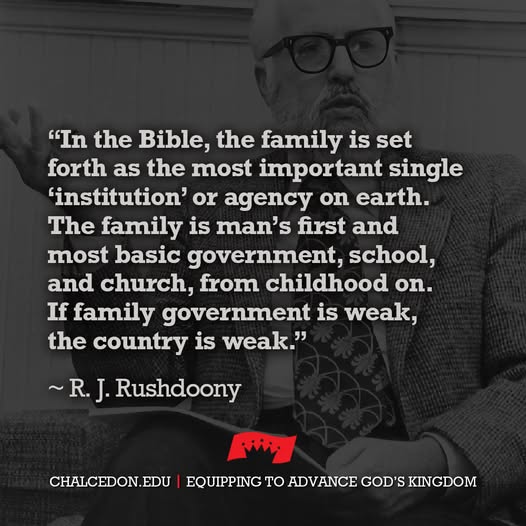
Chalcedon | Rushdoony on the "Functions of the Family"
Mankind was originally placed in the Garden of Eden. The Family is the basic unit of humanity. We might call this original society "patriarchy." There was no "institution" of "civil government" in the Garden of Eden. (Nor a "church.") Nor did God "institute" a "government" over and apart from "patriarchy" in Noah's day.
Feminists have poisoned the word "patriarchy." They tell us husbands beat their wives and all sex is rape. Jesus said husbands should love their wives the way Christ loves the Church. Husbands should not be like the kings of the nations (1 Samuel 8:5; Mark 10:42-45).
Jesus clearly says His followers are not to be "archists." They are to be "servants." A Jewish scholar saw mankind divided into two classes: "Economic Man" and "Political Man." The word "economics" comes from the Greek words for "house" and "law." Those who aspire to become, or vote for, "Political Man" are idolaters. (See more on this "economic/political" distinction here.)
Micah says we will beat our "swords into plowshares."
Actually, it is God who says this; it is God who says this is what a society is morally obligated to do if it wants to become a Godly, obedient, safe ("blessed" because not "cursed" - Deuteronomy 28; Leviticus 26) society.
This means replacing the "public sector" ("swords") with the "private sector" ("plowshares"). It means abolishing the Pentagon and West Point and "not learning war any more." "No one to make them afraid": a free market, free from men with guns and badges threatening to arrest you if you don't follow the Socialist planners and bureaucrats.
"Sword" in the Bible usually means "government."
No sword = no "government." The "public sector" is transformed into the "private sector," or to use my terminology, the "Patriagoric Sector." The family/market sector, rather than the political/governmental sector.
This website advocates anarcho-pacifism.
My claim is that the Bible is an anarchist manifesto.
If we obeyed the Bible, we would live peacefully in a stateless society under our own Vine & Fig Tree.
Micah's "last days" began in the last days of the Old Covenant, at the birth of Jesus the Messiah/Christ.
Israel's temple was a model of the Garden of Eden. Edenic restoration is the goal of the Bible (Revelation 20-22). The "Last Adam" (1 Corinthians 15:45) reverses the relationship broken by the first Adam. Jesus substituted love of enemy for the generations of retaliatory vengeance which marked mankind before His Advent.
I can persuade you of these wild claims if you will read the Bible from cover to cover and be willing to ask,
"In the chapter I just read, did God create a perpetual monopoly institution called 'government'? Did God say this 'institution' can forcibly extract its wages and violently prevent competition against its monopoly?"
It's actually a simple exercise -- a middle-school student should be able to do it -- but the implications are staggering.
God created human beings in families. That's the first place the "Great Commission" is put into effect. Parents must practice the commands of Christ and teach children to do the same.
Adam's family.
Then Noah.
Then Abraham.
The basic social unit is the household.
This is Patriagora.
The basic social unit is the household.
Abraham's household is enormous, wealthy, and international.
Yet Abraham is not called a king.
Instead he manages a vast network of voluntary and familial relationships.
He does not hurt people or take their stuff.
St. Augustine wrote a famous book called "The City of God." The book covers a wide range of subjects.
The City of God has 22 chapters (or "books")I want to revisit chapters 15-18, going through the history of the world in the Bible from Genesis to Revelation, comparing the "City of God" and the "City of Man," and asking some neglected questions.
Modern scholars often use the phrase "City of Man" to speak of the opposite of "The City of God" (Civitate Dei). Augustine never used the phrase "City of Man." His original term was the "Earthly City" (civitas terrena), which I don't like, or the "City of the World" (civitas saeculi), which is OK, but I prefer "The City of Man." Both the City of God and the City of Man exist on planet earth, while for Augustine, the City of God tends to be in heaven, and the "Earthly City" is, obviously, on earth. Pitting the spiritual against the physical is called "neo-platonism." Augustine got a lot of his ideas from the Greeks, not the Bible. Jesus told us to pray "Thy will be done in earth as it is in heaven" (Matthew 6:10).
Another thing Augustine got wrong was eschatology: the future of Christianity, and the future of planet earth. He believed the good guys never win on earth and in history, and the bad guys never lose -- at least until everything is wrapped up at the Second Coming of Christ, and both sides are dispatched to their eternal destinations. This is called "amillennialism," from the Greek "a-" meaning "without," and "millennium" speaking of a time when the City of God flourishes on earth.
The Bible says God put human beings on planet earth to exercise dominion (Genesis 1:26-28). If you compare the first three chapters in the Bible with the last three, you should get the idea that human beings were put on earth to turn an undeveloped planet into the City of God -- the New Jerusalem.
The key issue in human history is not physical vs. non-physical, but obedience vs. rebellion; Theonomy vs. Autonomy -- God's Law vs. Man's Law.
Augustine tends to suggest that the City of God never gets built on earth, but only in heaven. In this life -- in history -- the City of Man dominates. The City of God isn't here on earth; we experience the City of God only after death. Only after earth history is over.
Did God make a mistake by putting human beings on Planet Earth? Why not just leave us in heaven? Augustine didn't come right out and say that God made a mistake putting us here.
City of God vs. City of Man
Kingdom of God vs. Kingdom of Satan
Light vs. Darkness
Original Social order: Patriarchy | Eden -- Consistent with Christ's commands
My own theory, or nomenclature, is like "Patriarchy," which I define as a family-centered civilization without "church" (e.g., Levites) or "state" (extortion-funded vengeance-takers), but my word is "Patriagora," family (patria) + market (agora). Voluntarily networked families. One could call a network of families a "church," but it's more like a business relationship Mon-Fri than a meeting for one hour on Sunday morning."The State" is not an "institution," it's a way of life.
Christians lead a different life -- a “Vine & Fig Tree” life;
non-Christians lead a different life -- a sword + powers life, or a life of escape from dominion/service
Every government eventually bans the Bible.
The Bible undermines every government.
The Bible is at war with governments.
The Institutional Church tries to soften this conflict.
Churches use passages like Romans 13 to pacify the State: "Don't shut us down!
Look! We have a Romans 13 bumper-sticker! The Bible really loves governments!"
But the more they study the Bible, the more they realize this just isn't true.
The Bible is not a strictly "religious" book. More pages of the Bible are about politics than any other subject. The Bible describes the utter failure of human "government" and empires. The Advent of the "Prince of Peace" made that clear.
The disciples did not understand this at first.
When Jesus told His disciples He was a pacifist and would allow Himself to be tortured to death by the government, Peter reacted like a defender of the Second Amendment:
Matthew 16:22
Then Peter took Him aside and began to rebuke Him, saying, “Far be it from You, Lord; this shall not happen to You!”
Jesus turned and said to Peter,
23 “Get behind Me, Satan! You are an offense to Me, for you are not mindful of the things of God, but the things of men.”
24 Then Jesus said to His disciples, “If anyone desires to come after Me, let him deny himself, and take up his cross [tool of government execution], and follow Me. 25 For whoever desires to save his life will lose it, but whoever loses his life for My sake will find it. 26 For what profit is it to a man if he gains the whole world, and loses his own soul? Or what will a man give in exchange for his soul?
A few weeks later, Jesus overhears His disciples arguing about who will be the greatest in the coming Kingdom. Who gets to be the Vice-Messiah? Who gets to be the Secretary of Defense? Who will sit at His right hand?
|
But Jesus called them to Himself and said to them, "You know that those who are considered rulers over the Gentiles lord it over them, and their great ones exercise authority over them. {43} Yet it shall not be so among you; but whoever desires to become great among you shall be your servant. {44} And whoever of you desires to be first shall be slave of all. {45} "For even the Son of Man did not come to be served, but to serve, and to give His life a ransom for many." |
The word translated "rulers" comes from the Greek word from which we derive our English word "anarchist."
"Lords," "rulers" and "great ones" are "archists."
The "kings of the gentiles" believe they have a right to impose their own will on others by political force:
This is what "archists" do.
| The archist is a person who believes he has the right to impose his will on others by force or threats of violence. |
The "anarchist" is not an archist. The an-archist denies that anyone has the right to impose his will on others by force. The public school caricature of an "anarchist" (here) believes in using force to impose his will on others. He is therefore an "archist." Not an an-archist.
The goal of this website is to transform you into a Bible-believing Christian who, as a follower of Christ,
This is the 180° opposite of what most of us have been told is an "anarchist" in our archist-approved "public" schools.
If you believe the Bible, then your heart's desire should be to see "archists" repent and leave an archist-free world. A true "anarchist" does not seek to impose Christ's will on archists by force. We need to pray that archists will repent and stop trying to impose their will on others by force. This will not happen through armed revolution against "the government." We wait for God to regenerate archist hearts.
In 1st Samuel 8, Israel demanded a king "like all the nations."
Most church-goers are not familiar enough with "the nations." That's a major part of the Bible. God wants us to know about "the nations."
|
The nations outside Israel were rebels against God.
"The nations" were "political," from the Greek word "polis" meaning "city" or "city-state."
Nowhere do we find:
"God creates a ministry of civil government."
The pattern is:
"Ye shall be as gods"
They hurt people -- people who won't give them their stuff.
All kings of gentiles were condemned by God, and their empires destroyed by God
|
James Benjamin Green compiled a Harmony of the Westminster Standards, including the Confession of Faith, the Larger and Shorter Catechisms. In his exposition of Chapter XXIII on the Civil Magistrate in the Westminster Confession of Faith, Green correctly observes (concerning Romans 13:1),
"It is not meant that God directly ordained the state by saying to man, Thou shalt set up a government or organize a commonwealth."
Whose idea was the State? The first polis was built by Cain after he murdered his brother (Genesis 4:17). His successors are Lamech (Genesis 4:23-24); Nimrod (Genesis 10:8-12); Pharaoh (Genesis 12:15,20; 37:36); Chedorlaomer (Genesis 14); “the Kenite, the Kenizzite, the Kadmonite, the Hittite, the Perizzite, the Rephaim, the Amorite, the Canaanite, the Girgashite and the Jebusite” (Genesis 15:19-21). Just keep reading the Bible: nation after nation, empire after empire. Evil men, influenced by demons, conquering, murdering, enslaving. It's really horrible, and nobody likes reading the violent Old Testament.
On the other hand, nobody likes the New Testament either, because it says we have to "be subject" to all these evil governments, pay their taxes, and obey their laws. We like our government when it persecutes "the bad guys" and takes their stuff and gives it to us, but we don't like it when the government says WE are the bad guys and starts persecuting US. And we don't like when Jesus says Give them what they want. The Bible would be a better book if it were OUR word instead of God's Word.
Genesis 10 is known as the "Table of Nations." It is also the table of empires. These empires are all in rebellion against the God of the Garden.
Which nations epitomize imperial creature-worship? Babel (Genesis 11:1-9); Egypt (Exodus 1:8); Israel (1 Samuel 8 – “like all the nations”); Greece, Rome (Daniel 2:44); The Third Reich; U.S.S.R.; U.S.A.
At no point in the Bible's history of mankind did God "institute" something called "civil government." God never gave anyone permission to tax others. There's no "God-ordained office" that anyone can legitimately aspire to. All the governments of the history of the world as seen in the pages of the Bible were organized crime syndicates in rebellion against the God of the Garden. They were not morally legitimate. They were not "ordained" by God in the sense of having a morally legitimate social function, but they all "served" God's purposes, and none of them -- even the most savagely violent and perverse -- did ever bear the sword "in vain." Because God was using them for His purposes. All human governments are rebellious and criminal.
The Bible is mostly about politics.
• Genesis: God creates human beings in families. There is no "civil magistrate" among God's People.
• Exodus: God liberates Abraham's family from slavery to "the State" in Egypt.
• Leviticus-Deuteronomy: Laws given to a
Stateless Israel.
• Joshua: The governments of the Promised Land are judged.
• Judges: A book about civil officers?
• Samuel and Kings: Four Books about "the government."
• Psalms: Poems written by a king, about the life
of kings.
• Proverbs: written by a king.
• The Prophets: Proclaiming God's judgments against governments around the world.
• The Gospels: A New King is born, and the Empire is nervous. They try to kill the King.
• Acts: The
Government against the Gospel.
• Epistles to people persecuted by the government, often written by an Apostle in prison.
• Revelation: 666 = the Empire.
In Daniel chapter 2, we have a dream interpreted by Daniel. It is a statue that represents the great empires of the pre-Christian world. Rome is the last empire on the statue. During this empire, The Messiah would come, and crush this empire to powder. The prophecy has been fulfilled, and we've just about cleaned up the mess that was Rome. That final leg of Daniel's statue brings us to Paul's letter to those who were still under the boot of Rome.
If one goes through the Bible there is never a point in time where God says, "From now on I want to shift the locus of Godly living from the family-business (e.g., Abraham) to the State. I want there to be this thing called the state that irons out all problems, that keeps civilization going." The Bible says repeatedly that God sends governments as a curse on a disobedient people. The State is a symptom of the Fall, not a remedy. It is the pinnacle of man's rebellion
I argue that there was never such a point in time where God said "This guy has the right/authority to confiscate other people's money without their consent and take vengeance on his enemies. And this "thing" - the state - is to continue in perpetuity. And then Paul will talk about this thing in Romans 13."
But the defender of the traditional view of Romans 13 dogmatically insists that God wants human beings to have "governments," and the only place he could hang his hat is seven verses in Romans 13. I want to suggest that Paul and his readers understood that the Bible looked at the Roman empire (La cosa Romana) and all other previous empires as beasts or criminal "things." They were "things" Abraham had to deal with, they were "things" that were outside Israel, which at the time of Moses was a "church" Acts 7:38 not a "state."
My point is that there is no such thing as "a legitimate government." God never "ordained" "legitimate government," He only ordained well-ordered patriarchies. These Abrahamic units have to deal with Genesis 14 units.
Paul considered Rome the culminating unit or "thing," in Daniel 2, which says Jesus puts an end to these "things."
The next step in human evolution (if you don't buy Biblical creationism) is the repudiation of state-things and the flourishing of Patriagora.
La Cosa Caino (Genesis 4)
See Rushdoony
La Cosa Nephilim (Genesis 6) Violent "mighty men"
Can it be said that the "mighty men" of Genesis 6 and the "kings" of Genesis 14 are basically the same "office" of "civil government?"
Within your framework, yes, I can see why you would group them together. Within mainstream biblical scholarship, the answer would be "not exactly, but there are connections."
"Not exactly" -- because "mainstream biblical scholarship" puts undue emphasis on Athens rather than Jerusalem. There is no moral/ethical difference between any of the "cosas" in the City of Man. They are all morally/ethically illegitimate. The Mainstream wants to maintain the moral legitimacy of "the State" in principle. It wants to appear principled by saying some archists are not "legitimate governments." It tries to distinguish "The State" in a legitimate form from less-legitimate upstarts. So it tries to say that there is a categorical difference between "real" governments and the violent gibborim ("mighty men") of Genesis 6. The "mighty men" are "out of control" or something. But they all want to be "mighty" (Mark 10:43). See below on Alexander the Great [ mighty ]. The Clinton/Bush/Obama/Biden/Trump Regime is not ethically different from the "mighty men" of Genesis 6. Both trust in violence. Genesis 6 speaks of the gibborim ("mighty men"):
"The same became mighty men which were of old, men of renown." (Gen. 6:4)
Genesis 14 describes kings such as:
Chedorlaomer,
Amraphel,
Arioch,
Tidal,
and the kings of Sodom and Gomorrah.
The text does not explicitly say the gibborim became kings or held a formal office of "civil government."
See? If it's "formal" it's more legitimate. But "formal office" is a myth. It's from Athens, not Jerusalem.
"Government" = "mafia" = violent "mighty men"However, there are several observations that support the comparison:
1. Both represent concentrated power
The gibborim are not presented as ordinary family heads or craftsmen.
They are figures of unusual:
strength,
prestige,
fame,
dominance.
Likewise, the kings of Genesis 14 are power-concentrators:
collecting tribute,
organizing military campaigns,
subjugating populations,
and waging war.
In that sense, both belong to the same general category of elite rulers.
2. Genesis moves from violent men to organized empires
One theme running through Genesis is increasing social centralization:
Cain builds a city.
Lamech boasts of violence.
The world fills with violence before the Flood.
Nimrod becomes a mighty one and kingdom-builder.
Babel centralizes humanity.
Genesis 14 presents interstate warfare and imperial tribute systems.
A reader could plausibly argue that Genesis depicts the evolution of violence from individual acts into organized political structures.
That sounds very close to what is being likened to "la cosa nostra."
"organization" and "structure" are not particularly relevant. . The very first act of theft or violence moves the perpetrator from the "private sector" into the sinful "public sector." It doesn't matter how "organized" the perpetrator becomes, or what kind of "structures" or "constitutions" or anything like that are developed. There is no moral/ethical difference between the "mighty men" of Genesis 6 and the most "formal," "organized," "structured" polis.
3. Nimrod is the strongest bridge
Genesis 10 explicitly says:
"He began to be a mighty one [gibbor] in the earth."
Nimrod is both:
a gibbor ("mighty man"),
and the founder of kingdoms.
That is probably the strongest textual connection.
In building the case for Patriagora, Nimrod is actually a more important link than Genesis 14.
He is the character where:
"mighty man"
and
empire-builder
appear together.
It's not a "textual" connection. The Bible doesn't speak in those terms. There is no moral/ethical difference between "mighty man" and "empire-builder." Only Athens is more impressed with an "empire-builder" than a pirate. The mighty men of Genesis 6, Nimrod of Genesis 10, the builders of Babel, and the kings of Genesis 14 appear as successive manifestations of the same pattern: the concentration of power, violence, and human glory that culminates in the imperial states later condemned throughout Scripture.
"From Cain's city to Nimrod's kingdom to Chedorlaomer's empire, Genesis repeatedly associates centralized human power with violence, domination, and rebellion against God."
Are you saying the "mighty men" of Genesis 6 were not "centralized?" Is that the criterion? To copy the statement: "Genesis repeatedly associates [the mighty men of Genesis 6] with violence, domination, and rebellion against God."
Doesn't Genesis associate Cain with violence, domination [of Abel], and rebellion against God." Would Abel be less dead if he were the object of the wrath of a "centralized human power" rather than Cain?
La Cosa Nimrod (Genesis 10)
La Cosa Babel, La Cosa Erech, La Cosa Accad, and La Cosa Calneh (Genesis 10:10)
La Cosa Pharaoh (Genesis 12)
Pharaoh is:
enslaver
confiscator
murderer of infants
forced labor organizer
The Exodus story is not:
"God delivers Israel into government."
It is:
"God delivers Israel from government."
La Cosa Chedorlaomer (Genesis 14) FEDERALISM over e.g., La Cosa Sodom (Genesis 13, 18-19)
- The kings of Sodom, Gomorrah, Admah, Zeboiim, and Bela pay tribute for twelve years. In the thirteenth year they rebel. In the fourteenth year Chedorlaomer invades with allies, crushes resistance, seizes property, and carries away captives—including Lot.
That's almost a textbook description of:
taxation,
rebellion,
punitive military expedition,
confiscation,
kidnapping.
It looks less like a legitimate government and more like a large-scale protection racket.
And then Abraham does something fascinating: he rescues Lot, refuses the spoils, and declines economic partnership with the king of Sodom.
8. La Cosa Abimelech (Genesis 20, 26) — local kingship
9. Canaanite city-kings (Joshua).
10. Midianite domination (Judges).
11. Philistine domination (Judges–Samuel)
12. 1 Samuel 8: "We want a "Cosa/Thing" like all the nations"
The list Samuel gives is essentially:
He will do to you what Pharaoh did.
La Cosa Solomon -- bureaucracy, taxes, forced labor (1 Kings 4–12).
Solomon gets his "thing" from foreign nations (polygamy, idolatry)
[[Sad story, started out wise, ends up total failure
(Ecclesiastes)
"wise" - High I.Q. vs. service / genius vs. ethics ]]
conscription
taxation
confiscation
bureaucracy
servitude
La Cosa Assyria
La Cosa Babylon
La Cosa Medo-Persia
La Cosa Greece
Aristotle tutored Alexander the Great. Aristotle and Empire
He was "Alexander III of Macedon" but Aristotle helped him become Mégas Aléxandros "Alexander the Great."
The word "Mégas" is found in Mark 10:42
In Book IV of the City of God, Augustine observes:42 But Jesus called them to Himself and said to them, “You know that those who are considered rulers (Gk.: "archists") over the Gentiles lord it over them, and their great ones (megaloi | μεγάλοι) exercise authority over them. 43 Yet it shall not be so among you; But whoever would be great (megas | μέγας) among you must be your servant
Justice being taken away, then, what are kingdoms but great robberies? For what are robberies themselves, but little kingdoms? The band itself is made up of men; it is ruled by the authority of a prince, it is knit together by the pact of the confederacy; the booty is divided by the law agreed on. If, by the admittance of abandoned men, this evil increases to such a degree that it holds places, fixes abodes, takes possession of cities, and subdues peoples, it assumes the more plainly the name of a kingdom, because the reality is now manifestly conferred on it, not by the removal of covetousness, but by the addition of impunity. Indeed, that was an apt and true reply which was given to Alexander the Great by a pirate who had been seized. For when that king had asked the man what he meant by keeping hostile possession of the sea, he answered with bold pride, “What thou meanest by seizing the whole earth; but because I do it with a petty ship, I am called a robber, whilst thou who dost it with a great fleet art styled emperor.”
St. Augustine (5th C) | Online Library of Liberty
"La cosa Alexander" -- he says "empire," Jesus says "organized crime syndicate"
La Cosa Romana.
Their Thing = the "public" thing
It's not our thing
Not God's Thing
Is there a "their thing" which parallels our thing-- "la cosa nostra"
La Cosa Loro = "Their Thing"
Becomes "The public thing"
La cosa pubblica, or to use the Latin:
Res Publica ("the public thing")
The Romans themselves called the Roman state the res publica—literally "the public thing."
It was in reality "our thing," la cosa nostra, but we want to appear public-spirited.
La Cosa Nostra — Our Thing
Res Publica — The Public Thing
The Kingdom of God, the City of God — God's Thing
La cosa pubblica
La cosa di Dio
I actually think those are better than La Cosa Nostra La Cosa Pubblica
This is immediately recognizable as:
"The Public Thing"
which is very close to the Roman res publica ("public affair," "public matter," "commonwealth").
The State claims to be La Cosa Pubblica — the Public Thing.
It claims to belong to everyone.
It claims to represent everyone.
It claims to speak for everyone.
But in practice it is often merely:
La Cosa Nostra masquerading as La Cosa Pubblica.
La Cosa di Dio
This may be even more interesting.
The contrast becomes:
City of Man City of God La Cosa Pubblica La Cosa di Dio Caesar's thing God's thing Political salvation Kingdom salvation Compulsion Discipleship Tribute Stewardship Vengeance Forgiveness Rule by force Rule by Spirit And then Abraham becomes the first great exemplar of La Cosa di Dio.
- Not a king.
- Not a politician.
- Not a bureaucrat.
A patriarch.
- A covenant-keeper.
- A trader.
- A host.
- A father.
- A teacher.
Along with the much-ignored history of the vengeance-taking nations in the Old Testament is the account of the demonic influence over these nations.
The Bible says Godly angels guarded the nation of Israel (Acts 7:53; Deuteronomy 33:2; Psalm 68:17; Galatians 3:19; Hebrews 2:2; Revelation 5:11), while fallen angels animated the gentile empires (Deuteronomy 32:8; Daniel 10). Other passages that exhibit the relationship between fallen angels and gentile empires include:
I have richer conversations with Atheistic AI's than with "Christian" AIs.
This is Claude talking about my "cosa" theory, when I asked a softball question about Isaiah 13 (God sends Medo-Persia against Babylon) and Daniel 10:13,20 (speaking of "The Prince of Persia" battling against the archangel Michael):
Isaiah 13 is the oracle against Babylon — its fall is described in cosmic, almost apocalyptic language ("the stars of heaven and their constellations will not flash forth their light," v.10), which is the standard Old Testament idiom for the collapse of a political order. The target is unmistakably the Babylonian imperial system, La Cosa Babilonese.
Daniel 10:13 introduces "the prince of the kingdom of Persia" — a spiritual being, apparently angelic or demonic, who opposed the angel sent to Daniel for twenty-one days until Michael came to help. This is the passage that gives us the clearest biblical picture of what we might call the spiritual architecture of empire — that behind each earthly "cosa" stands a corresponding spiritual power that both animates and is identified with it.
The connection Scripture hints at is this: if the "prince of Persia" in Daniel 10 is the spiritual correlate of the Persian imperial system, then by extension every cosa has such a correlate. The prince of Babylon would be the spiritual power behind Isaiah 13's target. Paul's "principalities and powers" and "rulers of this age" language in Ephesians 6 and 1 Corinthians 2 is almost certainly drawing on exactly this framework.
This has a significant implication for the La Cosa narrative: the cosas are not merely human criminal enterprises — they are demonically animated structures. That raises the stakes of the argument considerably. It's not just that Nimrod organized a protection racket. It's that behind La Cosa Nimrod stands a spiritual "prince of Shinar" or equivalent — which is why these structures are so persistent, so resistant to reform, and so comprehensively corrupting.
It also sharpens the anarcho-capitalist reading of Colossians 2:15 — Christ "disarmed the rulers and authorities and put them to open shame, triumphing over them." That's not metaphor. That's the spiritual decapitation of the cosa structure at the cross, with the Great Commission as the historical outworking of that victory.
All power given to Christ
Christ overcame all the powers.
During the OT, demons/dignities deserved respect
Titus 3:1 - Put them in mind to be subject to principalities and powers, to obey magistrates, to be ready for every good work - seems to be talking about both the human archists and the demonic forces controlling them.
Jude 1:9 - Michael the archangel did not blaspheme the devil himself (βλασφημία (blasphēmia)
2 Peter 2:10 - criticizes those who "do not tremble as they blaspheme the glorious ones" (ESV). "Glorious" is not the same word, but may be the same theme as the "higher powers" of Romans 13:1.
Binding of Satan
Lake of fire
| The goal of teaching/evangelism is REPENTANCE
Repent everyone out of la cosa mondo into la cosa di Dio Everyone OUT of the City of MAN No neutrality "Neutrality" = unconverted. Cannot serve two masters |
The stateless “Vine & Fig Tree” society.
5 minute sermon here?
Daniel does not present the succession of empires as: God's wonderful institutions for social improvement.
Instead he portrays them as giant metallic beasts and kingdoms that are ultimately shattered.
Christ came to serve, ergo we are not archists - plug archism from Romans 13 here.
James 1:27 unspotted from "the world" - the City of Man - La Cosa Mondo - "That's not 'my thing'"
Repentance is necessary for Justification. The Bible clearly states that repentance is necessary for forgiveness (Isa. 55:7;Luke 24:47; Acts 2:38; 3:19; 5:31; 11:18; 17:30; 20:21; 26:20). Accordingly, the Westminster Confession of Faith says that repentance “is of such necessity to all sinners, that none may expect pardon without it (WCF 15.3).” [Repentance and Salvation]
Repentance means defecting from the City of Man to the City of God. Repudiating your citizenship in the City of Man and becoming a citizen of God's Kingdom.
How to Become a Christian by Getting Under the LawThe purpose of the Great Commission is to elicit repentance and obedience to the commands of Christ.
Most Christians think of salvation primarily as:
I tend to think of it as:
Colossians 1:13 ("transferred us into the kingdom of His beloved Son"). The issue is not merely what happens after death, but which kingdom one belongs to now. Frame biblical history as a contest between rival allegiances. La Cosa CainoA civilization organized around:
La Cosa NimrodA civilization organized around:
La Cosa RomanaA civilization organized around:
La Cosa di DioA civilization organized around:
Then Christianity becomes not merely:
but
Biblically, the rival allegiance is usually broader than the State. For example:
We must renounce allegiance to:
That is very close to Augustine's two cities, except that the conflict is located more concretely in social institutions and historical allegiances.
The Mafia was not primarily a job. It was a life of loyalty/allegiance Likewise, the Roman Empire was not merely a bureaucracy. It was a life of loyalty/allegiance. Christianity is not merely assent to propositions. It is a life of obedience/loyalty/allegiance to Christ the King. Governs every area of life. Not just "church," not just "state." Business also. The Business Covenant |
Would Augustine say that everyone inhabiting the "earthly city" had a moral obligation to defect from that city and become a citizen of the City of God?
Yes, almost certainly — but with qualifications that create the very tension exploited on this webpage. Augustine would say that every person has an obligation to seek the City of God, that citizenship in it comes through grace and election, and that the earthly city is heading toward destruction. In that sense, yes — defect.
But here's where Augustine's framework diverges from "pariagora" in ways that matter for this narrative:
For Augustine, "defecting" from the earthly city is primarily an interior and ecclesial act. You join the City of God by conversion, baptism, participation in the sacraments, and reorientation of your loves from temporal to eternal goods. The earthly city doesn't get abolished — it limps along until the eschaton, coexisting with the City of God, the two cities being invisibly intermingled until the final judgment separates them. The line of Cain builds their city, polis, "Cosa Nostra." The line of Seth just wanders and waits for the Second Coming.
This means Augustine's framework has no mechanism for transforming earthly institutions. A person can defect spiritually while remaining a Roman citizen, a magistrate, even a soldier. He explicitly says Christians can serve in these roles. Augustine's two cities are distinguished by their loves, not their institutions.
The Vine & Fig Tree framework differs at precisely this point. For VFT, defection is institutional and visible — repentance means actually dismantling the cosa, actually beating the sword into a plowshare, actually casting the crown (Revelation 4:10-11). It's not a reorientation of interior loves on Sunday while leaving the M-F life and the machinery of violence intact. It's the Great Commission as a program of abolition of the City of Man..
So Augustine would say: everyone must defect spiritually. VFT says: that spiritual defection, if genuine, produces visible institutional consequences Augustine never drew.
That's actually a stronger critique of Augustine than the Neoplatonism charge — it's not that he had bad metaphysics, it's that his two-cities framework insulates earthly institutions from transformation by making the distinction invisible and interior. Optimillennialism is precisely the claim that the distinction should become visible and external over time through the work of the Gospel.
“Vine & Fig Tree”: Eschatology is more important than neo-platonism. Even if he concedes at points that interior conversion of multitudes might transform the Roman Empire in some visible (and even institutional) ways here on earth, he is ultimately pessimistic about mass conversion any time in the future before the end of human history.
The Neoplatonism charge requires the church-goer to care about the history of philosophy. The eschatology charge requires him only to answer one question: do you believe the Great Commission will succeed in history? If he's a postmillennialist — or even an optimistic amillennialist — he already half-agrees with you against Augustine. If he's a pessimillennialist or a dispensationalist raptureologist, Patriagora has a prior argument to win before Augustine matters at all. But either way, the eschatological question is the load-bearing one.
The argument against Augustine might be stated this way:
Augustine was right that there are two cities and that everyone has an obligation to defect from The City of Man to the City of God. He was wrong about whether that defection would happen at scale before the end of history. His pessimism about mass conversion meant he never had to work out what a world of successful Great Commission obedience would actually look like institutionally. We do. Micah 4 is what it looks like.
They credit Augustine where he's right, locate the precise disagreement, and point toward the positive vision of Patriagora without requiring a detour through Platonic metaphysics.
The deeper implication is that eschatological pessimism functions as a permission structure for institutional accommodation. If the earthly city is never going to be substantially transformed anyway, there's no pressing reason to dismantle it. Why beat your sword into a plowshare if the millennium isn't coming? Augustine's amillennialism and today's dispensationalism both produce the same practical result: leave the state alone, manage your interior life, wait for the end.
Optimillennialism is the theological root that makes the institutional program not just possible but obligatory.
Suppose the Body of Christ fulfills "the Great Commission" to make disciples of all nations, teaching them to obey everything Christ commanded. Two things would happen:
That "vote" might be contentious, as pro-state forces mount hysterical predictions about what would happen under "anarchy!" But "archism" is a sin, so it must be repented of. That is not an option, though it may be a challenge.
Secular Humanists have done a better job describing a stateless society than Christians have. I have tried to address the issue of dispute resolution here:
The Bible says that if we obey God's commandments we will be blessed (Leviticus 26, Deuteronomy 28). We will "dwell safely" with "no one to make us afraid" (Micah 4)
Some people say we have to have a State, otherwise Walmart would never figure out a way to get customers to their stores. Bulldozing a strip of land and covering it with asphalt is so complicated and scientific that only government bureaucrats can figure out how to build a road.
Since we all went to schools run by government bureaucrats, we were never told that many of America's Founding Fathers -- like Jefferson, Madison ("Father of the Constitution") Monroe and Calhoun -- opposed having the government build roads. They assumed that politicians would not build roads that benefited most voters, but would build roads that benefited special interests and campaign contributors. So in the early years of America, roads were built by "Turnpike Companies" and oil companies who wanted customers to get their cars to the gas station to fill up. If there's a demand for roads, "greedy" capitalists will find a way to build roads, supply the demand, and make a profit, just as Walmart finds a way to get thousands of items in the store at low prices.
Some say we need government to build schools. But many parents are not satisfied with atheistic schools that produce illiterate students. They would rather send their children to private Christian schools. But the government subsidizes secular public schools making it hard for private schools to compete when parents are forced to pay for the inferior schools. Again, there is no reason to believe that capitalists will not fall all over themselves competing for education dollars from parents if we implemented a "wall of separation" between school and state.
National Defense
If we abolished the United States and created 50 new "nations," what other nation in the world would seek to invade and conquer any one of those 50 new nations?
How would a Christian society defend itself against China, Russia, Iran, or some other "bad guy" non-Christian society dominated by a large organized crime syndicate that resolves to impose its protection racket on the stateless Christian society?
What did Jesus say to do in such a case?
His answer was simple and clear: be a pacifist, and then start over:
Although things are much better than they were in Micah's day, they are not as good as they could or should be. There's always work to be done. But the current state of affairs, with organized crime syndicates like Washington D.C. subjugating the people, is certainly not normative. If we abolished the organized crime syndicate in Washington D.C., some other "cosa nostra" might try to gain the political power that Washington D.C. formerly exercised. We would, of course, want to prevent that. But violent vengeance is not the Biblical way to do that.
"Provoked is manna from heaven for anyone who wants to know where the extreme Russophobia in the West came from, as well as the central role the United States played in causing the Ukraine war. Horton provides a detailed account of America's foolish and dishonest behavior toward Russia in the years since the Cold War ended." — John J. Mearsheimer, R. Wendell Harrison Distinguished Service Professor of Political Science at the University of Chicago
These are "practical" questions. Does "civil government" in practice lead to a more peaceful and prosperous society, or would society be more peaceful and prosperous if there were no organized crime syndicate engaging in extortion, vengeance, and banning the Bible from public schools?
There is also the moral question.
This website claims that every human being has a moral obligation to repent of being a "government."
Here are some atheists mapping out practical descriptions of a stateless society:
These scholars (and many others) have shown how so-called "public goods" have in the past been provided by competing agencies in the private sector, and how they could be provided in the future at a higher level of quality and lower price than government provides them. Capitalism raises our standard of living; socialism (central monopolized planning) brings poverty. This isn't just a "political" claim, it's a matter of the laws of economics.
But some Christians claim it would be a sin to abolish all "governments." They claim human beings are commanded to vote for extortion-funded vengeance-takers. The number one verse where these claims take refuge is Romans 13.
|
Romans 12 precedes Romans 13, and Romans 13 cannot be understood unless reading begins in the previous chapter.
When Paul says "Bless those who persecute you" (Romans 12:14), he's not saying God has created the "Institution of Persecution." God did not ordain an "Office of Persecutor" which is a legitimate calling, but can be criticized for "abuse" of persecution, or persecuting beyond certain "limits." Paul is saying what Jesus said: "Resist not evil" (Matthew 5:39), "leave vengeance to God" (Romans 12:19) and "overcome evil with good" (12:21) -- blessing, praying for, and giving to -- even to the most evil thing on the planet: [turn the page to Romans 13] The Government.
Being a "Government" is evil.
In fact, it would be good to start in Romans 8, because commentators usually agree that chapters 9-11 are a parenthetical discussion about the place of Israel in God's predetermined plan.
Romans 8:28 says all things work together for good. Even evil things. Like the Sword. Like persecution. Like the demonic principalities and powers. Compare Romans 13:4.
Romans 8:35 Who shall separate us from the love of Christ? shall tribulation or anguish, or persecution, or famine, or nakedness, or peril, or sword?
36 As it is written, For thy sake are we killed all day long: we are counted as sheep for the slaughter:
It's not "good" to have tribulation and persecution imposed on you at the point of a sword. It's not good to be killed all day long. But God works all these things together for our good.
37 Nevertheless, in all these things we are more than conquerors through Him that loved us.
38 For I am persuaded that neither death, nor life, nor Angels, nor principalities, nor powers, nor things present, nor things to come,
39 Nor height, nor depth, nor any other creature, shall be able to separate us from the love of God, which is in Christ Jesus our Lord.
|
"Creature" is an important word.
Idolatry is worship of the creature rather than the Creator. Romans 1:25
Our Governor should be Our Creator. Isaiah 33:22
But we would rather be governed by a creature like us. It's hard to trust an invisible spirit and easier to trust a visible creature.
But the desire to be ruled by a creature is a rejection of God (1 Samuel 8:7). You cannot miss that point in the Bible. Those who desire a government reject God. Israel said to Samuel:
"Now make us a king to judge us like all the nations.”
But the thing displeased Samuel when they said, “Give us a king to judge us.” So Samuel prayed to the Lord. And the Lord said to Samuel, “Heed the voice of the people in all that they say to you; for they have not rejected you, but they have rejected Me, that I should not reign over them. According to all the works which they have done since the day that I brought them up out of Egypt, even to this day—with which they have forsaken Me and served other gods—so they are doing to you also. (1 Samuel 8:5-8)
Paul said believers should not take their disputes to the courts of "the powers that be" (1 Corinthians 6:1-11). If there is a demand for dispute resolution services, entrepreneurs should hire the wisest among us to staff Free Market Dispute Resolution Organizations.
Romans 9:21-23
21 Hath not the potter power over the clay to make from the same lump one vessel unto honor and another unto dishonor?
22 What if God, choosing to show His wrath and to make His power known, endured with much longsuffering the vessels of wrath fitted for destruction;
23 and this, that He might make known the riches of His glory on the vessels of mercy, whom He had prepared before unto glory,
Romans 12 says leave vengeance to God.
Romans 13 says God takes vengeance using "vessels of dishonor, fitted for destruction." Vengeance Vessels.
Judas Iscariot and Pontius Pilate were both vengeance vessels. Also Assyria, Babylon, Rome.
I think it's helpful (for pedagogical reasons) to look at a parallel passage (1 Peter 2) before looking at Romans 13.
1 Peter 2 |
|
| 1 Therefore laying aside all malice and all guile, and hypocrisy and envy and all evil speaking, | |
| 2 as newborn babes, desire the sincere milk of the Word, that ye may grow thereby, | |
| 3 if so it be that ye have tasted that the Lord is gracious. | |
| 4 Coming to Him as unto a living stone, disallowed indeed by men, but chosen by God and precious, | |
| 5 ye also as living stones are built up a spiritual house, a holy priesthood, to offer up spiritual sacrifices acceptable to God by Jesus Christ. | |
| 6 Therefore it is also contained in the Scripture: “Behold, I lay in Zion a chief cornerstone, elect, precious; and he that believeth in Him shall not be confounded.” | |
| 7 Unto you therefore who believe, He is precious; but unto those who are disobedient, “The stone which the builders disallowed, the same is made the head of the corner,” | |
| 8 and, “A stone of stumbling and a rock of offense,” even to those who stumble at the Word, being disobedient, unto which also they were appointed. | |
| 9 But ye are a chosen generation, a royal priesthood, a holy nation, a peculiar people, that ye should show forth the praises of Him who hath called you out of darkness into His marvelous light. | There is only one legitimate "nation" on earth: the "holy nation" headed by Christ the King.
This verse is originally from Exodus 19, but now applies to all people who defect from their old nation and become "naturalized citizens" of Christ's new nation. |
| 10 In times past ye were not a people, but are now the people of God; who had not obtained mercy, but now have obtained mercy. | |
| 11 Dearly beloved, I beseech you as strangers [πάροικος (paroikos)] and pilgrims [παρεπίδημος (parepidēmos)], abstain from fleshly lusts which war against the soul, | Peter began this letter with these words:
The word translated "strangers" in 1 Peter 2:11 is also found here:
Sometimes the same Greek word is translated using more than one different English word.
Christians are "sons":
Why would Christians create an institution which treats Christians as "strangers?" Christians are citizens of the "holy nation" governed by the Messiah. We are "ambassadors" from this "holy nation" to all other nations. We are not citizens of those other nations.
Paul was a Roman citizen by birth (Acts 22:28). After Daniel's prophecy was fulfilled and the Roman Empire was no more, would Paul say we have a moral obligation to create a new pagan empire which would claim newborn children as its citizens? |
| 12 having your way of life honest among the Gentiles, that, whereas they speak against you as evildoers, they may by your good works, which they shall behold, glorify God in the day of visitation. | When you think of "Gentiles," you should also think of the "kings of the gentiles." Israel wanted a king "like all the gentiles" (1 Samuel 8) ("gentiles" and "nations" are two
English words translating the same Greek or Hebrew word), and the disciples of Christ initially wanted to kings like the gentiles (Mark 10:42-45). Gentiles are to become
Christians, citizens of a new Kingdom, and not be like Gentiles any more.
Gentiles do not always "praise the good" (Romans 13:3). Sometimes, if not often, they speak against Christians as evildoers and bad citizens, sometimes because we do not acknowledge "civil government" as legitimate, but serve a rival Sovereign. |
| 13 Submit yourselves to every ordinance of man for the Lord’s sake, whether it be to the king as supreme, | Although Christians are ambassadors and not citizens under their jurisdiction, we obey all their laws, unless a law requires us to disobey any of God's Laws (Acts 5:29). |
| 14 or unto governors as unto those who are sent by him for the punishment of evildoers and for the praise of those who do well. | "The kings of the gentiles" are not good people, not good kings. They feed Christians to the lions. As Peter explains below (along with the Apostle Paul), Christians are to serve tyrants as if
they were serving Christ Himself. Christians are to serve gentile kings as if they were not tyrants, but Messiahs like Jesus. See Psalm 72, for an example.
This is known as "as if" thinking. Thinking "as if" something is true. But Peter goes on to say |
| 15 For so is the will of God, that with well-doing ye may put to silence the ignorance of foolish men” | Tyrants are ignorant and foolish men. They are not Christ-like. A disobedient society is cursed by God with tyrannical false messiahs. An obedient society obeys the true Messiah, and neither desires false messiahs, nor does God curse them with false messiahs. |
| 16 as free, and not using your liberty as a cloak for maliciousness, but as the servants of God. | |
| 17 Honor all men. Love the brotherhood. Fear God. Honor the king. | We are to honor all men, even tyrannical evil men. Paul says "Bless those who persecute you" (Romans 12:14). To "bless" is to "honor." That does not mean that God has "ordained" the "office" of Persecutor for us, even though God works all persecution together for our good (Romans 8:28ff; 13:4). |
| 18 Servants, be subject to your masters with all fear, not only to the good and gentle, but also to the froward. | Wycliffe translates this verse:
Paul says "Be subject" to demonic "powers" (Romans 13:1). |
| 19 For this is thankworthy: if a man, because of his conscience toward God, endure grief, suffering wrongfully. | We are conscience-bound to live godly lives, even if that gets us in trouble with "the powers that be." Paul mentions our "conscience" in Romans 13:5. Our conscience tells us to follow in Christ's steps (verse 21). Our "conscience" does not tell us that it would be wrong to abolish slavery and "civil government" (the "public sector"). Our conscience does not tell us that Caesar was morally justified to violate Israel's national sovereignty by an invasion which slaughtered thousands of Jews, and impose an undemocratic, unrepresentative military dictatorship over the nation, plundering the people through exactions of tribute to fill Rome's coffers. |
| 20 For what glory is it if, when ye be buffeted for your faults, ye shall take it patiently? But if when ye do well and suffer for it, ye take it patiently, this is acceptable with God. | Note: tyrants more often than not are a terror to the good. We are to think "as if" they are a terror to the evil and praise the good. We are to be good because we expect praise from the True King. |
| 21 For even unto this were ye called, because Christ also suffered for us, leaving us an example, that ye should follow His steps, | The "powers that be" murdered the sinless Son of God. He did not resist them, we should follow Christ and be pacifists with respect to evil tyrants. |
| 22 “who did no sin, neither was guile found in His mouth”; | |
| 23 who when He was reviled, reviled not in return; when He suffered, He threatened not, but committed Himself to Him that judgeth righteously; | False kings do not judge righteously. We honor them as if they were righteous, knowing they may nail us to a cross because they are tyrants. |
| 24 who His own self bore our sins in His own body on the tree, that we, being dead to sins, should live unto righteousness; by whose stripes ye were healed. | |
| 25 For ye were as sheep going astray, but are now returned unto the Shepherd and Bishop of your souls. |
What follows is a very abbreviated study of Romans 13:1-5. The traditional view of the State and of Romans 13 is so entrenched in the minds of most Christians that it will take many months of study in the other "13's" of Scripture to overcome this tradition. All we can hope to show here is that our view of the State is not inconsistent with Romans 13.
It must be remembered that this is not a dispassionate and objective look at Romans 13. It is an argument for a particular view of the State. So as we go through Romans 13 keep the question in mind: is this passage consistent with the interpretation we have been given in Isaiah 13 and Revelation 13, that the State is essentially demonic? Or does Romans 13 teach that the State is prescribed by God as a laudable, exemplary, and (possibly) Christian institution? Can a Christian, having read Isaiah 13, Revelation 13 and Romans 12 then conclude that he would like to grow up to be a part of the State?
Romans 12 is a restatement of Christ's "Sermon on the Mount." These passages teach "pacifism." We are not to resist evil. That does not mean we aid evil. We are to rebuke evil and not assist it. We are to preach to evil the command to repent. We seek to prevent evil and in love we preach to evil doers, working for their redemption.
Romans 12 says we are not to take vengeance. Those who take vengeance are evil, but God is in control of evil vengeance-takers. We are not to resist evil, says Romans 12, but overcome evil with good (verse 21). We are not even to resist the most evil entity on the planet, namely (turn the page to Romans 13) The State.
|
|
One way to do this is to honor all men (1 Peter 2:17).
|
God will be our Civil Government
|
|
The Bible enumerates several "good" ways to overcome evil including "blessing," "giving," "being subject," "honoring," and "praying" for evil people. Paul is not a "pessimillennialist" who says evil will always be on top, but an "optimillennialist" who says we can overcome evil. The Great Commission will be fulfilled.
"Overcome evil" -- Even the most evil thing on the planet: civil government, which was always manipulated by demons.Audience: This passage is not directed to "the powers that be," it is directed to those who are being oppressed by "the powers," continuing the letter from chapter 12, and going back to chapter 8 (commentators agree that chapters 9-11 are something of a parenthesis) . Be pacifists. Overcome evil with good, not with more powerful evil.
The immediate context of Romans 13 is the passage before it: Romans 12. The message of Romans 12-13 is to be pacifists, leaving vengeance to God, overcoming evil with good works -- prayer, blessing, honor, giving. Not "resisting" or overthrowing.
Romans 12-13 highlights four important concepts:
Romans 13:11-14
11 And do this, knowing the time, that now it is high time to awake out of sleep; for now our salvation is nearer than when we first believed. 12 The night is far spent, the day is at hand. Therefore let us cast off the works of darkness, and let us put on the armor of light. 13 Let us walk properly, as in the day, not in revelry and drunkenness, not in lewdness and lust, not in strife and envy. 14 But put on the Lord Jesus Christ, and make no provision for the flesh, to fulfill its lusts.
When Paul says "leave vengeance to God, God will repay," the question might have arisen in his readers' minds: "How does God take vengeance?"
When Paul says "overcome evil with good," his readers might have asked, "Even the most evil thing
on the planet?" That would be "the powers that be."
In 1750 a sermon by Jonathan Mayhew was published: “A Discourse Concerning Unlimited Submission and Non-Resistance to the Higher Powers.” John Adams said it "ignited the American Revolution." Mayhew claimed that Romans 13 did not require us to "be subject" to evil governments, but only to those that were good enough to be called "ministers of God." My take on the passage is that it is acknowledging what the Bible teaches from cover to cover -- that all "governments" are evil -- and we are to "be subject" to "the powers that be," that is, the ones that now exist, whether we view them as good or as evil. The Bible says evil governments "serve" God's purposes, and may therefore be called God's "servants" or "ministers." Evil is put in place by God. God is sovereign. "The powers that be" -- is Paul talking about the existing "powers" (Caesar, Rome), or is he talking about a hypothetical ideal of "government?" Mayhew said it was a charter for the ideal government. I disagree. Paul is referring to Rome, the empire that ruled over Paul's readers. This chapter is addressed to the ruled, not the rulers. It's talking about the empire that existed at that time, and not about some future government that political architects might fashion. Rather than looking ahead to some ideal government, we should be reminded of Rome's historical ancestors: Greece, Persia, Babylon, etc. Rome was the final segment of the statue in Daniel 2. The Bible says these empires all had demonic guardians. Paul is not saying anything new that hadn't already been said by the Old Testament. Paul is echoing the Old Testament teaching that pagan kings are guided by demons. Every time Paul uses the word "powers" (Greek: exousiai, plural) he's speaking of demonic powers (and sometimes including their human puppets). See more here: Everyone in Paul's day believed that the empires were influenced by demons. Rome believed its national demons were helping the emperor conquer and be victorious. This demonic-political nexus is explored on this website:
Sometimes these demons were believed to be the spirit of the previous emperor, now guiding the present emperor. Secular Humanists will sometimes speak of "The Genius of the Emperor," but the word "genius" was originally more like our word "genie." These demonic monsters -- demons and their political puppets -- were "ordained" by God. The Greek word, tassō (τάσσω) does not mean a modern ecclesiastical ordination (such as appointing a priest or pastor). The root meaning of tassō is a military or organizational term. It is found in Luke 7:8
"The powers that be are ordered by God."Everywhere that Greek word for "powers" is found in the New Testament, it refers to fallen angelic (demonic) "powers." The Jews of Paul's day understood that the Gentile governments were animated by demons. The Romans believed this too, although they believed the demons were guardians of the empire and were dedicated to preserving Caesar's power. Paul's readers understood that Paul was talking about evil, which was the subject he introduced in Romans 12 ("overcome evil with good"), and continues in Romans 13. Isaiah tells us that the State is animated by demonic powers. We are also told that God is sovereign over the powers and orders them according to His purposes. Romans 13:1 confirms this. The powers are "ordered by God." "Ordained" has the connotation of "enthusiastically appointed." "Ordered" is a bit more neutral, consistent with other passages, and avoids the problem of having this one verse indicate "enthusiastic appointment," when everywhere else in the Bible God is less than enthusiastic over the State. God "ordained" Saul to be king, but it wasn't enthusiastically (I Samuel 8). Many Bibles accurately have "ordered" in the margin. "There is no power but of God"Satan could do nothing unless God has allowed it. The State can do nothing that God has not predestined for His own sovereign purposes. The State would like to delude itself into thinking that it has autonomous power: Pilate said to Jesus, "Knowest thou not that I have power to crucify thee, and have power to release thee?" Jesus did not disagree; Pilate did have that power. But He added, "Thou couldst have no power at all against Me, except it were given thee from above." (John 19:11) Does this mean that Pilate's exercise of his power to crucify the Lord of Glory had God's divine sanction and approval? Should a Christian in the same position today follow Pilate's example? Of course not; God's predestinating decree is not the same as His prescriptive decree (in His Law). "Be subject to the higher powers."
Does this square with Revelation and Isaiah 13? It certainly does. Most Christians who can quote Romans 13 cannot also quote any or all of the other occurrences of the word "powers" in Paul's writings. Simply look up each of these verses and you will have an idea of what Paul is saying when he speaks of "the powers." I Corinthians 15:24; Ephesians 1:21; 3:10; 6:12; Colossians 1:16; 2:10,15 (cf. also Luke 12:11; I Peter 3:22). Titus 3:1 is similar in thought to Romans 13. We analyzed the "principalities and powers" more extensively in another paper. To be on their side hardly seems a desirable goal. In what sense, then, can it be said that we should be "subject" to them? Render them absolute obedience and support? No. No more than God's "ordering" of the powers indicates absolute approval and approbation. The Apostles said, "We must obey God rather than man" (Acts 5:29). But if the State does not command us to sin, but only inconveniences us, we are to be "subject" to the State and subject to "every ordinance." (1 Peter 2:13-14). Jesus said that an illegal military occupation by a foreign nation must still be obeyed. For more on this topic see here and here. The Christian's goal is not to assassinate the king, but for the king to repent. So we are to love our enemies (Matthew 5:44) and use persuasion rather than violence. Christ is said to have (in principle) "spoiled" the powers that be, and will (in fact) put them down before His second coming. And it is precisely by being "subject" to them -- not revolting against them -- that their judgment is made certain. Our judgment of the powers is not to be "blasphemous" or vengeful, but is to be rooted in obedient faith. God will judge the State through His Spirit. Other verses support this view: Notice how Peter and Jude warn us not to "blaspheme" Satan (Jude 8-9; 2 Peter 2:10-12, where "railing accusation," etc. is the Greek word "blasphemy." Notice also the reference to cosmic warfare (see also Daniel 10 for explicit reference to the State). Jude 9 literally speaks of a "blasphemous judgment" (cf. 2 Peter 11). We are not to take judgment into our own hands; it is God who is to shake the heavens (Isaiah 13:10,13), not us; our judgment is to be in obedience, by allowing the Spirit to empower us to live independent of the State and its welfare/warfare machinery (John 16:11). Isaiah speaks of a cosmic "crisis," and Jude and John use the Greek word "krisis" to describe the act of judgment. Our judgment is not be violent vengeance. God "ordains" the State as a judgment on a people. This teaching pervades the Bible from cover to cover. "The slothful shall be under tribute" (Proverbs 12:24). If the slothful do not want to pay tribute, they need to repent, not assassinate the tribute collectors. Do not revolt against the State and the powers behind it. They are stronger than your autonomous efforts. Revolution is taking vengeance on the State (Romans 12:19). God is in control; He orders the State and judges the kingdoms of the world through their mutual self-destruction. "All" you have to do is resist the State and its ministers of propaganda as they tempt you to abandon the pursuit of holiness. God Uses DemonsFor example, God uses lying demons to manipulate kings into going to war. Here's a summary of 1 Kings 22:
Those who are called "governing authorities" by mainstream writers (and some pro-state Bible translators who like "governing authorities" better than "higher powers") are closely connected with "lying spirits." The human and demonic agents are considered as a unit. This is why Paul calls them "powers," and his readers did not think "authorities," which sounds complimentary or honorific, like "wise and benevolent statesmen"). Everywhere in the New Testament, the Greek word for "powers" means "demonic forces." Paul and everyone else in his day understood that empires were animated by demons. Caesar believed the demons behind his empire were good, but Paul knew better. The "powers" are fallen angels that God uses to guide vengeance-takers to execute His wrath. Here are the verses: If you're going to understand "the powers" in Romans 13, you have to read the other verses. It also helps to understand the history of ancient empires and the scope of the demonic influence. That link above has links to essays that put the human-demonic connection on full display. Church-going Americans in 2026 have a completely different view of government than Paul and his readers had. Our view has been sanitized by government teachers (K-12) and university prophets. Israel was guided by unfallen angelic forces (Acts 7:53; Deuteronomy 33:2; Psalm 68:17; Galatians 3:19; Hebrews 2:2; Revelation 5:11). The "powers" are put in place -- "ordained" -- by God. No empire exists that has not been "ordained" by God. The most evil empire imaginable is under God's sovereign control. "Ordained" does not mean "morally legitimate." God ordains empires to commit savage acts of barbarism: God "ordained" Assyria to destroy Israel in judgment of Israel's sins, and then God punished Assyria for doing what God "ordained" that violent empire to do. This is a frequently-occurring event in the pages of the Bible. God raises up Evil Nation A to judge Evil Nation B, and then condemns Evil Nation A for the evil acts of destruction and murder that God ordained it to do to Evil Nation B. Paul didn't just invent Romans 13 out of thin air. He's repeating the entire history of pagan empires in the Scriptures as it culminates in the beastly Roman Empire in his day. |
Again, the purpose of Romans 13 is not to blueprint the ideal government. It's talking about the government that existed in Paul's day. The first seven verses of Romans 13 are an elaboration on three words in the Sermon on the Mount: "Resist not evil" (Matthew 5:39, 41) If God sends the powers your way, Do not resist. This is a command to Christians, not a command to those who claim to be "governors" with a right to take vengeance and disobey God's commandments. In other words, Romans 13 is directed to citizens, not rulers. Romans 13 describes rulers, prescribes actions for the ruled. It does not prescribe action for rulers. It does not create or authorize a ruling class or oligarchy. God has always said that if you obey His commandments, He will bless you with statelessness. If you disobey, He will send evil governments against you (Deuteronomy 28; Leviticus 26). Paul's readers were existentially tempted to resist evil, both because Rome was so evil and oppressive, and everyone felt it, and because Jews were possessed of a resistant spirit, which ended with their destruction in AD 70. Jesus said "resist not evil." Paul is not saying anything new, or creating a new "office" or "institution." America's Founding Fathers resisted the British tax collectors (the Red Coats). This was sinful. If we obey God's commandments, He promises to keep us safe from "archists." If we want to be like the archists, God will send us plenty of archists -- as a judgment. We are not to resist them because God sent them -- not because they are wise and benevolent. Sometimes God sends archists like the Sabeans and the Chaldeans to righteous people like Job. That's God's business, and sometimes it's hard to figure it all out. (I recommend the essay by R.J. Rushdoony in his book By What Standard.) But Jesus commands us to love our enemies, and the Great Commission commands us to go to all nations, but sometimes God brings the nations to our country. We are not to resist by getting out our muskets. The purpose of Romans 13 (and chapter 12 before it) is to inculcate pacifism (or "non-resistance). That is clearly taught in verse 2. Admittedly, verse 3 is a formidable-looking arrow in the quiver of the anti-anarchist. This sentence was not intended to be interpreted with strict literalism. Generally speaking, if you aren't breaking God's Laws, evil empires will leave you alone. 1 Peter 2 says the same thing: if you're going to be punished by the government, let it be because the government is evil and foolish, not because you are. But literally speaking, "rulers" are often a terror to good works. Christians are put to death by "rulers." I try to obey God's Commandments, and I've never been arrested, but I've never received a phone call, personal visit, or letter of "praise" from the government.There are two issues in this "debate."
Revolutionaries deny God's sovereignty. They assert that their land does not deserve God's judgment. God has "ordained" a Babylon or an Assyria or a Soviet Union to judge us for our sins (2 Chronicles 24:24), our incompetence, our covetousness, our indebtedness (Deuteronomy 28:44), and our love of State benefits (Luke 22:25), but the revolutionary manifesto says we can take vengeance against the State; that we can eliminate God's judgment without eliminating our sin. Paul says "whoever resists the power" (lit., is against ["anti-"] God's "order" [v.1]) "resists God's disposition; and they that resist shall receive to themselves damnation." By focusing on the consequences of sin, rather than the sin itself, revolutionaries damn their nation as well. We do not eliminate bureaucrats by taking vengeance or by resisting (Matthew 5:39). We eliminate bureaucrats by Love, in the full theonomic sense of that word (Romans 13:8-10), applied to our relationships with the uneducated, the sick, the delinquent, and the aged (Matthew 25:35-36ff.). But doesn't the Bible say we're supposed to "resist" the Devil? Yes, and certainly that includes resisting Satan's temptation to take vengeance or be an archist. We resist the Devil by positive, faithful obedience, not by negative, vengeful, revolutionary violence (I Peter 5:9). We don't push Satan away; we stand with God and Satan runs (James 4:7). We don't blaspheme the demons, we stand in the Word and resist by faithfulness to God's Law-Word (Ephesians 6:12-13). Satan cannot resist the Word prophesied and applied (Luke 21:15). Romans 13 does not contradict Romans 12. Anti-Resistance RhetoricIt is not Paul's purpose in Romans 13 to call attention to how evil the Roman Empire was. It was the "beast" in Romans 13. It was persecuting Christians "all day long" (Romans 8:35-36). Paul's purpose is to defuse revolutionary resistance. His purpose is to extinguish the fuse of vengeful resistance that took the Jews into civil war and led to their destruction in AD 70. He does this by viewing earthly persecution, violence, vengeance, and oppression from God's perspective, not from the perspective of believers in prison. From God's perspective these evil powers were under His control and were serving His purposes without intending to do so. Paul wants his readers to cultivate a higher purpose for their relation to the empire. His rhetoric is exaggerated praise for these evil unwitting "servants." He wants his readers to think of their persecutors as pawns in God's hands, not as enemies and targets. So Paul exaggerates. Paul uses the language of Old Testament prophets who said savage bloodthirsty empires were God's "sanctified" (Isaiah 13:3) servants (Isaiah 10:5; Jeremiah 25:9). They served God unwittingly; Paul wants his readers to serve self-consciously. Above all, he wants them to live godly lives, and not be criminals who get arrested. Paul's "servant" rhetoric is not meant to be taken literally in a praiseworthy sense. "Servant" rhetoric does not literally contradict the reality of persecution and oppression by an evil demonic empire that Paul's readers experienced on a day-to-day basis. It doesn't mean soldiers are literally good. It means something else. This is the hardest thing for modern readers to get a hold of. |
Paul is still talking about the demonic powers, still talking about those we are to overcome (with good -- blessing, prayer, etc. -- not with evil). Are demonic powers always and only a terror to good works? Of course not. Caesar was intentionally trying to terrorize Christians into not worshiping God and worshiping Caesar as a god. Paul knew this, and so did his readers. Paul's readers knew they had no chance of ever receiving a letter or ambassador from Caesar praising them for leading godly lives. If Paul wasn't trying to be literal and universalistic, what was he trying to say? He was saying, generally speaking, if you're not committing crimes, you're not on Caesar's radar. This was Peter's message in 1 Peter 2 -- don't get in trouble with Caesar for doing evil. Better to be terrorized by Caesar for following in the steps of Christ (1 Peter 2:21). Peter and Paul said to imagine your neighborhood tyrant is Christ Himself. The purpose of Romans 13 (and chapter 12 before it) is to inculcate pacifism (or "non-resistance). That is clearly taught in verse 2. Admittedly, verse 3 is a formidable-looking arrow in the quiver of the anti-anarchist. This sentence was not intended to be interpreted with strict literalism. Generally speaking, if you aren't breaking God's Laws, evil empires will leave you alone. 1 Peter 2 says the same thing: if you're going to be punished by the government, let it be because the government is evil and foolish, not because you are. But literally speaking, "rulers" are often a terror to good works. Christians are put to death by "rulers." Paul's readers certainly knew this. And we're willing to admit that the Roman Empire was not a good government -- unlike ours. We think our government is good. I try to obey God's Commandments, and I've never been arrested, but I've never received a phone call, personal visit, or letter of "praise" from the government. There are two issues in this "debate."
Verse three is often used as a slogan or soundbite to buttress the claim that every society needs an organized crime syndicate ("government"). Let's break down verse 3 and see what the whole Bible says about four main themes:
1. Who are "rulers" in the Bible? How can we avoid living our lives in fear of the organized crime syndicates of the world? The Greek word in Romans 13:3 is ἄρχων (archōn). An "archist" is someone who believes he has a right to impose his own will on others by force or threats of violence. Jesus was murdered by archists.
"Rulers" are evil. 1 Peter 2:15 describes them as "ignorant" and "foolish." 2. Does a Godly society need terrorists? Churches tell us that only "government" -- armed terrorism -- will keep depraved human beings from breaking out into perpetual lawlessness, crime, aggression, theft, vandalism, and mayhem. This must be because Jesus is not the Savior of the world -- government is.
Human life before the advent of Christ was incorrigibly violent. Christ changed all that. 95% of all human beings are now anarchists in practice: they go to work, they don't aggress or steal, they provide for their families, and they seek a better life for themselves and others. Sociopaths (archists) make up only 5% of the population. The myth of "government" puts these sociopaths in charge of our economy. The myth of "government" cripples peaceful humanity by insisting that "government" is our savior, and violence is the answer, not the Gospel. Romans 12 and the Sermon on the Mount prohibit Christians from being sword-bearing terrorists like "la cosa nostra," "la cosa Cain" and "la cosa Romana," "la cosa publica." Being an archist in "la cosa publica" is not a morally legitimate vocation. 3. Should we fear government terrorists? We need to be realistic. Paul reminds his readers that government terrorists tortured Jesus to death, and they will do the same to you. The Bible directly warns that followers of Jesus will face the same hatred and rejection that He did. The most famous of these passages is John 15:18-25, where Jesus says, "If the world hates you, keep in mind that it hated Me first".
These references are primarily to Christians living in "the last days" of the Old Covenant. Things are different in the New Covenant. The last days of the Old Covenant were pretty intense. But Paul reminds Christians in this Romans 13:3 (and elsewhere) that God works all things together for good (Romans 8:28). Even evil things (Romans 8:35-39).
4. Rulers praise As we will see in the next verse, archists unwittingly "serve" God. And at the end of the day, after threatening and carrying out violence, they grudgingly praise God and His people.
The "revelation" of Jesus Christ was in AD 70, terminating the last days of the Old Covenant.
If you preach the gospel will the powers praise you? Not always (Acts 5:29). Have any praiseworthy Christians ever been unjustly martyred by the State? Quite possibly. Are communist dictatorships a terror to good works? Not in my mind. Was an unjust occupation government a terror to Jesus? Romans 1-2 says that God's Law is known to all human beings. When we obey God's Law, others recognize it and secretly admire it, regardless of what they say. Most governments claim to be upholders of justice and goodness. They will usually honor upright behavior. If America would put God's Law into practice we would eliminate the threat of Saddam's biological terrorism. If Nicaraguans would put God's Law into practice they would eliminate the threat of American Imperialist intervention and Soviet Marxist expansion. Israel never learned: practice evil and create terror (Assyria). The message in Romans 12-16 is clear: Decentralize; depend upon Providence, not politics; defend the powerless; support the weak; "Mind not high things, but condescend to men of low estate." Advance the interests of your struggling neighbor, not yourself; then you shall have praise from the withering State (2 Chronicles 12:7; Isaiah 60:10; Isaiah 49:23). Continued below In Acts 4, believers prayed for boldness. Why? Because the rulers were a terror to them. Paul says "For rulers are not a terror to good works." That has to be interpreted non-literally, or Paul contradicts the lived experience of believers. Roman archists intentionally terrorized believers.
Ephesians 6:19-20 is also a Prayer for Boldness. Crucifixion and "State Terrorism"Paul says "Rulers are not a terror to good works." Generally speaking, if you live a godly life, you'll stay off the empire's radar. But Jesus lived a good life, and He was tortured to death in a grizzly public spectacle known as "crucifixion." It was public because it was intended to terrorize the public. On at least one occasion, Rome crucified dozens of dissidents along a public highway. Imagine walking down the street and hearing dozens of people scream in agony above you. Imagine blood hits you from above like a bird dropping as you walk past a cross. ChatGPT responds to that claim:
Paul is exaggerating the goodness of the Empire to encourage godly living and derail revolution, not to deny everything the rest of the Bible says about The City of Man, nor to contradict the daily experience of Christians in a pagan empire. |
Paul's purpose must be kept in mind: He doesn't want his readers to engage in violent resistance against an oppressive empire. He wants his readers to live godly, peaceable lives. Paul says those who claim to have been given the right to sinfully violate God's commandments ("civil government") are God's "servants." Paul is not saying that the demonic archists are self-consciously worshiping and serving the God of Abraham. Everyone knew that wasn't true. Paul is seeing things from God's point of view, not the powers. Honorific language underscores God's sovereignty, not the goodness or necessity of Assyria/Nero. Being called the "servant" or "minister" of the God of Abraham would have been offensive to Assyria or Nero. They claimed divinity for themselves, and they claimed autonomy, not subjection to the God of Israel. But all the empires that God destroyed for their sins are said to have been God's "servants." Isaiah even says they are "sanctified" servants, an honorific title that exceeds Paul's mere "servant" in Romans 13. No ruler in all of human history has borne the sword in vain. They all used the sword the way God predestined ("ordained") them to use the sword. Paul isn't saying anything new in Romans 13. The entire Bible is the history of demonic empires that serve God's purposes because God is in sovereign control over them all.
In Romans 12-13, Paul is saying "Overcome evil with good . . . even the most terrifying evil of them all: The Government." Paul says governments are terrifying, but believers (who believe Romans 8, 12, and 13) should not be terrified. If you're a disobedient criminal, "be afraid." Verses 3 and 4 are terrifying verses. The State bears the sword. The State is God's instrument of violent conquest, torture, rape, and subjugation. The sinless Jesus was stripped naked and tortured by "the Epstein class." But He was not afraid. Too many church-going Christians have a view of government as a wise and benevolent Santa Claus, bringing gifts. Or as a brave Protector. Or a unicorn frolicking in a spring meadow. In the Bible, "government" is a fearful, terrifying bearer of the Sword: armies, destroyers, savage beasts. But God is sovereign over the demons and the nations. He uses them to accomplish His purposes. Despite their rebellion, despite their desire to be their own gods, they are the unwitting servants of the Most High God. They don't want to hear that; they want to be as gods (Genesis 3:5). But
All of the evil nations chronicled in the Old Testament were
continued from above
But if you jump on the political bandwagon, seeking security from the State, justice from revenge, and peace from violence, then you may expect what Israel, Babylon, Assyria, and all other statist populations receive: The sword (2 Chronicles 36). God will send His "minister" (Romans 13:4), His "sanctified ones" (Isaiah 13:3), the army of the Beast from out of the earth (Revelation 13:11) against you and your society. God's wrath, anger, and indignation rest on a nation that refuses to trust Him and obey His Law. When God takes vengeance upon such a nation, He often uses famine, pestilence, tornadoes, etc., as His "ministers." At other times, depending on how appropriate it is to the society to be judged, He uses the war-monger State. After the State has done its work, judgment then falls on the destroying State (Revelation 13:10; Ezekiel 25:15). It is certainly no honor for the Medes to be called His "sanctified ones" or His "ministers"; they were subsequently judged for "obeying" God's "command." God calls them his deacons because they serve His purposes. When God says to Babylon, "I am sending my ministers," he does not mean to comfort the Babylonians with the promise of the presence of his divine ambassadors, the army of the Medes. This is a threat of judgment! This is the way it is in Romans 13. God is saying, NO! Don't revolt against the State! I have it there for a purpose, and if you want it to disappear, then obey My Word! In Isaiah 13 the message is threatening. In Romans 13 the message is a warning: don't take vengeance on the State, or the State will take vengeance on you! "He beareth not the sword in vain."This is a statement of universal fact. No government ever bears the sword "in vain." God's predestinating plan covers all contingencies. Nothing escapes His Will. As you have always understood Romans 13, does the State at times bear God's sword in vain? Does Saddam Hussein bear weapons of mass destruction in vain? Do Jiang Zemin and Zhu Rongji have missiles pointed at L.A. in vain? If you think Bill Clinton bears the sword in vain, then you may not understand the Biblical doctrine of the State. Paul says "he beareth not the sword in vain," period. This is a description, not a prescription. Too many Christians say, "We don't have to be subject to our government, because it is not a Christian government, and it bears the sword in vain." No it doesn't. You must be subject to it. Hitler did not bear the sword in vain. Not every German joined the SS, but the majority were in favor of them. Not of their excesses, of course, but they tolerated the excesses because the National Socialist Party promised -- not a return to Biblical Law -- but economic prosperity, health, welfare -- in short, everything that the Biblical word for "salvation" describes. Hitler promised "law and order," he opposed smoking, drinking, foreign imports, and all the great "evils" of the day. Hitler was swept into power on the crest of a wave of conservative support. And among his biggest supporters were the Protestant clergy. Hitler did not bear the sword in vain. And the Lord is not finished with the "ministers" that he has been raising up since Hitler's day. The Soviet-American coalition that divided up post-war Germany (and much of the rest of the world) are being positioned by God to serve His plans of judgment. The world powers are serving and will serve God's purposes. As you read this paper, is God "mustering an army" (Isaiah 13:3-4) to be used against your nation? Remember, not every single person has to be Godless before the Godly will feel the effects of judgment upon the lawless; God deals covenantally. Besides, are you going to claim that you have nothing to fear from the Lord's "sanctified ones"? Is your home a "L'abri" (shelter) for the poor and powerless, or a showplace for the entertainment of the powerful? North Korea does not bear the Bomb in vain. |
Does "conscience" refer to the obligation to treat tyrants as if they were Christ Himself (1 Peter 2) and not resist them (Romans 13:2) or does it mean that our "conscience" testifies that archists are good, and Caesar has a right to invade, conquer, and put nations under tribute? After all, Jesus said "Render unto Caesar," so that must mean that Caesar had a right to invade and conquer Israel and put Israel under tribute. And all the other nations as well. That is, our conscience tells us that the "office" of extortion-funded vengeance-taker is an office created by God -- "ordained" by God -- and our conscience tells us that being put under tribute is good for us, and not being under tribute would be a great loss, and we certainly wouldn't want the entire empire to repent of theft and violence and get honest peaceful jobs in the private sector so we could all live in a stateless “Vine & Fig Tree” society. Our "conscience" does not tell us that Caesar had a right to invade Israel and plunder the nation. The Bible says that Rome -- the final segment of the statue in Daniel 2 -- was destined to be crushed to powder by the Rock. It was an evil, depraved, savage empire. But Paul was telling his readers that Christians are conscience-bound to follow Christ to the Roman cross rather than resist in violent revolution and vengeance. Our conscience should tell us to follow in His steps (1 Peter 2:21), and not return evil for evil, but overcome evil with good (Romans 12). Our conscience should tell us that being an archist is a sin (Mark 10:42-45). At the same time, we seek to be winsome apologists for the City of God. "Conscience, I say, not thine own, but of the other" (1 Corinthians 10:29)We pay taxes "lest we should offend them" (Matthew 17:24-27). Christians are conscience-bound to follow Jesus to the electric chair, gas chamber, firing squad, or cross
As Christians we are not to react to the State, simply fearing its coercion. This is its function for the unsaved (Galatians 3:19-4:9). Its very nature and existence should be viewed in faith. We live and overcome by our faith in Christ, following His example of non-resistance; we do not overcome by our own vengeance. So for conscience' sake we do not resist the evils of the State (I Peter 2:19). "Conscience, I say, not thine own, but of the other" (1 Corinthians 10:29). The State has no right to confiscate our wealth. "Notwithstanding, lest we should offend them (Matthew 17:27) we "give to him who asks" (Matthew 5:42). More on "conscience." |
God's servants are "continually devoted" to serving God.
Everything about this verse is exaggerated honorific rhetoric. But it also has a root in Greco-Roman tradition. Just as Luke says archists are called "benefactors," There were those the empire called "liturgists," as if they were priests or altar boys. The Greek word λειτουργοὶ (leitourgoi) is the masculine nominative plural form of λειτουργός (leitourgos), meaning "minsters," "public servants," or "servants". It combines laos (people/public) and ergon (work), literally translating to someone doing public work or service for the common good. Etymology and Historical Meaning
Biblical and Religious Context
In what sense were Pharaoh, Moloch, or Caesar "servants of God?" They denied any duty whatever to serve the God of Abraham. Paul is using the language of the prophets to say God uses people who are in rebellion against Him to serve His purposes. In what sense were Pharaoh, Moloch, or Caesar serving God "continuously?" Paul says they were killing Christians "all day long" (Romans 8:35-36) i.e., "continuously." This is an apparent "contradiction," unless we are missing Paul's point. Paul's point in Romans 8 was that the rulers were pretty much continuously rebelling against God and doing evil, persecuting Christians. Romans 13:6 was not intended to contradict that fact, by saying that "the powers that be" are "continuously" doing good for the public. Zealots were waiting for the opportune time to rise up and overthrow the Roman occupation government. There is no real (legitimate) opportunity to revolt, because, God says, the empire is "continually" serving Me. Even when Caesar is invading, conquering, and stealing, it is "continuously" God's sevant. They are constantly serving God, and you must constantly be willing to go to the cross instead of fomenting revolution. Some Christians claim that we don't have to pay taxes unless the empire is "continually" good. That's not a good interpretation of Paul's words. No organized crime syndicate ("government") is "continually" good. No government has ever been, literally speaking, continually good. Paul says pay taxes to any demonic government that demands them.
And as long as unbelief exerts an influence, demanding earthly gods and a military State, we will be subject to tribute (Proverbs 21:24). Not that the State has any lawful right to redistribute wealth, especially over those who are not even its subjects (Matthew 17:24ff.; Philippians 3:20). But until the Gospel has taken root and the New Day has dawned (Romans 13:11-12), the State will be dedicated to lining its coffers, ever continuing to exact tribute, ever fueling its war-fires, and readying itself to take vengeance upon its enemies.
|
Paul says we are to pay whatever the tax collector says is "due." Jesus said we are to "Render unto Caesar" (Matthew 22:21, ἀποδίδωμι, apodidōmi), and Paul says (Romans 13:7) "Render (ἀποδίδωμι, apodidōmi) therefore to all what is owed (ὀφειλή opheilē)." The Greek word is neutral. It does not say that what is "due" is righteously exacted. If the Mafia says protection money is "due," pay it. "Owe no man anything" (Romans 13:8) except the duty to love, that is, the duty to obey the commandments (Romans 13:8-10), don't hurt people, don't take their stuff, leave vengeance to God. The Christian standard is very high. We are commanded to honor all men (1 Peter 2:17) even those who are tyrants (1 Peter 2:18, Wycliffe). Slaves are commanded to honor their slavemasters by working for them as if they were Christ Himself. No higher honor could be paid to any human being than to treat him as if he were Christ Himself. Paul says we are to "bless those who persecute you" (Romans 12:14). Is not "blessing" a form of "honor?" But we cannot infer that God has thereby created an "office" of "Persecutor."If some guy demands that you honor him by calling him "August Caesar," "Dear Leader," "Führer," or "Il Duce," give him the honor he says is due. And pay the protection money. Paul is not saying the demands of tyrants are morally legitimate. Jesus was asked if Israelites should pay the tribute demanded by Caesar. He famously said, "Render unto Caesar." This does not mean that Caesar wasn't sinning by invading Israel and taxing Israelites. It is a sin to tax someone -- even one penny. Caesar had no right to invade Israel, violate Israel's national sovereignty, slaughter thousands of Jews, impose an unrepresentative, undemocratic military dictatorship, conscript Israelites as slaves (Matthew 5:41), and start milking Israelites with taxes to fill Roman coffers. But Jesus says we are to pay taxes. And anything else we are said to "owe." The Bible says every criminal syndicate from "la cosa Caino" to "la cosa Romana" is evil and we are not to resist it, but to "give to him who asks" (Luke 6) and be pacifists (Hebrews 12:14). Too many Americans say government is good and yet we celebrate "Kill the Tax Collector Day" on the 4th of July. The Bible says government is evil and we are not to resist it, but to "give to him who asks" (Luke 6) and be pacifists (Hebrews 12:14). Romans 13 is usually taken out of its Biblical and Old Testament context, and transformed into something that is consistent with "the traditions of men" -- e.g., Greece and Rome -- but ends up negating the commandments of God (Mark 7). The Bible is the history of rebellious "thug-ocracies" -- organized criminal enterprises who claim to be gods. At no point did God ever create an "institution" of "government" -- an "office" which exists in the world of Platonic forms, although occupied by sinners who never match up to the platonic ideal of "the institution of government," which we also call "the public sector." |
Theonomists look to the Old Testament for a blueprint for the creation of a Godly government. They will dispute our theory of "Patriagora."
Dispensationalists do not look to the Old Testament for a blueprint for civil government. They will probably still dispute Patriagora and retain some conventional theory of civil government based on "Natural Law."
Theonomists oppose "natural law."
Google AI:
Theological Framework View on Earthly Government Blueprint for Civil Law Ultimate Political Goal Dispensationalism Pessimistic & Temporary: Human governments are inherently flawed and bound to fail during the approaching End Times. None: Believes civil laws cannot redeem society; focuses on personal evangelism rather than changing secular legal codes. The Rapture & Millennial Reign: Waiting for Jesus to return, destroy human empires, and personally establish His literal 1000-year kingdom. Christian Dominionism Optimistic & Triumphant: Christians are commanded by God to take control of secular institutions to prepare the earth for Christ. Theonomy (Old Testament Law): Uses biblical law (including Levitical civil codes) as a literal blueprint for modern criminal justice and governance. Christianization of Society: Achieving systemic, institutional dominance across the "Seven Mountains" of culture (government, media, education, etc.). Dispensationalism: No Blueprint, Only Rescue
Dispensationalists do not have a political blueprint for governance because they believe human society is on an irreversible downward trajectory.
- The Church's Role: The church is viewed as a temporary "parenthesis" in history meant to save individual souls, not to reform secular institutions.
- Theocratic Skepticism: Attempting to force biblical law onto a secular nation is seen as futile. Any truly "Godly government" on Earth can only be established directly by Jesus Christ during His future Millennial Kingdom.
- Political Action: When dispensationalists engage in politics, it is usually defensive (protecting religious liberty, slowing moral decay) or geopolitical (supporting the state of Israel to fulfill prophecy), rather than an attempt to rebuild the state in God's image.
Christian Dominionism: The Legal Reconstruction
Dominionism (often rooted in Postmillennialism, Christian Reconstructionism, or Seven Mountain Mandate theology) claims that Christians have a divine mandate to govern.
- The Church's Role: The church is an army meant to occupy and conquer the structures of society. Adherents believe Christ will not return until the church has successfully Christianized the world's governments.
- Theocratic Blueprint: Reconstructionist variants use Theonomy —the application of Old Testament biblical law to modern society—as their literal blueprint. This includes replacing secular constitutions with biblical statutes regarding economics, family, and criminal justice (sometimes advocating capital punishment for Old Testament offenses).
- Political Action: Dominionists engage in politics offensively, aiming to systematically place believers into positions of supreme authority within secular governance to actively enforce God's law.
If you want to look at specific movements, I can explain:
- How dominionism manifests in modern politics via the Seven Mountain Mandate
- How the Moral Majority of the 1980s blended dispensationalist voters with dominionist-leaning political goals
Google AI:
1. The Source of Law: Natural Law vs. Theonomy
- Geisler (Natural Law): Geisler argued that God has revealed a universal moral standard to all humanity through creation and human conscience—known as Natural Law or General Revelation. Therefore, a just civil government does not require the Bible as its legal blueprint. Civil laws should be built on shared, self-evident moral truths (e.g., prohibiting murder and theft) that both Christians and non-Christians can agree upon via human reason. [2, 4, 7]
- Rushdoony (Theonomy): Rushdoony completely rejected Natural Law, viewing it as humanistic and unbiblical. He argued that human reason is fallen and cannot be trusted to generate laws. Instead, his blueprint relied strictly on Theonomy ("God's Law"), meaning that the Old Testament civil codes (including dietary-hygienic principles, economic regulations, and Levitical judicial punishments) must serve as the literal, substantive basis for modern civil law. [2, 5, 8, 9, 10]
2. The Nature of the State: Pluralistic Republic vs. Biblical Theocracy
- Geisler (Pluralistic Coexistence): Because Geisler operated from a dispensational framework, he viewed the institutional Church and the secular state as distinct entities. His ideal blueprint was a democratic, pluralistic republic where Christians can participate alongside non-believers under a neutral, moral framework. For Geisler, the state's job is not to enforce religious devotion but to maintain civil order and protect human rights. He famously warned against dominionist models, asking, "Since reconstructionism is government based on religious revelation, the question can always be asked: Whose revelation?" [2, 4, 7, 11]
- Rushdoony (Biblical Theocracy): Rushdoony’s blueprint was an explicitly Christian theocracy . He did not believe the state or its constitution could ever be truly neutral. He envisioned a highly decentralized society where the federal government's role is stripped to a bare minimum, but where local civil judges are legally bound to enforce biblical mandates. Under his blueprint, secular pluralism would be dismantled, and non-Christian religions would not share equal legal or cultural standing. [5, 8, 12, 13]
3. Purpose of Politics: Restraining Decay vs. Reconstructing Society
- Geisler (Slowing the Decline): Adhering to premillennialism, Geisler believed that society is in a long-term moral decline that will culminate in the Tribulation. Therefore, political engagement is a holding action —a way to act as "salt and light," preserve religious freedom, and slow down societal decay until Christ returns to establish His literal millennial kingdom. Politics cannot fix the world, but it can maintain enough order to allow for global evangelism.
- Rushdoony (Systemic Reconstruction): Driven by postmillennialism, Rushdoony believed that Christians are commanded to actively "take dominion" over the Earth. His blueprint was an offensive strategy to systematically reclaim and reconstruct civil government in accordance with biblical law. In this view, Christ will not return until His Church has successfully placed all earthly institutions under the authority of His law. [6, 10, 11, 14, 15, 16]
Direct Comparison
Feature Norman Geisler R.J. Rushdoony Primary Framework Dispensational Premillennialism Postmillennial Christian Reconstructionism Legal Blueprint Natural Law (General Revelation) Theonomy (Mosaic Civil Law) View of the State Pluralistic, morally bounded republic Decentralized biblical theocracy Religious Diversity Allowed; state protects liberty for all Disallowed; society must explicitly submit to Christ End Goal of Politics Restrain evil until Christ returns Conquer social institutions to prepare for Christ Would you like to explore how Geisler used Natural Law to argue his points in public debates, or look at the specific Old Testament punishments Rushdoony's blueprint advocated enforcing?
Another Google summary:
ߔ? Core Facets of the Political Theory
1. Hyper-Focus on Israel and Foreign Policy
The absolute cornerstone of dispensationalist political theory is the strict distinction between Israel (God’s earthly people) and the Church (God’s heavenly people) . [5]
- The Principle: Dispensationalists believe that God's Old Testament covenants with literal, national Israel are unconditional and must be physically fulfilled in the future. [2]
- Political Impact: This translates into an uncompromising, hawkish Christian Zionism . The survival, expansion, and security of the modern State of Israel are treated as paramount geopolitical priorities. U.S. politicians influenced by this theory view supporting Israel not merely as a strategic choice, but as a divine mandate to avoid God's judgment (citing Genesis 12:3). [2]
2. Pessimism Toward Global Governance (Anti-Globalism)
Dispensational eschatology foretells a coming seven-year Tribulation period characterized by a tyrannical, centralized one-world government led by the Antichrist. [4, 6]
- The Principle: Human systems cannot redeem the world; global unification is viewed as a precursor to demonic control.
- Political Impact: This fosters deep skepticism, if not outright hostility, toward international bodies like the United Nations , the World Health Organization, global currencies, and international treaties. Dispensationalists generally champion national sovereignty and view aggressive globalization trends as prophetic warning signs.
3. Shift from "Soul-Winning" to the Moral Majority (Domestic Policy)
Historically, early dispensationalists (like Dwight L. Moody) practiced a form of political quietism —the belief that because the world is a "sinking ship," the church's only job is to rescue individual souls through evangelism rather than fix structural social ills. [7]
- The Shift: In the late 20th century, groups like Jerry Falwell’s Moral Majority merged dispensational theology with active right-wing American politics. [2]
- The Logic: Even though society is destined to decline eventually, Christians still hold a civic stewardship duty (rooted in the dispensation of "Human Government") to restrain evil, protect religious liberty, and delay societal decay so that gospel preaching can continue unhindered. This manifests in conservative voting blocks focused on judicial appointments, traditional family structures, and religious freedom. [1, 7, 8]
ߓ? Summary Comparison: Dispensational vs. Other Christian Political Theories
Feature Dispensational Premillennialism Christian Reconstructionism / Theonomy Anabaptist / "Two Kingdoms" View of the World Deteriorating until Christ returns to rule. Progressively Christianized before Christ returns. Sinful; a separate realm from the Church. Primary Foreign Goal Unconditional defense of national Israel. Spreading Christian law globally. Strict pacifism and global humanitarianism. Domestic Strategy Restraining evil; delaying decay to evangelize. Rebuilding civil law using Old Testament codes. Separation from state structures entirely. View of State Power Highly skeptical of centralized/global power. Tool to be occupied and reformed by Christians. Babylon; an engine of violence to be avoided.
⚠️ Common Criticisms and Blind Spots
- The "Environmental/Social Neglect" Accusation: Critics argue that because dispensationalists believe the earth will eventually be destroyed by fire before being remade, the theory disincentivizes long-term environmental conservation or systemic reforms to combat poverty and racism.
- Fatalism: Opponents claim that viewing global conflict (especially in the Middle East) as an inevitable, divinely ordained prophetic script can lead to a dangerous passivity regarding peace-making initiatives. [7]
[10] https://www.dbu.edu[11] https://faith.edu
Theonomic opposition to Patriagora often stems from futurist eschatology (inconsistent preterism). They claim that a Micah 4/ “Vine & Fig Tree” society cannot come into existence until after a future "Second Coming" (which even they will admit is a third coming). Even though they admit that the "last days" spoken of in Micah 4 began at Christ's first coming, and maybe in some sense we are currently living (in this current age) in "the last days," we are not morally obligated to "beat swords into plowshares," even though the text says beating swords into plowshares is a feature of "the last days."
Theonomists will not object so much to our claim that all "civil governments" in the Old Testament outside Israel were "cosa nostras," but they contend that God instituted a perpetual system of "civil government" within the state of Israel. So at this point we will do two things
I was asked back in February of 2025 to give my opinion on an article by Chris Hume:
I would like to write more than just a quick opinion about that article. This paper is designed to help the stranded island inhabitants create a Biblical society on "Theonomic" grounds. Most "Theonomists" are not anarchists. They should be.
The purpose of Hume's article is to critique the position of "Christian Nationalism" as articulated by Stephen Wolfe from Hume's perspective of "Non-Legislative Theonomy", a.k.a. "Lancastrian Theonomy."
The first question is, "What is 'Non-Legislative Theonomy?'" That requires a logically prior question:
I'd like to start this review of Hume with a bird's-eye view of "Theonomy."
I do not defend "Christian Nationalism" of any variety, but Wolfe's version of "Christian Nationalism" is based on "natural law" rather than "Theonomy."
I have jotted down a few notes on "Natural Law" here:
Consistent, Biblical Opposition to "Natural Law" Leads to "Anarcho-Theocracy"
The word "Theonomy" comes from two Greek words meaning "God's Law." It is the antithesis of atheism (no god) or humanism (man as god). It is also the opposite of "dispensationalism," which holds that God's Word in the Old Testament is not to be obeyed in the New Testament. Specifically, dispensationalism holds that nothing in the Old Testament is binding unless it is repeated in the pages of the New Testament, while Theonomy says that everything in the Old Testament is binding unless the New Testament says otherwise. Dispensationalism is about discontinuity; Theonomy is about continuity.
Of course, as we will see, everything depends on exegesis: how you interpret a specific law in the Old Testament, or how you interpret any New Testament reference to that law. One can imagine two interpreters that completely overthrow this distinction between "dispensationalism" and "Theonomy"
The dispensationalist in this example is a Theonomist in practice, but not in theory.
The Theonomist in this example is a practicing dispensationalist, and a Theonomist only in theory.
I claim to adhere to the Theonomic principle and reject the Dispensationalist principle. But there are some who charge me with finding too much annulment of Old Testament law in the New Testament. In my opinion, that objection is based on humanistic presuppositions. I'm not going to argue my case for that claim right now, but you must be aware of that issue.
Theonomy is a principle, but exegesis must create the principle. Too often, the principle creates the exegesis. If the principle is "ceremonial law is out," and you come across a commandment you don't want to obey, you can call it a "ceremonial law" and that inconvenient commandment goes away. You justify your dislike of the commandment by some important-sounding principle. But is that principle a Biblical principle? As I said, you must be aware of that issue.
The clash above between a Theonomist and a Dispensationalist often results from the principle that divides Old Covenant commandments into two or more categories. Often the law is divided into the "ceremonial law" and the "moral law." Some also add the category of "civil law" or "judicial law." Everyone agrees that the "ceremonial law" can only be obeyed by faith in Christ.
But how do we determine to which category a particular verse belongs? That's a matter of exegesis. And exegesis is often a matter of larger presuppositions.
Some notable advocates of "Theonomy" have had disagreements over the details of God's Law and how it should be applied. It often boils down to which category you place a given law. And what those categories actually are.
It might seem easy enough to say "That verse is 'ceremonial,' this verse is 'moral.'" But it isn't always easy. And I think it's necessary to see what a mess it is before we can begin to clean it up. Please start here:
We're all learning how to be good Theonomists.
Every Christian should be a "Theonomist." Jesus said, “If you love Me, you will keep My commandments” (John 14:15). But here are some of His commandments:
Matthew 5:17 “Do not think that I came to destroy the Law or the Prophets. I did not come to destroy but to fulfill. 18 For assuredly, I say to you, till heaven and earth pass away, one jot or one tittle will by no means pass from the law till all is fulfilled. 19 Whoever therefore breaks one of the least of these commandments, and teaches men so, shall be called least in the kingdom of heaven; but whoever does and teaches them, he shall be called great in the kingdom of heaven. 20 For I say to you, that unless your righteousness exceeds the righteousness of the scribes and Pharisees, you will by no means enter the kingdom of heaven.
The Westminster Confession of Faith says
“The whole counsel of God concerning all things necessary for his own glory, man’s salvation, faith and life, is either expressly set down in Scripture, or by good and necessary consequence may be deduced from Scripture” (WCF 1.6).
How many "commandments" can be deduced from Matthew 5:17-20?
Would you not agree that those commandments can be deduced from Scripture "by good and necessary consequence?"
The Jews say there are 613 commandments in the Bible, but from just 4 verses we have deduced 8 commandments. We can deduce "by good and necessary consequence" a law or two from nearly every one of the 30,000 verses in the Bible. This is why Rushdoony speaks of "The Law-Word of God." Every Word of a Sovereign is a Law.
What makes "Theonomy" offensive to many people is that Theonomists see God's Word in the Bible as a textbook for all society, not just "the church," or one's hidden personal spirituality. The Bible is held out as a blueprint for the "Christian Reconstruction" of a Godly society in its economy, education, business, charity, arts, sciences, and resolution of disputes. People in those disciplines who do not want God telling them what to do denounce Theonomy as "oppressive" (or something). Churchmen who are friends with those people want to be respected by those people, so these churchmen come up with theories to explain why the Bible doesn't dictate anything in those disciplines. "Natural law" is one such theory." "Dispensationalism" might be another.
Leftists, Democrats, socialists, and their ilk also disagree with Theonomy. They call Reconstructionists "The American Taliban." I call leftists "The Un-American Taliban." America was founded by (inconsistent) Theonomists. America's Founders would be appalled at today's secularists and the influence given them by too many Americans.
Theonomy is often equated (by its critics, but also by its supporters) as the view that "The Mosaic Code" should be enforced by "the civil government." In all our years of brainwashing in atheistic schools and anti-theonomic churches, we have been taught that "The Mosaic Code" is a bad thing. We have been programmed to react with horror when we hear about "The Mosaic Code" potentially being enforced by governments. But "The Mosaic Code" is better than "The Code of Federal Regulations."
I don't believe "governments" can be "Theonomic."
In my opinion, God's Law (Theonomy) commands pacifism, non-aggression, no retaliation. Most Reconstructionists, I admit, disagree with me on this. In my view, pacifism is the obvious teaching of the Bible, and anti-pacifism requires a lot of "nuancing" or fancy exegetical footwork. Or else appeals to a "natural law" tradition as championed by the "magisterial reformers."
This is Theonomy 101:
"Pacifism" does not mean that if you have a shield and someone comes at you with a sword, you cannot engage in "self-defense" by shielding yourself from his sword. But if you fail to defend yourself, leave vengeance to God.
Jesus said "Love your enemy" (Matthew 5:44). Here's how that works in practice. You love your son. Suppose your son became your enemy. Suppose your son accidentally ingested a naturally-occurring form of LSD called "ergot" and began hallucinating that your wife was a lethal threat to you, and because you taught your son to use lethal force against lethal threats, your son was about to kill your wife to defend you. Would you think to yourself, "Hmmm. My son is now a lethal threat to my wife. I guess to protect my wife I need to blow my son's brains out" and then pull the trigger? No, you would not de-humanize or de-personalize your son, declare him to be the "enemy," the "threat," the "target," and pull the trigger. You would try everything else to prevent you son from committing evil, but you would not want to kill your son, because you love your son.
Jesus says you have the same duty toward a stranger. Your first thought should not be "How can I kill this stranger?" but rather "How can I be used by God to cause this stranger to repent of the evil I suspect he is planning?" Ultimately, you should want the stranger to repent and be reconciled to his Creator. That's what "love" means.
You naturally love your son. It may take supernatural grace for you to obey the command of Christ to love your enemy.
If you fail to defend the innocent, Romans 12 says you must leave vengeance to God. That means you can't hire a Mafia Hit-Man to take vengeance. Nor can you "vote" for a "candidate" who promises to steal from your neighbor to build a police state and military-industrial complex to take vengeance.
Obviously, "pacifists" like this are seen as a threat to the continued prosperity and security of "nations" and "governments."
All "pacifists," if consistent, are "anarchists," because pacifists oppose violence, and every professor of Political Science in every university on planet earth will agree that the distinguishing feature of "government" or "The State" or "The Public Sector" is the claim to possess a "Monopoly on Violence."
If you abolish theft, you abolish "the State."
Leaving vengeance to God means
At this point, you might disagree with my claim that true Theonomy teaches pacifism. I used to agree with you. I used to believe that pacifists were either naive or nuts.
|
"The Great Commission" (Matthew 28:18-20) commands Christians to make disciples of all nations, teaching them all that Christ commanded. Among the commandments that we should be teaching the nations (and ourselves):
Consistent obedience to these commandments would preclude the creation or maintenance of "civil government."
Is there a command which overturns or modifies all these commandments: a command like "Thou shalt form a civil government" or "Thou shalt levy taxes on your neighbor."
Leftists use the word "patriarchy" to talk about Theonomy, because God's Law is pro-family.
But Biblical families are Reconstructionist families, and they "exercise dominion over the earth" (Genesis 1:26-28) by networking with other families in voluntary cooperation. I call the Biblical model "Patriagora," from the Greek words for "Family" and "Market"
A free market is peaceful because it is voluntary.
No, it actually forbids it -- Romans 12 + Great Anarchist Commission
This issue is huge. When the task seems to be an easy one of asking "Is this verse part of the 'civil law' or the 'moral law?'" I want to ask a larger question: Is there even such a thing as "civil government" in the Bible?
Obviously there are "civil governments" in the Bible: Nimrod, Pharaoh, Molech, Babylon, and Rome are all "in the Bible." My question is, "Is the concept of civil government prescribed, or merely described?"
If we consider the concept of the "Law-Word" of God, we sometimes can say "The reason God described X was to command X." Sometimes that works. See the article above. Sometimes it doesn't.
Augustine wrote a book called "The City of God."
The Bible is all about the conflict between the City of God and the City of Man.
Kingdom of God vs. Kingdom of Satan
Light vs. Darkness
I'm working on a website called Patriagora.com
"Patriagora" comes from two Greek words: family (patria) + market (agora).
In Augustine, "The City of God" is the line of Abel/Seth, while the City of Man is the line of Cain.
Up until the time of Moses, "The City of God" was the Patriarchs, e.g., Adam, Noah, Job, Abraham.
It is said of Abraham
And I will make thy seed to multiply as the stars of heaven, and will give unto thy seed all these countries; and in thy seed shall all the nations of the earth be blessed;
Because that Abraham obeyed my voice, and kept my charge, my commandments, my statutes, and my Torah.
Genesis 26:4-5
That's a lot of Theonomy. We have no record in Scripture of God revealing all those commandments to Abraham, as we do of God revealing laws to Moses. It must have happened, or else God revealed everything to Adam and it was all passed down through the line of Seth to Abraham. If it was all revealed Adam (and it assuredly was), then even Cain and the City of Man knew of these laws, to some degree.
I take the stand that the Patriarchs had all the law they needed to construct a complete civilization. And I call this civilization "Patriagora."
The great Jewish sociologist Franz Oppenheimer said human beings can be divided into two categories:
"Economics" comes from two Greek words, oikos, "house," and nomos, "law." Abraham had a home-business with hundreds, if not thousands of employees.
"Political" comes from the Greek polis, "city." The murderer Cain built a "city" (Genesis 4:17). Augustine said this was the beginning of the nemesis of the City of God.
Oppenheimer says men either produce and trade ("Economic Man") or they steal ("Political Man").
Original Social order: Patriarchy | Eden -- Consistent with Christ's commands
My own theory, or nomenclature is like "Patriarchy," but I don't want to be associated with some who promote that term (Joel Webbon comes to mind). I define "Patriagora" as a family-centered civilization without "church" (e.g., Levites) or "state" (extortion-funded vengeance-takers). Voluntarily networked families. One could call a network of families a "church," but "Patriagora" is more like a business relationship Mon-Fri than a meeting for one hour on Sunday morning."The State" is not an "institution," it's a way of life. The Mafia is a way of life.
Christians lead a different life -- a “Vine & Fig Tree” life.
Gary North has described three types of religion:
The term "dominion" comes from the "Dominion Mandate" in Genesis 1:26-28. Rather than "Dominion Religion," I prefer the term "Service Religion." "Dominion religion" sounds too much like "Power religion." The Patriagoric capitalist "serves" the customers. "The Customer is King." Production is service; "public service" is theft.
Non-Christians lead a different life from Christians like Abraham -- a sword + powers life, or a life of escape from dominion/service.
|
Every government eventually bans the Bible.
The Bible undermines every government.
The Bible is at war with governments.
The Institutional Church tries to soften this conflict.
Churches use passages like Romans 13 to pacify the State: "Don't shut us down!
Look! We have a Romans 13 bumper-sticker! The Bible really loves governments!"
But the more "Political Man" studies the Bible, the more they realize this just isn't true.
"Patrioagora" means "families working in a free market."
Proponents of "natural law" want to resurrect the statue in Daniel 2. The want to replace God's Law in the Bible with "the law of nations." The law of the Gentiles. The law of the "City of Man."
Aristotle said man is by nature a political animal. Aquinas, bringing Aristotle into the church, said man's laws are part of "the natural law":
"For to the law of nations belong those things which are derived from the law of nature as conclusions from principles, e.g., just buyings and sellings, and the like, without which men cannot live together; and this belongs to the law of nature, since man is by nature a social animal, as is proved in Politics i. [1253a2]." THOMAS AQUINAS, SUMMA THEOLOGIEA, in 2 BASIC WRITINGS OF SAINT THOMAS AQUINAS I-II, question 95, art. 4 (Anton C. Pegis ed. & Laurence Shapcote, O.P. trans., Random House 1945). Quoted in James V. Schall, S.J., Natural Law and the Law of Nations: Some Theoretical Considerations, 15 FORDHAM INTERNATIONAL LAW JOURNAL 997 Issue 4, Article 3 (1991).
Calvin, also bringing Aristotle et al into the church, said in his Institutes (iv.xx.14-16) that we are to be governed by the "law of nations," because they are part of nature, and the laws of nations supercede the Old Covenant law:
| 14. Old Testament law and the laws of nations
Next to the magistracy in the civil state come the laws, stoutest-sinews34 of the commonwealth, or, as Cicero, after Plato, calls them, the souls, without which the magistracy cannot stand, even as they themselves have no force apart from the magistracy. Accordingly, nothing truer could be said than that the law is a silent magistrate; the magistrate, a living law.35 But because I have undertaken to say with what laws a Christian state ought to be governed, this is no reason why anyone should expect a long discourse concerning the best kind of laws. This would be endless and would not pertain to the present purpose and place. I shall in but a few words, and as in passing, note what laws can piously be used before God, and be rightly administered among men. I would have preferred to pass over this matter in utter silence if I were not aware that here many dangerously go astray. For there are some who deny that a commonwealth is duly framed which neglects the political system of Moses, and is ruled by the common laws of nations.36 Let other men consider how perilous and seditious this notion is; it will be enough for me to have proved it false and foolish . . . . Therefore, as ceremonial laws could be abrogated while piety remained safe and unharmed, so too, when these judicial laws were taken away, the perpetual duties and precepts of love could still remain. But it this is true, surely every nation is left free to make such laws as it foresees to be profitable for itself. For the statement of some, that the law of God given through Moses is dishonored when it is abrogated and new laws preferred to it, is utterly vain.39 For others are not preferred to it when they are more approved, not by a simple comparison, but with regard to the condition of times, place, and nation; or when that law is abrogated which was never enacted for us. For the Lord through the hand of Moses did not give that law to be proclaimed among all nations and to be in force everywhere; but when he had taken the Jewish nation into his safekeeping, defense, and protection, he also willed to be a lawgiver especially to it; and -- as became a wise lawgiver -- he had special concern for it in making its laws. _______________ 39 Cf. sec. 14, note 36, above. The present Section emphasizes the point that positive law rightly relies on natural law and equity, and requires penalties adapted to nations and conditions, without dependence on Old Testament legislation. 40 In this and following sections, Calvin's familiarity with legal procedures reflects his early legal training. Cf. Cadier, Institution IV. 467. |
(The title "Old Testament law and the laws of nations" was assigned to Book IV, Chapter 20, Section 14 by Ford Lewis Battles, who translated the widely used 1960 Westminster Press edition edited by John T. McNeill. [1])
Calvin is completely un-Theonomic. Rushdoony has called him out. I have examined Rushdoony's exposure of Calvin's repudiation of Theonomy here:
The articles collected there make the point that "equity" is a Roman law concept, not a Biblical one. Let me state it clearly:
The concept of "case law" is this: God gives a law, and we must apply that law in every case that comes under that law. Theonomy says the law is binding, authoritative, and governs us. "Thou shalt not kill" applies to cases involving guns, swords, or poison. The law must be applied.
The concept of "equity" is part of an anti-Theonomic package. The specific verse in the Bible (usually the Old Testament) does not obligate us, or govern us. However, it turns out many nations may have done things which are like that verse in some way. "Nations" are "natural," because humans are by nature "political animals." The practice of nations is part of "natural law." We must respect nature, but not the actual verse in the Old Testament, which is "expired." The "law of nations" takes precedence over (what the Theonomist would call) the Law of God.
There are some Theonomy-adjacent influencers who don't want to be labeled "Theonomists" or "Theocrats" but don't want to appear to completely "diss" the Old Testament, so they speak glowingly about the "general equity" of certain O.T. commandments, and how they (to our surprise) might actually be applied in the modern world. They don't understand the contrast between the theory of Roman law and the Theonomic theory of Biblical Law.
It doesn't have to be Old Testament laws; it can also be New Testament laws. Paul says "women should not be X." But you live in a whacked-out pagan matriarchal culture where women are X. The non-Theonomist might say "Paul lived in a culture where women were generally not X, and he didn't want Christian women to offend their culture by being X. But in our culture X-like women are culturally accepted. So we're not morally obligated to apply God's Law today." The Theonomist would say We are morally obligated to obey this law; our culture must repent and be changed by obeying God's Law.
"It is the case that X."
God's Law changes the case. That's Theonomic "case law."
"Equity" says the case changes the law.
T. David Gordon, retired professor of Religion and Greek at Grove City College, in an article entitled How My Mind Has Changed at R2K Modern Reformation magazine says:
2. Theonomy
Theonomy is not merely an error, though it has manifestly been regarded as erroneous by the Reformed tradition. It is the error du jour, the characteristic error of an unwise generation. It is the error of a generation that has abandoned the biblically mandated quest for wisdom on the assumption that the Bible itself contains all that we need to know about life's various enterprises. It is the proof-textual, Bible-thumping, literalist, error par excellence. It is not merely the view of the unwise, but the view of the never-to-be-wise, because it is the view of those who wrongly believe that Scripture sufficiently governs this arena, and who, for this reason, will never discover in the natural constitution of the human nature or the particular circumstances of given peoples what must be discovered to govern well and wisely.
The Bible is sufficient to guide the human-as-covenanter, but not sufficient to guide the human-as-mechanic, the human-as-physician, the human-as-businessman, the human-as-parent, the human-as-husband, the human-as-wife, or the human-as-legislator.
That phrase "human-as-legislator" brings us to this article on "Non-Legislative Theonomy."
We must agree with Gordon on a trivial point: obviously, the details of car repair are not found in the pages of Scripture. Nor are there specifics on how to run a brothel. Maybe that's because nobody should be running one. Gordon and Calvin both believe someone should be running a "civil government." Someone should pick up where Cain, Nimrod, Pharaoh, Assyria, Babylon, Greece, and Rome left off. I disagree. Someone needs to rebuild the statue of Daniel 2.
This is bad reasoning. Bad reasoning is sinful reasoning. Not because it violates Aristotle's laws of logic, but because it violates God's Law in the Bible. Gordon is saying he's not a Theonomist because Theonomy covers points A-Y but not Z. The Theonomist says laws covering A-Y ought to be applied to case Z wherever possible. So while the Bible doesn't talk about carburetors or transmissions, it does say this:
“If you meet your enemy’s ox or his donkey going astray, you shall surely bring it back to him again.”
Exodus 23:4
That means if your enemy forgets to put the brake on and his car rolls down your enemy's driveway, out into the street, and into your front yard, you don't get to keep the car. You must return it to your enemy. Let theologians talk about "case law" (whether Exodus 23:4 is itself "case law" or whether it must be applied in this particular case involving your enemy's automobile), and let Calvin talk about "law of nations," the Theonomist says we must talk about the concept of the "Law-Word" of God: every word from a Sovereign is law, including Exodus 23:4. The Theonomist says we must apply laws A-Y to case Z wherever possible.
The Theonomists says we must obey all of God's Laws. Somehow, Gordon concludes we should not feel obligated to obey laws A-Y because the Bible doesn't talk directly about Z. Laws A-Y have been annulled, abrogated, or "expired" because Z isn't in the Bible. The Theonomist says we must figure out how to apply laws A-Y to case Z.
Proverbs 25:2
It is the glory of God to conceal a thing:
but the honour of kings is to search out a matter. (cf. Revelation 1:6; 5:10)
This is obviously not going to be resolved by "exegesis" alone. I certainly think I have correctly exegeted the relevant texts, but I think Calvin has brought into the conversation ideas from Aristotle, Cicero, and Plato. Let me rephrase that:
Calvin admits he has brought Aristotle into our conversation about the Bible and "civil government." I think he has done so wrongly. I think we have to have a different presuppositional framework before we can answer the question about "civil government" in the Bible. That presuppositional framework is pacifist. It begins with "Thou shalt not steal." Calvin would say "Thou shalt not steal" must be modified by the "general equity" of the "law of nations."
Some scholars who agree with Corcoran would say that Christian Reconstruction needs to be scrapped entirely. Theonomy is a dangerous toxin or cancer in the Body of Christ. But not all scholars are this intellectually consistent.
I have to confess some confusion in my mind on this paragraph. I see three groups:
I get the distinction being drawn here between the "first generation" Theonomists (Rushdoony, North, Bahnsen) and the current generation (Wilson, White). Wilson is a "Christian nationalist" but I think he's somewhat uncomfortable with Wolfe's "natural law." Maybe I'm wrong about that. I hope Wilson is uncomfortable with "natural law."
"Classical theonomy" is problematic. Bahnsen and Rushdoony differed significantly, and North and Rushdoony were completely estranged.
Bahnsen tried to defend WCF 19:4; Rushdoony said the Confession was guilty of "nonsense." In that respect, Bahnsen is actually in Wilson's camp. (I'll have more to say about Wilson's new "brand" of Theonomy.)
Rushdoony and North may have agreed to differ with Bahnsen on the Confession's claim that the judicial laws "expired," and they felt no need to defend the Confession as Bahnsen (ordained OPC minister) did. But Rushdoony's "Theonomic Familyism" clashed with North's "Theonomic Ecclesiocentrism" (my terms).
Rushdoony would not agree that those who speak of "equity" "do not differ substantively 'in their conception of Biblical Law and its application' from Rushdoony. This is a point that needs to be examined in more detail. I started doing that here:
"Christian nationalism" is not Theonomy. Moses and Aquinas are two different worlds.
The concept of "man-made legislation" is confusing, and is discussed below.
Definitions do matter. Differences matter. No point in defining a word if the definition buries all differences. "Theonomy" means something that some people passionately object to.One thing people object to is "Mosaic law." Just attach the modifier "Mosaic" to just about anything, and many people will object to whatever it is that is "Mosaic." But "Mosaic" law is God's Law.
Deuteronomy 1:3
Moses spoke to the children of Israel according to all that the Lord had given him as commandments to themEzra 7:6
Ezra was a skilled scribe in the Law of Moses, which the Lord God of Israel had given.
Theonomists do not believe that only the Mosaic Law should be implemented by "nations and governments today." Gary North, for example, contends that nations and governments are obligated to follow the implied command of Isaiah 1:22 and abolish fractional reserve banking.
Rushdoony taught that the entire Bible was God's Law. He spoke of the "Law-Word" of God. The exposition of the Ten Commandments in the Westminster Larger Catechism give examples of this kind of thinking:
"Mosaic law" is the best law there is:
Deuteronomy 4:8
And what great nation is there that has such statutes and righteous judgments as are in all this law which I set before you this day?
But some people are still offended by anything "Mosaic."
And everyone agrees there are parts of "Mosaic Law" that are not to be literally followed today, e.g., "ceremonial law."
This is a major issue, and it's given only one sentence. We have to get this issue straight.Down below, Thigpen says “general equity” is "a term from WCF 19.4." Greg Bahnsen was an ordained clergyman in the OPC, and fiercely loyal to the church as an OPC pastor. Bahnsen defended WCF 19 in his book Theonomy (Appendix 2). It would not be unfair to call Bahnsen a "general equity theonomist," though Thigpen classifies him as an "older brand theonomist."
Rushdoony, by contrast, shook the OPC off his shoes. Rushdoony says the Westminster Confession is guilty of "nonsense" at this point. Rushdoony levels harsh criticisms of Calvin and Luther and other "magisterial reformers" for departing from true Theonomy into "equity," and taking the Reformation "from victory to defeat."
The concept of "equity" in the Westminster Confession is a "natural law" concept. "Equity" is a Roman Law concept. Calvin was trained as a Roman Law scholar. "Natural law" or "the law of nations" is the enemy of Theonomy. "Nature" is not normative. God's normative revelation is in Scripture.
When men began to depart from Biblical faith, they turned to ancient classical thought with its pagan faith in natural law. The doctrine of natural law asserts the presence in nature of inherent laws which govern reality, so that law is transferred from God to nature. Law is no longer over creation but within its process. The concept of natural law, confused by Christians with God’s providence in nature and the total subservience of all nature to God’s decree and law, made great inroads into Christian thinking and became the mainspring of Enlightenment faith in its rejection of the God of scripture. Classical liberalism is based on this enlightenment faith, as are modern libertarianism and conservatism.
Biblical Philosophy of History
See section "3. Natural and Supernatural Law" in Institutes of Biblical Law. And Calvin and Aquinas parrot Aristotle saying man by "nature" is a "political animal," so politics is natural, "nations" are natural, and the "law of nations" supercedes Moses.
I don't understand why anyone seeking to be in the same ballpark as "Theonomy" or "Christian Reconstruction" would call themselves a defender of "general equity." As I suggested above, I think it's a desire to carve out a new niche. It is not theologically consistent.
Joel McDurmon wrote a PhD thesis on "Rejections of Mosaic Civil Law by the Magisterial Reformers, 1520–1536" which sheds light on this topic.
The first I ever heard of Doug Wilson was through a little pamphlet he wrote titled "Love or Law?" (or maybe it was "Law or Love?"). It was critical of Christian Reconstruction (though not in an excommunicating kind of way).
In a YouTube video, Wilson has said:
"One of the problems with Reconstructionism back then was they had a terrible time getting along with each other."
I know about these disagreements. I was a Chalcedon Scholar and wrote a regular column in The Chalcedon Report, but was fired by Rushdoony (along with my friend David Chilton, who subsequently "fired" me by removing all mention of my name from the first edition of his book Rich Christians in an Age of Guilt Manipulators). I was excommunicated by Greg Bahnsen, author of Theonomy in Christian Ethics. I received an enigmatic note from Gary North about this excommunication, and never really wanted to know what he meant. All this infighting has left me somewhat paranoid. John M. Frame personally intervened in the Bahnsen case, and his mediation resulted in the ban of excommunication being lifted, and while Frame is my favorite theologian, I've never had as close a relationship with him as I would like, for fear he would inevitably excommunicate me as well (I admit my brand of "anarchism" is technically a "heresy"). But I'm still proud that I was a "card-carrying member" of the Christian Reconstruction movement. I might even be in the "Who's Who" of Christian Reconstruction. Or not.
So because of these disagreements, Wilson says
"No, I wasn't a card-carrying member of that movement. I would like a kinder, gentler Reconstruction."
But Wilson speaks of "smashmouth" Reconstructionism, and writes with a knife that has a "serrated edge." After he published a revisionist history of southern slavery (almost calculated to offend and get clicks) he seems to be having a terrible time getting along with some former buddies of his. I think the atheists in Moscow Idaho would agree with me that in practice Wilson is the same kind of Theonomist as Rushdoony or Bahnsen. Wilson's acceptance of "natural law" belies that identity, but that's inside baseball.
Wilson can still be called a "Reconstructionist" in that he is against secularism, and against it in a "smashmouth" way, as Rushdoony and North were. I agree with Chilton, who pointed out that the Prophets were not always "kind and gentle." I think "kinder and gentler" is for Doug Wilson just a marketing ploy. He's trying to carve out a niche for himself. He wants to be different from the Chalcedon brand, and also from the Tyler brand.
It's not that Theonomists are unkind; they can all be kind to family and friends. It's just that they put doctrinal purity ahead of friendship. I respect that, even if I disagree with their doctrinal formulations. I also find myself separating from people when I disagree with them. I disagree because I care about truth. Separation seems "natural." There must be a better way to do it; I haven't figured out how to hold on to truth without losing friends.
This is a valid point. "Love" = "obey God's law"Jesus said the two greatest commandments are (1) Love God (2) Love your neighbor.
But what does it mean to "love?"
Modern culture says we should accept all people regardless of who (or how) they love:
• same-sex attracted love
(homosexuality)
• minor-attracted love (pederasty)
• sibling-attracted love (incest)
• etc.
But the Bible says "Love" is "fulfilling God's Law."
(1) “If you love
Me, keep My commandments." John 14:15
"He who has My commandments and keeps them, it is he who loves Me. John 14:21
"For this is the love
of God, that we keep His commandments." 1 John 5:3
(2) "By this we know that we love the children of God, when we love God and keep His commandments." 1 John 5:2
And also your enemy:
“If you meet your enemy’s ox or his donkey going astray, you shall surely bring it back to him again.”"one integrated worldview" is important, though all of us are at points inconsistent with our stated worldview.
Exodus 23:4
"Your interpretation of that verse is not consistent with my theonomic presuppositions. Ultimately, your interpretation is not based on a theonomic worldview, but on a humanist worldview. If you were consistent with that humanistic worldview, you would be an atheistic secular humanist."
True so far, in a logical sense. All of us have some unBiblical ideas in our head, but by God's grace we are not logically consistent with those ideas.
"Therefore I'm going to excommunicate you as a full-blown atheistic secular humanist."
Ooops. Your Theonomic adversary may be wrong in the way he's interpreting that verse, and may have brought in some humanistic baggage, but that doesn't make him a full-blown humanist. Not yet, anyway. There's still time for negotiation, clarification, maybe some prayer.
Maybe the problem is our not giving our theological opponent time. Or maybe we love to make ourselves look good by making our opponent look heretical:
"Equity" means the statute in the Bible is not in force; kings have the right to pass a law in this case that looks more or less like what other kings in other nations do. "Law of nations." An AI bot answers the question,
But see the link before that.
Gary North (and I think other O.G. Theonomists) deny that there are three categories of law; they would say that there are only two: "moral" and "ceremonial." The "ceremonial" law is out, and there are "moral" laws for individuals, "moral" laws for families, "moral" laws for businesses, "moral" laws for governments, and moral laws for every institution in every area of life.
A person can theoretically deny the tri-partite division of the law and still be a "general equity theonomist." Such a person would say that governments are not morally obligated to apply the moral law as it is applied in the Bible, but can apply the moral law in ways that fit in with what other governments do. See the AI bot above.
Wilson here shows that Westminster held that the "ceremonial" laws are not to be literally obeyed today.Wilson now shows that Westminster held that the "judicial laws" or "civil law" of the Bible need not be followed by any government today. Rushdoony and North would for sure disagree with this doctrine.
Westminster says the "judicial laws" (whichever ones those are -- that is not clear; see below) "expired" with the State of Israel. "State" seems to be capitalized in the Carruthers version of the text, but not in all modern versions. I've never seen a compelling answer to this question:
The most common answer is "AD70. But not all of "the people of Israel" (WCF 19:3) expired in AD70.Only the apostates were destroyed. Presumably those who were believing Israelites were still part of that "holy nation" (1 Peter 2:9; Exodus 19:6).
Galatians 6:16
And as many as walk according to this rule, peace be on them, and mercy, and upon the Israel of God.
To say that the nation of Israel expired is all but saying Jesus is no longer the King of Israel. Some citizens of Israel rejected Jesus as their King. Other Israelites accepted Him. Many times in Israel's history Israelites rejected God as their King (1 Samuel 8:7), but the apostasy of a few did not cause the whole nation of Israel to "expire."
Micah 5:2
But thou, Bethlehem Ephratah, though thou be little among the thousands of Judah, yet out of thee shall he come forth unto me that is to be Ruler in Israel; whose goings forth have been from of old, from everlasting.John 1:49
Nathanael answered and saith unto him, Rabbi, thou art the Son of God; thou art the King of Israel.
If Israel "expired," did the "Christ" expire?
Isaiah 9:7
Of the increase of his government and peace there shall be no end, upon the throne of David, and upon his kingdom, to order it, and to establish it with judgment and with justice from henceforth even for ever.
Valid point: many verses are both "moral" and "judicial," or "moral" and "ceremonial." Hard to split them up cleanly.
So which laws are "judicial laws?" The most common answer to that question is Deuteronomy 22:8
Why is this law "judicial?" Why is it not "moral?" Why is it that Israelites should be concerned about home safety but not other nations?It is not "equity" that requires home safety. It is the concept of "case law" that does this. "Case law" is up next
"Moral law" is a vertical concept -- God to man.
"Equity" is a horizontal concept -- our nation to other
nations. Our nation is obligated to the laws inherent in all governments. Whatever that is.
A second characteristic of biblical law [is] that the major portion of the law is case law, i.e., the illustration of the basic principle in terms of specific cases. These specific cases are often illustrations of the extent of the application of the law; that is, by citing a minimal type of case, the necessary jurisdictions of the law are revealed.
— R.J. Rushdoony, The Institutes of Biblical Law, p. 11
Corcoran adds,
It is this “case law” nature of Mosaic Law that one derives a hermeneutic for Biblical ethics that has commonly been referred to as the “general equity” principle.
It may be "commonly" done, but it is not correct. Calvin used "equity" in a different way, not connected to the "case" quality of Biblical Law. "Equity" does not mean applying the cases in the Bible specifically and directly to cases in the modern world. It actually means the opposite.
Wilson correctly notes that the "common law" system of Anglo-American nations is based on a "case law" approach, where the decision of judges in particular court cases are collected and codified. Our system is "judge-made law."
"Equity" says that governments are not obligated to apply Scripture in any case, but can follow "the law of nations" instead.
A Short Theonomy Quiz
The "good news" is a theonomic/law-observing stateless “Vine & Fig Tree” society.
The Gospel is Anarchy || Salvation is Anarchy
I hope looking at Wilson's blog was helpful, and I think it was good for Thigpen to link to it. Now let's get back to Thigpen, who wants to talk about the
Or skip the rest of Thigpen and go back to Hume.
Both Reconstructionists and General Equitists attract evangelicals who bemoan what they perceive as ineffective conservative Christian social engagement. Where the Reconstructionists gained adherents among those tired of dispensational hand-wringing, the General Equitists appeal to Christians disaffected with today’s prevailing models of evangelical cultural engagement, such as James Davison Hunter’s “faithful presence,” Tim Keller’s so-called “third-wayism,” or the popular phrase, “Jesus is neither a donkey nor an elephant.”
Thigpen starts out by saying Kumbaya: why can't we get along? But then he tries to make distinctions. But he isn't, really. It just sounds like he's engaging in sophisticated theological analysis. "While A does X, B does Y." So A and B must be different.But let's try re-writing Thigpen's sentence:
Where the Reconstructionists gained adherents among those disaffected with today’s prevailing models of evangelical cultural engagement, such as James Davison Hunter’s “faithful presence,” Tim Keller’s so-called “third-wayism,” or the popular phrase, “Jesus is neither a donkey nor an elephant,” the General Equitists appeal to Christians who are tired of dispensational hand-wringing."
Have I said anything that's not accurate, or changed the meaning of Thigpen? Has Thigpen actually drawn a distinction between "Reconstructionists" and "General Equitists?" I don't get this paragraph.
Against these, both brands of theonomists argue for a better way. They cast themselves as the few, the proud, the truly reformed who will give “no quarter” to the progressive left or the squishy middle. Their aim is to defeat secularism and its Dispensationalist and Big Eva co-conspirators. Their burden is to construct a society built on God’s law.This paragraph seems to be uniting the two brands.
Reconstructionists and General Equitists share many assumptions, but their project is not mainly exegetical. Nor is their task to do constructive theology as traditionally understood. Instead, theirs is a comprehensive worldview. They attempt to stand amidst traditional reformed thought and construct a social system that confronts western decadence; it’s not an overstatement to say that their aim is a transformed society.I don't understand how the word "but" sets up a contrast with "share many assumptions." (I think Gary North's project [writing an economic
commentary on the Bible] was exegetical. Rushdoony did exegesis in Institutes of Biblical Law. And most of the differences Doug Wilson bemoans are exegetical differences.)
Same with the word "instead."
Do those who engage in "constructive theology" not have "a comprehensive worldview" and vice versa?
Such a program rests on certain theological and philosophical commitments. It is presuppositional in epistemology, postmillennial in eschatology, and transformationalist toward culture.
Arguing from presuppositional commitments, they insist there is no ideological neutral ground. You can have autonomy or theonomy. Man can make up his own law or obey God’s law. For them, secular neutrality is a myth, and accepting the lordship of Jesus is a precondition for making truly just laws.
"Postmillennialism" = Great Commission actually fulfilled in history
With a dour view of government, you may expect such men to be pessimistic. But they espouse a hopeful postmillennialism. David Schrock will have more to say about this. But here I’ll mention that such a view has them resist both the cultural pessimism accompanying premillennial and much amillennial theology and a preoccupation with heaven that eschews worldly responsibility.
Theirs is a worldview with a promise. Engage in the fight, join the fray—victory is assured.
These sentiments have wide appeal. Christians are assured victory. But what kind of victory are we promised prior to Christ’s return? Postmillennialists say we’re marching toward the Christianization of the world. Though Christendom is in tatters now, it will be reconstructed, and it’s our responsibility to engage in the fight in particular ways. We may not see ultimate victory in our lifetime, but victory is assured, as our efforts will result in the Christianization of the world and its institutions. Then the end will come.
Such belief establishes confidence. It tempers their rhetoric with resolve. They’re on the winning side. Even though the immediate prospects seem bleak, they don’t waver from their principles, for they know victory is assured along particular lines.
It sounds like both "Theonomists" and "General Equitists" are postmillennial.Both theonomist streams are transformationalist toward culture. Their aim is to see this world transformed into the kingdom of Christ as its institutions conform to God’s purpose. Christ has claimed every square inch of creation, and the task of Christians is to assert Christ’s rule and reign.
The method for bringing about societal transformation is bringing everyone into obedience of God’s law. Governments ought to objectively acknowledge the supremacy of Christ. Here, to varying degrees, both Reconstructionists and General Equitists see the Old Testament civil law as instructive for society.
But they also diverge at this point.
Let's see if they diverge.General Equity theonomists agree on the abiding significance of the Sinai Covenant. They believe the Old Testament Law exists in part to discipline the nations. But for them, the “general equity” (a term from WCF 19.4 and 1689 LBCF 19.4) of the civil elements of the Mosaic law, meaning, their broadly applicable principles of divine justice, is binding on civil governments.
I don't see the "divergence." I don't understand the use of the word "but." Suppose I were to re-write Thigpen's sentence:Reconstructionist theonomists agree on the abiding significance of the Sinai Covenant. They believe the Old Testament Law exists in part to discipline the nations. And for them, the “general equity” (a term from WCF 19.4 and 1689 LBCF 19.4) of the civil elements of the Mosaic law, meaning, their broadly applicable principles of divine justice, is binding on civil governments.
Is this not correct? It is correct as far as Bahnsen is concerned.
Both Reconstructionists and General Equity theonomists agree that God has prescribed laws in Scripture that should govern all societies, but they differ on how the law should be interpreted and applied. Reconstructionists offer a detailed plan or provide a system for bringing a nation’s law in line with the Sinai covenant; General Equity theonomists are more ambiguous. The reasons vary. It’s possible these newer theonomists have learned from the mistakes of their predecessors. Bahnsen, Rushdoony, and company’s project splintered into factions."Reconstructionists offer a detailed plan" . . . yes, each one offers a plan, and disagrees with the details of each of the other Reconstructionist plans.
"General Equity theonomists are more ambiguous" . . . which is exactly the criticism leveled by one
Reconstructionist against another. And would Wilson agree that his plan to de-secularize society is "ambiguous?"
Is Thigpen saying that splintering into factions is inherent and inescapable if two people create detailed plans? Working out the difference in love is impossible as long as details are addressed? General Equitists should learn from the "mistake" of applying the details of Scripture to modern problems?
The General Equitists are more subtle. They have cultivated a movement more than a coherent system of thought. Even their name “general equity” resists tight definition. That God’s law should be obeyed in society is asserted, but what exactly that law is varies. Wilson argues that the Christian task is to baptize and teach the nations all that Jesus has commanded, and what he has commanded included the Old Testament law. But they differ from Reconstructionists on further details. General Equitists attempt to discern the principle at work in the Old Testament civil law and apply it to current laws. They assert there is a right way to order a society, and that is based in part on the civil laws of the Old Testament. Yet their framework is flexible and their application pliable, which allows them to critique various cultural expressions and customs.How is Moscow Idaho more of a "movement" than Tyler Texas was?
Since Bahnsen defended the "general equity" phrase in WCF, did he not strive for "a coherent system of thought?"
Yes, "general equity" "resists tight
definition." That's the purpose of looking to "the law of nations" rather than "the law of Moses."
But would Wilson say he avoids details?
Wilson strongly critiques the moral decadence of Western society and argues for better laws. He contends that departing from God’s law has led to chaos. He leaves room for direct action while calling for a long-term approach. He advocates working to transform society through proclaiming the gospel, praying for revival, building churches and schools, and raising families—matters that can gain wide consensus. Wilson is sharpest in his critiques, but it remains to be seen if his version of theonomy offers a constructive alternative that differs from what’s come before. It would seem that his version of theonomy could hypothetically include every civil element within the Sinai Covenant, just like the Reconstructionists. Yet his version is not constrained by the details of that covenant. In that sense, one might almost count him as a biblically unconstrained Reconstructionist. His version can do everything that Sinai does, but more as well.
Re-write:Bahnsen strongly critiques the moral decadence of Western society and argues for better laws. He contends that departing from God’s law has led to chaos. He leaves room for direct action while calling for a long-term approach. He advocates working to transform society through proclaiming the gospel, praying for revival, building churches and schools, and raising families—matters that can gain wide consensus. Bahnsen is sharpest in his critiques, but it remains to be seen if his version of theonomy offers a constructive alternative that differs from what’s come before. It would seem that his version of theonomy could hypothetically include every civil element within the Sinai Covenant, just like the Reconstructionists. Yet his version is not constrained by the details of that covenant. In that sense, one might almost count him as a biblically unconstrained Reconstructionist. His version can do everything that Sinai does, but more as well.
Is this re-writing of Thigpen inaccurate?
Would Wilson say, "Yes, I am not constrained by the details of Scripture"?
Would Bahnsen say that his version of Theonomy can't do as much as Wilson's?
Would Rushdoony say that his version of Theonomy can't do as
much as Wilson's?
Why would Thigpen say this?
Reconstructionists and General Equitists share many points of overlap. Their plans target similar disaffected people. A transformed society is their goal. Their frameworks are built upon presuppositional and postmillennial commitments, but they differ in the final application of Old Testament law.
Every individual writer among both the "Reconstructionists" and "General Equitists" differs with other writers in the same camp. But are these differences significant? In what way?Any assessment or critique of such arguments must pay careful attention to these commitments and evaluate their claims along appropriate lines. They must aim to understand the arguments of the theonomists on their own terms. General Equity theonomy resists tight definition, but those who share a concern and attempt to address its weaknesses must establish a common vocabulary and demonstrate where such arguments fail exegetically, theologically, and ethically.
What is the point of Thigpen's article?Too may articles are like this.
Back to Hume's critique of Corcoran.
Keep in mind Hume's goal: criticize natural law ethical theory in Corcoran/Wolfe.
Also, Hume wants to advance "Non-Legislative Theonomy."
I don't really know what the "post-war/post-constitution consensus" is.
Legislatures didn't exist before the emergence of this "consensus?"
[Down below Hume identifies the "war" as "war for independence" (1776). So I'm now clear on this.]
To sum up my disagreement with Hume:
"Man-made legislation" is inescapable. It can be Theonomic legislation or humanistic legislation.
There's nothing inherently wrong with this kind of "legislation."
The problem isn't with the "Legislature," a "branch" of government, the problem is with "the State" itself.
"The Common Law" is centuries of judge-created law.
"Lancastrian Theonomists" would do well to read about common law from anarchist John Hasnas, a fine scholar and Professor at Georgetown. Start here:
OKI think we disagree fundamentally on "what the Bible teaches about the civil magistrate."
The difference is substantial for two reasonsGordon, above, is making the same point about the difference between information and legislation. Gordon is saying the Bible isn't "sufficient" to give us all the information we need to make adjudications.
Adjudication is a kind of derivative law. The judge says, "Based on the facts, the defendant is hereby ordered to pay $100 in restitution." "Hereby ordered" = "Thou shalt pay." Law begins in the home, when Billy's mom orders him to make restitution to sister Sally, with ongoing legislation: "When you mess up, always make it right."
I certainly agree that nobody should make laws which conflict with God's Law.This doesn't prove that the concept of a "Legislature" is unBiblical (given the legitimacy of "civil government"). This just shows that one can do a poor job of being a "legislator," and the system of courts and legislatures can be dysfunctional.
I would think that there could be general agreement between Theonomists and non-Theonomists on the concept of human beings using God's Law as a standard in the resolution of disputes.
Looking at that last sentence, I can agree that it would be wrong for "Christian nationalists" to promote laws which are contrary to God's Laws. I join Hume in criticizing nationalists for finding laws in "natural law" that negate Biblical Law. "Natural law" is a big problem. But the existence of "The State" itself is a big problem, related to the fiction of "natural law."
I don't see the important difference between a judge saying "The jury must determine if the 8th Commandment was followed" and "The jury must determine if section 195(a) of the Penal Code (prohibiting theft) was followed."
I get the distinction, but I don't think this is the root problem.When Calvin speaks of "equity" and the "law of nations" he's saying something fundamentally different from "precedent" and "case law."
Mothers and fathers and employers make "new laws." This is not a problem in itself unless those laws conflict with God's Laws.
I understand this point in a theoretical/abstract sense, but in practice all institutions -- family, school, business, charity -- make "laws" or procedures, and adjudicate disputes over those procedures.
This illustrates my point, that making "laws" is not the problem, it's making laws that are unlawful, i.e., contrary to God's Law.
I agree: this issue is not "minor." But this is not a problem because there is a "legislature," the problem is unBiblical legislation. But if you are consistently following Biblical Law, e.g., "Thou shalt not steal," you end up with no "civil government," because "civil government" only exists when there is "taxation," i.e., theft; unconsented transfer of wealth. The problem is not the existence of a "legislature," but the entire existence of institutionalized extortion. The entire "public sector" is the problem.
Agreed.
The last sentence is ambiguous. The Bible says mothers and fathers, and by extension employers, make laws. They become "our own laws" when we are not subordinating our law-making to God's Laws.
The phrase "this country" is fatal. A "country" is a territory that is "owned" (for all intents and purposes) by "the government," which is people who claim "jurisdiction" over the "country." The word "jurisdiction" means "make law," literally "speak the law" into existence. How do people calling themselves "the government" of "this country" get their "authority" to hurt people and take their stuff?If Jones does not have a right under God's Law to coerce Smith, then he has no power which he can delegate to the "government" of "this country."
Nobody has a right to be an "archist." We are thereby commanded to be "anarchists," not in the cartoonish sense we learn from archist schools and archist-controlled media -- the bearded, caped, bomb-throwing assassin -- but someone who acknowledges that "The Customer is King" and I must serve others, not hurt them and confiscate their property. No human being has a right to claim "jurisdiction" over the property of another. Corcoran's phrase "reinforce one's duties to this country" is hideous and totalitarian. It reminds me of Rushdoony's evaluation of Calvin's use of Biblical Law:
The main function of this re-introduction of the Mosaic law is to buttress the power of the state with the death penalty, the duty of obedience, and the like.
Laws designed to "encourage" and "reinforce" involve threats of violence. Ultimately, "or else we will kill you."
I admit I haven't read Wolfe's book, but if Hume is giving an accurate picture of Wolfe, Wolfe is frighteningly statist. Wolfe doesn't understand the Hayekian tradition of spontaneous order:
I don't think Wolfe's real error is "legislation vs. adjudication." His problem stems from a trust in archist central planning.
I'm commenting as I read, and this section may discuss the issues I just raised about how "order" is created. Statists say liberty needs the order created by the State. Anarchists say liberty is the mother of order.
The State should not have a monopoly on reconciling diverse interests. There should be lots of pressures put on "families and vocations" which are contrary to Biblical Law, otherwise those families should be left alone.
This is why I haven't read Wolfe's book. Sounds horrible.
If all property is privately owned, and no property owner wants "evil people" on their land (what does Hume mean by "our land?"), then there will be no evil people. I guess Wolfe would say that the central planning authority should decide who is an "evil person," and this is determined by some kind of "minority report."
Hume here concedes the moral legitimacy of "the public sector," which I deny. Romans 13 does not legitimize the use of "the sword."I agree with Hume here.
The Bible does not prescribe a "civil government." This is the fundamental disagreement between "non-legislative theonomy" and "anarcho-theonomy."There are two problems with the claim that “private persons cannot determine many of the actions necessary for the common good.”
The "public sector" is a "social tradition of men" like Nimrod, Nebuchadnezzar, Aristotle, Cicero, Plato, Aquinas, and Calvin. Even Theonomists like Rushdoony and Bahnsen accepted the moral validity of these traditions.
There is no such thing as a "civil realm," Biblically speaking. This is an "archist realm." This is a realm of extortion-funded vengeance-taking.
If Hume believes he has a right to wield a sword to punish someone, he has no right to extort funds from me to buy his sword. And that prohibits Hume from creating any "civil magistrate" whatsoever. That seems like a radical claim because we have been taught more Aristotle and Calvin than actual Theonomy. If there is a market demand for sword-based punishment, Hume might want to go into business satisfying market demand. Meanwhile, I'm working to change the demand of the market by fulfilling the Great Commission to teach the market the commands of Christ, including the command to "beat swords into plowshares" (Micah 4:3).
If I get the time, I'll move some of these notes up into the text above.
2.
No difference between Bahnsen's view ("classical" Theonomy) and "general equity" Theonomy
Pure Theonomy (Rushdoony) affirms case law, denies "equity"
Anarcho-Theonomy says abolish the State
Traditional theonomists (and, I assume, non-legislative theonomists) reply
No! must be a state
Traditional "Theonomy" retains a State
Bible has history and Law used to support state Neither do.
"The State" or "civil government" is the invention of the City of Man, not the City of God. The City of God is "Patriagora."
There was no "church" or "state" under the Patriarchs.
"The State" was invented by rebels. Organized Crime Syndicate.
Political Man vs. Economic Man
elders in the OT are "civil," but in the NT are "ecclesiastical?"
judges like Deborah and Samson are called "saviors" (Nehemiah 9:27).
kings are the product of national apostasy (1 Samuel 8:7)
Levites (priests) -- not in NT.
James Benjamin Greene: Romans 13 does not say "Form a Civil Government." No such command exists.
Non-legislative theonomy = epistemologically unstable halfway-house Between "pure theonomy" (anarcho-pacifism) and statism
1 Corinthians 6 - The Christian Conciliation Manifesto - Overview
Free market DRO | Matthew 18 - Free Market Dispute Resolution Organizations
Lex Mercatoria, Lex Patriagora - International Commercial Law without "The State"
common law = "judge-made law" | Hasnas
Precedents = application of God's Law to actual cases
codification of precedents = "common law"
DRO's will codify precedents/rulings/opinions
"Non-Legislative Theonomists" assume there's a state
Cy Rea: The Mosaic Code
The Model Penal Code versus campaigners, politicians
Government employees are not the only human beings who can draft laws
Judith Reisman: Model Penal Code inscriptured Kinsey
Private law adopted by "public sector"
If we abolish "civil government," people will still sin
How respond to sin?
1 Corinthians 6 = do not use the State, if one exists.
Matthew 18 DRO's Free Market Dispute Resolution Organizations
Jesus 3-step
Step 3: tell it to the ekklesia
Why "Church" is a Fine Translation of "Ekklesia"
What is ekklesia?
Ecclesia (ancient Greece) - Wikipedia
Non-"civil" "church" -- one that is no rival for the civil state -- is not Biblical ekklesia
A Non-civil "Church" is not part of Kingdom - Is "The Institutional Church" a Part of "The Kingdom of God?"
The institution of [non-civil] "church" is an unBiblical fake substitute for patriarchy/patriagora
The Institutional Church is The AntiChrist
Frame: Family, not State
Abraham = state
Pushback #1: Abraham was not statelessAbraham did not believe in today's Romans 13. He did not place himself under the authority of Chedorlaomer. He exercised dominion by serving customers, not extorting them or threatening them with violence. |
Abraham: Patriarchy as Theocracy
Does the Moses/Jethro system validate the existence of a "civil government" in our day?
Traditional/classical Theonomy = state enforce Mosaic Law
Anarcho-Theonomy = market enforces God's Law
"Mosaic Law" as typically applied by Theonomists to the "public sector" is not "standing
law" under Bahnsen's definition.
Note: this is a point of monumental importance. "Theonomists" generally believe that the Mosaic "judicial laws" should be enforced today.
They promote the tri-fold distinction between "Moral Law," "Judicial Law" (or "Civil
Law") and "Ceremonial Law."
But Bahnsen's concept of "standing law" is rarely discussed.
Here is what I wrote about Bahnsen's category of "standing law"
In the year 2026, who is the analogue to "Moses" and who represents "Jethro" (Moses' father-in-law). In other words, who has the moral authority to intervene in a free market of patriarchs (patria-agora) and set up a dysfunctional "civil government" over these functional families? Note: the generation coming out of slavery in Egypt was not "functional," but dysfunctional. They wanted to go back to slavery in Egypt rather than continue their trek to the Promised Land. God destroyed that generation. Subsequent generations were also failures. The entire Old Covenant age was a failure. "Finding fault with them" (Hebrews 8:8), God inaugurated a New Covenant.
Further, even Moses at that point did not have the complete revelation of God's Law, God's Blueprint for human society. See Numbers 15:34, and "5. 'Strange Fire'" in Gary North, Authority and Dominion, vol. 5, APPENDIX E–The Economic Implications of The Sabbath. pp. 1405ff., and the article cited in note 33 by James B. Jordan. But we have the complete revelation of God for every area of life. No "lawgiver" like Moses is needed in our day.
Greg L. Bahnsen notes the distinction between "standing law" and "positive commands for distinct incidents":
We should presume that Old Testament standing laws[note26] continue to be morally binding in the New Testament, unless they are rescinded or modified by further revelation.[note27]note 26: Standing law" is used here for policy directives applicable over time to classes of individuals (e.g., do not kill; children, obey your parents; merchants, have equal measures; magistrates, execute rapists), in contrast to particular directions for an individual (e.g., the order for Samuel to anoint David at a particular time and place) or positive commands for distinct incidents (e.g., God's order for Israel to exterminate certain Canaanite tribes at a certain point in history).
note 27: By contrast, it is characteristic of dispensational theology to hold that Old Covenant commandments should be a priori deemed as abrogated - unless repeated in the New Testament (e.g., Charles Ryrie, "The End of the Law," Bibliotheca Sacra, vol. 124 [1967], pp. 239-242).
Note: I am not advocating a "dispensational" view of Mosaic Law [note 27]. My "a priori" is that of continuity: the continuing moral obligation of God's Word in the Old Testament unless abrogated in the New Covenant. But while all Theonomists recognize the discontinuity involved in the "ceremonial law," what if Theonomists have erroneously failed to consider the concept of "standing law" [note 26], and are advocating the application of law in our day which was only applicable to the failed nation of Israel and not normative for a new Israel, a new "holy nation" (1 Peter 2:9), that is, the "new man," the Body of Christ?
What Jethro recommended to Moses is not "standing law" "applicable over time to classes of individuals." The positive laws given by Moses to a generation that God intended to destroy for their faithlessness is not applicable to Christian patriarchs, "sons of Abraham" in the New Covenant.
No human being on planet earth in the 21st century has the moral authority to impose a civil government on a community of fully-functioning Christian families networked in a free market. Nor does any Christian have the authority to impose a civil government on a nation of dysfunctional unbelievers.
See also our website, Anarcho-Theonomy -- Why Theonomists Must Be Anarchists
But what if the entire Old Testament political system is not "standing law?" This torpedoes the entire Theonomic vision for civil government on Theonomic grounds.
Recall this verse from above:
Genesis 26:4-5 says,
And I will make thy seed to multiply as the stars of heaven, and will give unto thy seed all these countries; and in thy seed shall all the nations of the earth be blessed;
Because that Abraham obeyed my voice, and kept my charge, my commandments, my statutes, and my Torah.
Included of this broad corpus of law was the commandments concerning circumcision, which Theonomists would characterize as "ceremonial law." We may assume that Abraham offered sacrifices like Noah did when he got off the ark (Genesis 8), and such laws would also be classed as "ceremonial law." But with these kinds of exceptions, we may assume that Abraham had all the law necessary to build a Christian civilization. We call this social theory "patriagora." Granted, there were a couple of occasions when Moses was given new laws which Abraham would have had to add to his Theonomic armor, e.g., the daughters of Zelophehad, Numbers 27. This would be considered "standing law."
But what if the entire Old Testament political system -- beginning with Jethro in Exodus 18, continuing through the Judges, then including Israel's rejection of God as King in 1 Samuel 8, and God's ordination of David as king, followed by other kings under Israel's monarchy -- what if none of this is "standing law," and none of it is applicable in the New Testament, and Abrahamic "patriagora" is the social norm today?
Freedom from archists is the Gospel (good news).
Galatians 3:8
And the Scripture, foreseeing that God would justify the heathen through faith, preached before the Gospel unto Abraham, saying, "In thee shall all nations be blessed."
The Scripture preached "the Gospel" to Abraham.
Q.: What was the good news?
A.: World-wide blessing.
Q.: What is "blessing?"
A.: Salvation: Being delivered from our enemies and living securely in peace and prosperity, free from archists in
a “Vine & Fig Tree” world.
Q.: How do we obtain God's blessing?
A.: By faithfully obeying His commandments.
Q.: Is that
possible before the Second Coming?
A.: That is the promise of the New Covenant.
- Jeremiah 31
- 31 “Behold, the days are coming, says the LORD, when I will make a new covenant with the house of Israel and with the house of Judah— 32 not according to the covenant that I made with their fathers in the day that I took them by the hand to lead them out of the land of Egypt, My covenant which they broke, though I was a husband to them, says the LORD. 33 But this is the covenant that I will make with the house of Israel after those days, says the LORD: I will put My law in their minds, and write it on their hearts; and I will be their God, and they shall be My people. 34 No more shall every man teach his neighbor, and every man his brother, saying, ‘Know the LORD,’ for they all shall know Me, from the least of them to the greatest of them, says the LORD. For I will forgive their iniquity, and their sin I will remember no more.”
35 Thus says the LORD,
Who gives the sun for a light by day,
The ordinances of the moon and the stars for a light by night,
Who disturbs the sea,
And its waves roar
(The LORD of hosts is His name):- Ezekiel 11:19-20
- 19 And I will give them one heart, and I will put a new spirit within you; and I will take the stony heart out of their flesh, and will give them an heart of flesh:
20 That they may walk in my statutes, and keep mine ordinances, and do them: and they shall be my people, and I will be their God.- Ezekiel 36:27
- 27 And I will put my spirit within you, and cause you to walk in my statutes, and ye shall keep my judgments, and do them.
Jeremiah 31:33 + Galatians 3:8
New Covenant = obedience to God's Law
New Covenant = blessing throughout the
world
New Covenant = salvation/peace/safety
New Covenant = freedom from archists
Your church will not likely support you in pursuing New Covenant obedience to God's Law.
Especially if God's Law is understood as prohibiting archism.
You may be interested in joining "The
Perfect Club."
Your church may become your mission field.
Old Covenant people were faithless and disobedient. New Covenant people are Theonomic law-keepers. The system Jethro gave to Moses, which metamorphosed into the system God gave to Israel under the Judges, and the system God gave to a nation that rejected Him as their King, is either a continuous system or a series of ad hoc systems which are not "standing law," and therefore not applicable under the New Covenant.
VI. Objections (Each answered briefly with links to fuller treatments)
Exodus 18 / Deuteronomy 1 — "Social training wheels for a doomed generation." Jethro's arrangement was temporary, for a condemned cohort, and shapat describes patriarchal governance not state machinery. Abraham exercised all the functions of a state except theft, kidnapping, and coercion — which are precisely what define a state. Paul's answer in 1 Corinthians 6 is the New Testament fulfillment: find a wise person among you.
SinaiThe traditional Romans 13 advocate will immediately point out that Israel did not leave Egypt and become a collection of completely autonomous households. Israel left Pharaoh's rule and came under God's rule through the covenant at Sinai. The real disagreement is over whether Sinai created:
You obviously argue for #2.
|
The generation that came out of Egypt had to be destroyed in the wilderness. They could not govern themselves. Jethro told Moses to appoint governors over them. Some theologians say these "elders" were "civil government." Other say they were precursors of the "elders" in the New Testament "church." Both are wrong. The "elders" were just patriarchs. But most of Israel was faithless. Jesus said they should have been able to resolve their disputes peacefully and efficiently (Mathew 18:15-17). Moses wished that all of the people could be self-governing (Numbers 11:29).
Ex 18/Dt 1 -- My article on Free Market Dispute Resolution Organizations advocates a Rothbardian vision of competing dispute resolution agencies. I've had conversations with "Christian Reconstructionists" who want to follow the Old Testament as a blueprint for the creation of a Godly State, and my first question is, "Who gets to be Jethro?" "Who gets to be Moses?" Next, how can it be proven from these passages that Moses was prohibiting Rothbardian competing dispute resolvers? Why can't the people choose their own courts, and why can't courts compete for the patronage of consumers? I think Moses was dealing with a generation that was going to be destroyed before entering the promised land, and was failing to follow the principles of Matthew 18:15-17 and 1 Corinthians 6:1-11. What Jethro proposed was a kind of "social training wheels" for a doomed generation.
"Social training wheels for a doomed generation" is a good phrase — memorable and defensible. The wilderness generation is explicitly a failed, condemned cohort; building a permanent theology of the state on administrative arrangements for people who never entered the land is exegetically thin.
It wasn't just that one generation, as though the second generation was better. Deuteronomy 28-32 predicts failure for the generation that entered the promised land, and all subsequent generations. This was a flaw in the entire nation of Israel throughout it's existence until it finally murdered God's Son. The Rothbardian competing-courts point is also strong, and the questions "who gets to be Jethro?" and "who gets to be Moses?" are exactly the right Socratic moves. The Reconstructionist has to appoint a Moses-figure to get his state off the ground, which is precisely the problem — that appointment is itself an act of coercion without authorization.
Of course God's appointment of Moses was not an act of coercion. This was the fallacious claim of Korah and his accomplices. There is no mechanism for Reconstructionists to appoint a Moses in our day. Moses did not prohibit Rothbardian anarcho-capitalist / 1 Corinthians 6 dispute resolution in a free market. Moses was simply trying to deal with faithless Israel failing to emulate Abraham and following the pattern of dispute resolution in Matthew 18:15-17 and 1 Corinthians 6 (implicit in the Old Testament, I would argue).
The Matthew 18 / 1 Corinthians 6 connection is the most powerful move here, and I'd suggest it deserves more weight than it might initially seem. Paul in 1 Corinthians 6 is explicitly telling Christians not to use the civil courts — to use internal arbitration instead. That's not a minor pastoral suggestion. That's Paul operationalizing exactly what you're calling patriagora dispute resolution, in the middle of the Roman Empire, with no state apparatus available.
No, there was a state apparatus available, and Paul said not to use it. So why create it again today after than empire was destroyed by the Rock (Daniel 2)? Theonomists generally claim we are obligated to create it. If Paul's answer to dispute resolution is "find a wise person among you," then the Reconstructionist reading of Exodus 18 as a state-building template has a serious New Testament problem it has to answer.
The strongest move here is the distinction between shapat as full-spectrum patriarchal governance versus the modern narrow "judicial" reading. The Reconstructionist who wants to build a state from Exodus 18 has to first reduce the biblical elder/patriarch to a mere judge, then expand that judge back into a magistrate. You're pointing out that the original was already something broader — and something categorically different from a state. Abraham exercised all the functions of a state except the defining ones: theft, kidnapping, coercion.
That parenthetical — "except theft, kidnapping, murder, invasion of privacy" — is actually the entire argument in miniature. The state is defined precisely by the exceptions.
The Rushdoony quote is useful and somewhat surprising — he's your opponent's primary authority, and here he's describing elders functioning as civil government precisely by avoiding civil courts. That's a strong internal critique of the Reconstructionist position using their own source.
| Levites were temporary
15 And Moses said to his father-in-law, “Because the people come to me to inquire of God. 16 When they have a difficulty, they come to me, and I judge between one and another; and I make known the statutes of God and His laws.” The Bible is "more sure" than Moses (2 Peter 1:19)
17 So Moses’ father-in-law said to him, “The thing that you do is not good. 18 Both you and these people who are with you will surely wear yourselves out. For this thing is too much for you; you are not able to perform it by yourself. 19 Listen now to my voice; I will give you counsel, and God will be with you: Stand before God for the people, so that you may bring the difficulties to God. 20 And you shall teach them the statutes and the laws, and show them the way in which they must walk and the work they must do.
|
| And there is considerable evidence in favor of the theory of Patriagora.
For example:
In other words, Sinai looks remarkably unlike what modern people call "government."
In fact, one of the strongest questions that can be asked is:
That's a difficult question for many defenders of the traditional view.
Where I would be careful is with statements like:
The traditional reader can immediately point to:
The Bible's primary social institution is the household, not the state. Or:
That argument is much easier to defend from the text itself.
And regarding your larger "La Cosa" idea, I think the most powerful point is not that every empire was criminal (though that is your conclusion). It is that the Bible repeatedly treats empires as temporary historical powers rather than permanent divine institutions.
The kingdom that endures forever is not another empire.
Any attempt to persuade a traditional Christian should begin with:
and then reach the conclusion:
The Berean Bible student must survey the whole biblical narrative rather than camping on seven verses in Romans 13. |
Google AI:
Moses is speaking, and "you" refers to the entire nation of Israel (the Israelite community). [1, 2]
Context and Breakdown
- The Speaker: Moses is delivering his farewell discourses to the Israelites in the plains of Moab before they enter the Promised Land.
- The Audience ("You"): While the pronoun is singular in the original Hebrew, it addresses the collective community of Israel. It places the responsibility on the whole society to establish local courts and ensure justice. [3, 4, 5, 6, 7]
Meaning of the Command
- Local Governance: Judges were to be appointed in all the tribal towns.
- Collective Responsibility: The community as a whole was accountable for maintaining a fair legal system. [8, 9, 10]
If you are researching biblical law, would you like to explore how these judges were selected, the specific qualifications they needed, or how this system compared to other ancient legal codes?
The 6 Best Arbitration Service Companies for Small Businesses - Corporate Vision Magazine
qwer
Deut 17 is a prophecy of apostasy, like Deuteronomy 28, 31, and 32, and specifically a prophecy of the events of 1 Sam 8, wherein God expressly says that God's "Chosen People" have rejected the God who chose them, preferring a creature to rule them rather than the Creator (1 Samuel 8:7; Isa 33:22; Romans 1:25). That shift from a separated Chosen nation to a nation "like all other nations" is fatal, and cannot be a blueprint for a contemporary state
Pushback #2: Sinai created a nation, not merely families
They would say:
Israel was not merely a collection of voluntary households. Israel had laws, judges, officers, tribal leaders, military obligations, sanctions, boundaries, and courts.
Their argument would be:
If that isn't government, what is?
Patriagora responds by seeing many of these institutions, e.g., Levites, as temporary, and Moses was creating a system of "Social Training Wheels" for a dysfunctional people that wanted to go back to Egypt under Pharaoh. Even so, these institutions were fundamentally decentralized, covenantal, and family-based rather than resembling Egypt, Assyria, Babylon, or Rome.
Social Training Wheels The Goal: Become "sons of Abraham"
Look ahead to Matthew 18/1 Corinthians 6
Pushback #3: Deuteronomy 17 is the biggest obstacle
A traditionalist will say:
God did not merely predict kingship. He gave detailed regulations for kingship.
Deuteronomy 17:
says Israel may set a king over themselves,
specifies qualifications,
limits the king's power,
requires the king to study God's law.
The traditional argument is:
God would not regulate an inherently illegitimate institution.
A possible reply:
God also regulated divorce, polygamy, and slavery without endorsing them as ideals.
Is that the strongest anarchist reply?
No, the strongest reply is that Deuteronomy 17 is a prophecy of apostasy and curse Just like Deuteronomy 28, 31, and 32
The debate then becomes whether Deuteronomy 17 is:
authorization,
or
damage control.
NO: it's actually meant to accelerate the damage, not control it. It's a prediction of apostasy which would lead to God's Judgment.
This chapter does not accommodate or authorize or "wink at" the rejection of the Creator as King and demand for a creature as king.
Deut 17 is not law, but prophecyDeut 17 predicts 1 Sam 8
1 Sam 8 is REJECTION OF GOD
None of the regulations were kept; they were all violated, which makes Israel's apostasy greater (the sins of the king impacted the people - covenantal federalism)
regulations "make hell hotter" - they don't baptize or authorize rejection of God
Now, where the traditional defender of "civil government" will push back is Deuteronomy 17. He will say:
God anticipated kingship centuries earlier and gave laws regulating it.
It might be thought that Patriagora would respond,
Deuteronomy 17 regulates a future departure from the ideal in the same way Moses regulated divorce because of hardness of heart.
Whether that interpretation succeeds is a separate debate, but it is a more sophisticated argument than simply claiming kingship appeared out of nowhere in 1 Samuel 8.
Deut 17 does not "regulate," it is a prediction of apostasy and curse It does not legitimize in any way.
It does not make 1 Samuel 8 a blueprint or model for today. It does not legitimize the concept of "civil government" or "the public sector" or any form of fascism or socialism as compared to capitalism.
My take on Deuteronomy 17:
I sometimes say (when trying to be controversial) that the Bible (even the "Jewish Bible," the Old Testament) is the most "anti-Semitic" book ever written. It portrays God's "chosen people" as consistently faithless,
idolatrous, always rejecting the very God who chose them. The New Testament would be even more "anti-Semitic" in this regard.
There are several chapters in the latter half of Deuteronomy which are very "anti-Semitic." Moses basically says "You guys are
losers, and you're going to apostatize, and God is going to bring curses down on you."
Deuteronomy 17 contains elements of this prophetic woe.
It basically predicts the events of 1 Samuel 8, which, expressly on its own terms, is a rejection of God, that God would not
reign over them. That's massive and serious: A rejection of God Himself.
I've attached a copy of a conversation on Deuteronomy 17 on some message board from 20 years ago with some guy ("Ferrell") who really
wants there to be a state, and he would kinda lean toward a monarchy. That would be cool, he thinks. In a vicarious or nostalgic way. He thinks he's being more "intellectual" than most folks for having 'insider" information on why monarchy would be good. The other
fellow whom I mentioned earlier (I think) regarding Romans 13 also really wants there to be a state. It's a longing inside. A longing and commitment that stems from a perceived obligation from God. I understand that feeling, as I used to be against anarchists and accepted the
traditional view of Romans 13. It's hard to kick.
It's as though they believe that "out there somewhere" -- a kind of "platonic form" -- is this idea of "the institution of government" (the word "institution" carrying a lot of emotional
patriotic baggage), and admittedly no government has come close to the platonic form that God intended (except our own government, of course, was really close but we're drifting into secular humanism), but there *has to be* somebody in society imitating the platonic form, coming
as close as they can. Romans 13 allegedly speaks of this ideal government form.
Deuteronomy 17 — Not a blueprint, a prophecy of apostasy. God's own commentary arrives in 1 Samuel 8:7: "they have rejected Me." You cannot build a Christian state on a foundation God explicitly called the rejection of Himself. Isaiah 33:22 describes the alternative: the LORD alone is judge, lawgiver, and king.
Deuteronomy 17 anticipates a king request → 1 Samuel 8 fulfills it → God's own commentary in 1 Samuel 8:7 is "they have rejected Me" → Isaiah 33:22 establishes what the alternative looks like ("the LORD is our judge, the LORD is our lawgiver, the LORD is our king") → Romans 1:25 identifies the theological root: preferring creature over Creator.
I want to convey the idea that the ideal social form is "Patriagora" or Anarcho-Capitalist Theocracy (Theocracy = "God governs," distinguished from "ecclesiocracy," "clergy govern"). God never said "I want every society to have
a 'civil government'" -- a "thing" that is not family, not business, not ecclesia, and has a "monopoly on violence," a right no other component of society (family, business, "church") has, the right to extort and take vengeance, contrary to
express laws of God.
I think Paul in Romans 13 is a product of the Bible and its history of empires; of those humanistic "la cosa nostras" that have popped up from time to time. They're not necessary, not "ordained" by God, and not even a good option if we
had a choice (but we don't because God has "ordained" that we have one for our society).
The "Great Commission" of Matthew 28 is, in my view, the "Patriagora Commission," because if we obeyed all the commands of Christ, we wouldn't create
"civil government," we would be "sons of Abraham" in an anarcho-capitalist network with other Abrahams.
Google's AI gives a mainstream comment on the effect of the death of Jesus the High Priest:
Theological Fulfillment of the Law
- Final Cleansing: Christian theology holds that Jesus' death provided the ultimate cleansing for all bloodguilt, removing the need for human retribution to purify the land. [3, 4]
- End of Exile: In the Old Testament, the death of the High Priest legally freed the manslayer; similarly, the death of Jesus is viewed as granting ultimate spiritual freedom to humanity. [5, 6]
- The Eternal Priest: Because Jesus arose from the dead and lives forever, His priesthood never ends, meaning the "legal term" for blood vengeance has permanently expired. [7, 8, 9, 10]
Shift in Authority and Vengeance
- Forbidding Personal Revenge: The New Testament explicitly forbids personal retaliation, instructs believers to "turn the other cheek," and commands them to love their enemies. [11, 12, 13, 14]
- Divine Prerogative: The Apostle Paul reinforces that vengeance belongs solely to God, quoting the Old Testament principle, "Vengeance is mine; I will repay." [15, 16, 17]
- Civil Government: The authority to execute justice and punish wrongdoers was transferred away from families and given exclusively to civil governing authorities. [18]
Notice in the very last line, Google says "The authority to execute justice and punish wrongdoers was transferred away from families and given exclusively to civil governing authorities." This is a question-begging negation of my own social theory, which I call "Patriagora." But the reference given by Google to support the claim of the shift from Patriagora to Politics, "The Rational Argument for Endless Punishment – Purely Presbyterian," has to do with hell, not civil government, and is completely inapposite. The reference does not prove that anything was "transferred away" or that the entity toward which the duty was transferred was a "civil" rather than "priestly" or "Levitical." Whatever duties might be prescribed by the Bible were administered by the patriarchs in the absence of any institutional church or state.
| Allegedly "Pro-Government" Verses | Anarchist Response |
| 1. "You shall not sacrifice to the LORD your God a bull or sheep which has any blemish or defect, for that is an abomination to the LORD your God. | No more sacrifices |
| Allegedly "Pro-Government" Verses | Anarchist Response |
| 2. "If there is found among you, within any of your gates which the LORD your God gives you, a man or a woman who has been wicked in the sight of the LORD your God, in transgressing His covenant, | |
| 3. "who has gone and served other gods and worshiped them, either the sun or moon or any of the host of heaven, which I have not commanded, | The preterist view is that there is no longer a connection between
The Bible says a lot about this connection:
"The Powers" were disarmed by Christ. Thesis 84: The End of Archists: The Pedagogues Judged by the Church Thesis 22: The Division of The Nations Thesis 83: Pedagogy and The Powers Thesis 60: Christ’s Binding of Satan See "powers" generally: Search results for powers A preterist interpretation sees a significant change in the first century when "powers" were demoted and their ties to stars cut. Astrology is just a goofy idea, not a worship of literal "powers" as was happening before the advent of Christ. |
| 4. "and it is told you, and you hear of it, then you shall inquire diligently. And if it is indeed true and certain that such an abomination has been committed in Israel, | "inquire diligently" could mean hiring private investigators and, only if necessary, judges. |
| 5. "then you shall bring out to your gates that man or woman who has committed that wicked thing, and shall stone to death that man or woman with stones. | |
| 6. "Whoever is deserving of death shall be put to death on the testimony of two or three witnesses; he shall not be put to death on the testimony of one witness. | |
| 7. "The hands of the witnesses shall be the first against him to put him to death, and afterward the hands of all the people. So you shall put away the evil from among you. | No archists are required for the witnesses and all the people to shed blood by stoning. The Patriarchs, living in stateless patriagora, could have obeyed this verse. This passage does not require or justify creating archists. It does not rule out Patriagora/anarcho-capitalism. |
| Allegedly "Pro-Government" Verses | Anarchist Response |
| 8. "If a matter arises which is too hard for you to judge, between degrees of guilt for bloodshed, between one judgment or another, or between one punishment or another, matters of controversy within your gates, then you shall arise and go up to the place which the LORD your God chooses. | Three features in this passage make it impossible for our island to follow this passage to the letter:
I think what this passage is designed to protect against is (1) a litigious spirit (2) a spirit of defiance, hubris, lawlessness, and acting presumptuously. Of course, if the defendant is truly innocent and the courts repeatedly rule against the defendant, Acts 5:29 applies: "We must obey God rather than" the courts. But if the defendant is guilty but also unrepentant, the question is, which system is better for society: a monopoly system of dispute resolution, or a competitive free market system of dispute resolution? Both systems will have litigious parties who will not accept final judgments. Which system is still better for society overall? A related question is this: Which system is less likely to create a litigious person who disregards the interests of society: a monopoly government-run atheistic schooling system, or anarcho-capitalism giving freedom to parents who want to give their children a Christian education that makes them more moral, less litigious, following Paul who said, "It's better to suffer injustice than to seek justice in Caesar's courts?" If, between the witnesses and all the people, no conviction in the case can be made, a private judge or judges could be hired for an appeal. All the parties in this matter need to be acting Theocratically, that is, with God as their Governor. |
| 9. "And you shall come to the priests, the Levites, and to the judge there in those days, and inquire of them; they shall pronounce upon you the sentence of judgment. | There are no priests to pronounce judgment.
There is no judge today in the sense of Deborah and Samuel. In the previous chapter is a command to appoint judges (Deuteronomy 16:18), although judges already existed (Deuteronomy 1:16). Who appointed these judges? Moses? Joshua? Israel was largely faithless, so being a judge might have been a full-time calling. Today, the majority of court cases involve government regulations. In the absence of a State, and in the presence of Theocratic education and culture, there would not be enough "matters arising" to keep a "judge" full-time. If parties are not "patriagoric" enough to reach a verdict/resolution, Moses would not preclude an anarcho-capitalist approach to disputes. These judges existed because the people were not obeying the moral principles found in Matthew 18:15-17. Moses hoped that all the people would become obedient by the power of the Spirit (Numbers 11:29). Would not an obedient people patronize judges who had a reputation for wisdom and justice? Would this selection process be a market-driven process, as proposed by anarcho-capitalists? Why not? America's Founding Fathers took alarm at the concept of "standing armies." I think we should also be wary of "standing judges" and "standing Levites." |
| 10. "You shall do according to the sentence which they pronounce upon you in that place which the LORD chooses. And you shall be careful to do according to all that they order you. | Matthew 18:15-17 and 1 Corinthians 6:1-11 is the basic paradigm for dispute resolution. If an offender will not listen to witnesses and experts, the victim is to regard him as a person whose profession of faith is not credible,
like a tax collector or other archist (Mathew 18:17).
When Israel needed a direct supernatural binary answer (such as yes/no or choosing a course of action), the High Priest used the Urim and Thummim kept in the priestly breastplate. Figures like Joshua inquired of Eleazar the priest for a divine decision regarding national movement, and David asked the priest Abiathar to bring the ephod to ask tactical questions during his flight from Saul. |
| 11. "According to the sentence of the law in which they instruct you, according to the judgment which they tell you, you shall do; you shall not turn aside to the right hand or to the left from the sentence which they pronounce upon you. | Back in Exodus 18, appeals came to Moses, who, on occasion, had to ask God for new legal regulations to deal with the case at bar.
We no longer have Moses, priests, and Urim and Thummim to resolve disputes. Peter says we have "We have also a more sure word of prophecy" with the completed canon of Scripture (2 Peter 1:19; 2 Peter 3:16). This revelation is available to all, not just a Levitical oligarchy. Neither to the Left Nor the Right - verses |
| 12. "Now the man who acts presumptuously and will not heed the priest who stands to minister there before the LORD your God, or the judge, that man shall die. So you shall put away the evil from Israel. | I reject capital punishment. But if my arguments against it don't sway the island's inhabitants, I would still ask, "Who is this island's 'priest,' and who is the 'judge?' Who appointed or anointed them? "
If the victim's witnesses and experts render a verdict unexpected by the victim, the victim would be wise to heed their judgment. I think Christians have better, more cooperative, less litigious character than Israel did in those days
In other words, acknowledging the absence of the three features of this law (place, priests, judge), we shouldn't feel hard-pressed to duplicate them. We should put more effort into Christianizing the culture generally. |
| 13. "And all the people shall hear and fear, and no longer act presumptuously. | People should hear and fear and not act presumptuously. John Adams said a limited government works only for a "moral and religious" people. Theocracy among the people is the only path to anarcho-capitalism. |
| Allegedly "Pro-Government" Verses | Anarchist Response |
| 14. "When you come to the land which the LORD your God is giving you, and possess it and dwell in it, and say, 'I will set a king over me like all the nations that are around me,' | This is a prophecy about a massive apostasy, in which God's chosen people rejected the God who chose them. 1 Samuel 8
The desire to have a creature for a king is a rejection of the Creator as King (Isaiah 33:22; Romans 1:25). |
| 15. "you shall surely set a king over you whom the LORD your God chooses; one from among your brethren you shall set as king over you; you may not set a foreigner over you, who is not your brother. | |
| 16. "But he shall not multiply horses for himself, nor cause the people to return to Egypt to multiply horses, for the LORD has said to you, 'You shall not return that way again.' | The following commandments were almost never followed. They underscore the sin of having a king other than Christ. |
| 17. "Neither shall he multiply wives for himself, lest his heart turn away; nor shall he greatly multiply silver and gold for himself. | |
| 18. "Also it shall be, when he sits on the throne of his kingdom, that he shall write for himself a copy of this law in a book, from the one before the priests, the Levites. | |
| 19. "And it shall be with him, and he shall read it all the days of his life, that he may learn to fear the LORD his God and be careful to observe all the words of this law and these statutes, | |
| 20. "that his heart may not be lifted above his brethren, that he may not turn aside from the commandment to the right hand or to the left, and that he may prolong his days in his kingdom, he and his children in the midst of Israel. |
In our "national debate" about what kind of government we should have, I would say that anyone using these passages of Scripture in a campaign to "Elect ME as your archist" is a fundamentally untrustworthy person.
I've heard the argument that "cities of refuge" are a justification for abandoning patriagora and creating/maintaining a "civil government" in our day.
Let's look at the passage line by line.
| Allegedly "Pro-Government" Verses | Anarchist Response |
| 1. And the LORD spoke to Moses in the plains of Moab by the Jordan across from Jericho, saying:
2. "Command the children of Israel that they give the Levites cities to dwell in from the inheritance of their possession, and you shall also give the Levites common-land around the cities. 3. "They shall have the cities to dwell in; and their common-land shall be for their cattle, for their herds, and for all their animals. 4. "The common-land of the cities which you will give the Levites shall extend from the wall of the city outward a thousand cubits all around. 5. "And you shall measure outside the city on the east side two thousand cubits, on the south side two thousand cubits, on the west side two thousand cubits, and on the north side two thousand cubits. The city shall be in the middle. This shall belong to them as common-land for the cities. 6. "Now among the cities which you will give to the Levites you shall appoint six cities of refuge, to which a manslayer may flee. And to these you shall add forty-two cities. 7. "So all the cities you will give to the Levites shall be forty-eight; these you shall give with their common-land. 8. "And the cities which you will give shall be from the possession of the children of Israel; from the larger tribe you shall give many, from the smaller you shall give few. Each shall give some of its cities to the Levites, in proportion to the inheritance that each receives." |
There are no Levites on our island, so this passage does not directly apply. This passage does not require or justify creating archists. It does not rule out Patriagora/anarcho-capitalism. |
| Allegedly "Pro-Government" Verses | Anarchist Response |
| 9. Then the LORD spoke to Moses, saying, | This is a perplexing passage. At the end of the day this passage does not require or justify creating archists. It does not rule out Patriagora/anarcho-capitalism. |
| 10. "Speak to the children of Israel, and say to them: 'When you cross the Jordan into the land of Canaan, | |
| 11. 'then you shall appoint cities to be cities of refuge for you, that the manslayer who kills any person accidentally may flee there. | |
| 12. 'They shall be cities of refuge for you from the avenger, that the manslayer may not die until he stands before the congregation in judgment. | 1. The avenger - "from the avenger"
Who is this "avenger?" Should we have this "office" today? Did any nation (before the nuclear war created our island) have provisions for people to seek "refuge" from their own government? 2. The congregation Is this the entire population of the island? How does this passage serve as a basis for creating an archist oligarchy? ("oligarchy" = "olig-" [small number] + archists, ruling over the larger number, "the congregation.") |
| 13. 'And of the cities which you give, you shall have six cities of refuge. | |
| 14. 'You shall appoint three cities on this side of the Jordan, and three cities you shall appoint in the land of Canaan, which will be cities of refuge. | |
| 15. 'These six cities shall be for refuge for the children of Israel, for the stranger, and for the sojourner among them, that anyone who kills a person accidentally may flee there. | |
| 16. 'But if he strikes him with an iron implement, so that he dies, he is a murderer; the murderer shall surely be put to death. | These verses apply in cases of murder. Genesis 9 says that if a man sheds innocent blood, his blood must be shed. As we will see below, the shedding of innocent blood pollutes the land, and the only way to cleanse the land (make atonement) is by shedding the blood of the murderer. If the murderer cannot be found, the blood of a heifer must be shed to make atonement (Deuteronomy 21:1-9). |
| 17. 'And if he strikes him with a stone in the hand, by which one could die, and he does die, he is a murderer; the murderer shall surely be put to death. | |
| 18. 'Or if he strikes him with a wooden hand weapon, by which one could die, and he does die, he is a murderer; the murderer shall surely be put to death. | |
| 19. 'The avenger of blood himself shall put the murderer to death; when he meets him, he shall put him to death. | |
| 20. 'If he pushes him out of hatred or, while lying in wait, hurls something at him so that he dies, | |
| 21. 'or in enmity he strikes him with his hand so that he dies, the one who struck him shall surely be put to death. He is a murderer. The avenger of blood shall put the murderer to death when he meets him. | |
| 22. 'However, if he pushes him suddenly without enmity, or throws anything at him without lying in wait, | The verses that follow apply in cases of accidental killings. Innocent blood was shed, but not intentionally. |
| 23. 'or uses a stone, by which a man could die, throwing it at him without seeing him, so that he dies, while he was not his enemy or seeking his harm, | |
| 24. 'then the congregation shall judge between the manslayer and the avenger of blood according to these judgments. | Congregation or oligarchy? |
| 25. 'So the congregation shall deliver the manslayer from the hand of the avenger of blood, and the congregation shall return him to the city of refuge where he had fled, and he shall remain there until the death of the high priest who was anointed with the holy oil. | There is no high priest today except Jesus, who died and who never dies.
Presumably, "the death of the high priest" (Jesus) is now a continual state, and those guilty of unintentional manslaughter are free from anyone claiming the office of "avenger of blood." |
| 26. 'But if the manslayer at any time goes outside the limits of the city of refuge where he fled, | |
| 27. 'and the avenger of blood finds him outside the limits of his city of refuge, and the avenger of blood kills the manslayer, he shall not be guilty of blood, 28. 'because he should have remained in his city of refuge until the death of the high priest. | This is curious. The manslayer has been found innocent of murder by the congregational court. What is the Biblical basis for the avenger of blood shedding the manslayer's blood anyway? If your neighbor killed your brother but the
killing was wholly unintentional and no jury would convict your neighbor of anything at all, would you feel the need to hunt your neighbor down and kill him? More specifically, would you feel the need to hunt your neighbor down and shed his blood?
It is the shedding of blood that is central in this narrative.
|
| But after the death of the high priest the manslayer may return to the land of his possession. | |
| 29. 'And these things shall be a statute of judgment to you throughout your generations in all your dwellings. | |
| 30. 'Whoever kills a person, the murderer shall be put to death on the testimony of witnesses; but one witness is not sufficient testimony against a person for the death penalty. | |
| 31. 'Moreover you shall take no ransom for the life of a murderer who is guilty of death, but he shall surely be put to death. | |
| 32. 'And you shall take no ransom for him who has fled to his city of refuge, that he may return to dwell in the land before the death of the priest. | |
| 33. 'So you shall not pollute the land where you are; for blood defiles the land, and no atonement can be made for the land, for the blood that is shed on it, except by the blood of him who shed it. | The death of Jesus is also the final shedding of blood, and the land has been perpetually cleansed.
This opens the question of whether any shedding of blood (Genesis 9) is warranted in our day, regardless of form of government (oligarchy or non-archist congregationalism). |
| 34. 'Therefore do not defile the land which you inhabit, in the midst of which I dwell; for I the LORD dwell among the children of Israel.' " | |
| This seems to be a flimsy basis for a society creating a system of extortion-funded vengeance-takers ("The State"). |
Parallel Passage: Deuteronomy 4:41-43
| Allegedly "Pro-Government" Verses | Anarchist Response |
| 41 Then Moses severed three cities on this side Jordan toward the sunrising; | |
| 42 That the slayer might flee thither, which should kill his neighbour unawares, and hated him not in times past; and that fleeing unto one of these cities he might live: | The pacifist says "Thou shalt not kill" includes "self-defense." The non-pacifist replies that the word "kill" in the 6th Commandment actually means "murder," not "kill." This claim is disproven by this verse, which uses the same word as in Exodus 20 to describe a killing which is clearly not "murder." |
| 43 Namely, Bezer in the wilderness, in the plain country, of the Reubenites; and Ramoth in Gilead, of the Gadites; and Golan in Bashan, of the Manassites. |
There's another cities passage in Joshua 20-21
Were Judges Permanent
Were Judges monopoly
Were Judges civil or priestly
see other file
Reconstructionists generally don't believe in continuing prophecy. My argument on Judges is that they were "charismatic" or prophetic and cannot be "democratically" elected, and were temporary in any case, and would have to be directly raised up by God today (if that's the model), and none of them seem to have been opposed to the people becoming more mature and adjudicating their disputes like the New Testament commands (and as Rothbard suggests).
Judges — The judges were charismatic/prophetic figures directly raised up by God, not institutionally appointed or democratically elected. They cannot be replicated by human design. Reconstructionists who deny continuing prophecy cannot appeal to this model without contradicting their own cessationism. And none of the judges opposed the people becoming more mature and self-governing — that was always the goal.
"No king in Israel / everyone did what was right in his own eyes" — This is the book's indictment, not its diagnosis. "No king" is shorthand for "no obedience to the divine King," not a complaint about missing human political infrastructure. The problem in the days of the Judges was absence of covenant faithfulness, obedience to God as King. The desire for a creature/king ("civil government") is a rejection of God as Creator/King. Apostasy is not the solution, it's more of the problem. "We want gods like the gentiles."
The trajectory runs: charismatic judges → Davidic monarchy as messianic type → Christ as fulfillment.
The author of Judges wasn't calling for a state. He was calling for a Messiah.
The central disagreement is not really about monarchy vs. another form of government. It was about what problem kingship is supposed to solve. Ferrell's position was essentially:
God intended kingship because David prefigures Christ.
Patriagora responds:
David may prefigure Christ, but that doesn't prove earthly [creaturely] kingship is a normative institution that God wants societies to create.
Who today can claim public sector rulership as some kind of successor of David or modeled in some way on David?
The desire for a king is expressly said to be a rejection of God (1 Samuel 8:7). How can this be a blueprint or model for anyone alive today?
And I think that's still the fault line.
The "category" is Greco-Roman, not Biblical The traditionalist starts with a category called civil government and asks:
How should it be structured?
Patriagora starts with Abraham and asks:
Why does this category exist at all?
Those are very different questions.
The traditional narrative is the legitimization of the "City of Man."
The traditional story
God created family.
God created church.
God created state.
These are three permanent institutions.
The state is often corrupt.
Nevertheless, the state remains a divinely ordained institution.
Romans 13 confirms this.
That is roughly the Calvin/Ferrell/DeMar framework.
The Patriagora story
God created family.
Families voluntarily cooperate.
Fallen men seek to rule rather than serve, and create increasingly centralized coercive structures.
Israel was repeatedly tempted to imitate them.
The request for a king was one example of that temptation.
Christ restores God's direct kingship through a worldwide family of faith.
The Great Commission expands Abraham's household model globally.
Notice how different those narratives are.
The disagreement is not whether God used David.
The disagreement is whether David proves the legitimacy of what we're calling "the thing."
- La Cosa di Dio — God's Thing
- La Cosa dei Gentili — The Gentiles' Thing
What deficiency in God's kingship was the human king supposed to correct?
That question cuts to the heart of the issue.
Samuel says:
"They have rejected Me, that I should not reign over them."
Traditionalists typically answer:
They rejected God's immediate rule but not the institution of kingship itself.
The answer:
If God was already King, why was another king needed at all?
The text says it was a rejection of God. It's real clear. That is a much deeper question than whether Saul was good or bad.
Pushback #4: 1 Samuel 8 condemns motives, not kingship
Many traditional commentators say:
The sin was not wanting a king.
The sin was wanting a king "like the nations."
Notice the distinction.
They would say:
Bad:
"Give us a king like pagan nations."
Good:
A king who rules under God's law.
They would point to David, Hezekiah, Josiah, etc., as examples of righteous kings.
What was the difference between Israel and the Gentiles? Was it merely a political theory about government/monarchy?
Samuel Condemns CREATURE as king rather than CREATOR as King
Condemns public sector
The only possible king Israel could have asked for is one "like the nations," because unlike the nations, Israel already had a king: Isaiah 33:22. 1 Samuel 8:7 says the desire for any king but God is a rejection of God as King. It was not possible for Israel to ask for a king that was not "like all the nations."
It seems to me that the request of Israel in 1 Samuel 8 is "we don't have a 'State' like all the nations, and we want one too," which proves that Sinai did not give Israel a "State."
The traditional interpretation usually says: Israel already had a government under Moses, Joshua, and the Judges. In 1 Samuel 8 they merely changed the form of government from judges to monarchy.
But the text itself can certainly be read another way:
"Appoint for us a king to judge us like all the nations." (1 Sam. 8:5)
The phrase "like all the nations" is doing a lot of work.
The obvious question becomes:
If Israel already possessed the same basic institution as the nations, why did they say they wanted to be "like" the nations?
The narrative seems to assume a meaningful distinction.
Samuel's warning is also noteworthy. He does not describe the king as merely another judge. He describes something new:
conscription ("he will take your sons")
court service ("he will appoint them for himself")
confiscation of property
confiscation of produce
confiscation of servants
confiscation of livestock
and finally:
"You shall be his slaves." (1 Sam. 8:17)
How could it be otherwise?
How could there be a human king without slaves?You must serve God or Mammon
Israel rejected beings slaves of the Creator
chose being slaves of a creatureThat sounds much closer to Pharaoh than to Abraham.
The purpose of judges was primarily to be saviors: to deliver Israel from foreign archists. They did not have the powers of a "state" like Solomon would exercise.
No human being on earth today can point to a verse which says "This verse proves that I have rightly/legitimately assumed the office of "Judge" like Deborah or Samson."
Further that verse allegedly granting office does not grant traditional state powers. Monopoly of violence.
Israel didn't ask for another Godly deliverer/judge, they asked for another Pharaoh.
In Exodus, Israel is delivered from Pharaoh.
In 1 Samuel 8, Samuel warns Israel that they are asking for something that will make them resemble the nations from which they had been delivered.
In other words:
- Pharaoh takes sons.
- Pharaoh takes labor.
- Pharaoh takes produce.
- Pharaoh takes freedom.
Then Samuel says:
- the king will take sons.
- the king will take labor.
- the king will take produce.
- the king will take freedom.
The repeated word in 1 Samuel 8 is "take."
That is probably more important than whether scholars classify pre-monarchic Israel as a "state."
The more fundamental observation is that the Bible presents a contrast between two social orders:
Abraham
- household-centered
- covenantal
- decentralized
- voluntary alliances
- no king
The Nations
- kings
- tribute
- standing military power
- centralized rule
- compulsory service
When Israel says:
"Give us a king like the nations"
They are asking to move from the Abrahamic pattern toward the Gentile pattern.
Rejecting God Creator in favor of creature
Going back to Egypt
Pushback #5: David receives extraordinarily positive treatment
The Bible repeatedly speaks favorably of David.
Traditionalists ask:
If kingship itself is fundamentally illegitimate, why does God make a covenant with David and use Davidic kingship as the pattern for the Messiah?
The fact that God used David does not prove kingship was ideal, or a model for anyone today
David is praised for not being as bad as all the other kings. God cuts David some slack.
David would not have been king if Israel had not REJECTED GOD AS KING Romans 8:28 God works [apostasy idolatry REJECTION ] for good
Anyone in 2026 who claims to be a son of David and rightful king over any nation is a psycho
David — David was a type of Christ, not a template for a civil magistrate. Were he here today, he would cast his crown before the throne rather than assume office. Which is exactly what the twenty-four elders do in Revelation 4:10 — voluntarily, worshipfully divesting themselves of authority in the presence of the actual King.
Good Kings like Josiah, Hezekiah
No human being on earth today can claim that God has called him to be a king. Nobody believes that any more.
Monarchy (one archist) is bogus, and so is oligarchy (small number of archists ruling over the vast number of non-archists)..
Daniel 2
Pushback #7: Daniel 2 does not necessarily condemn all political orderThe traditional reader will say:
In other words: Daniel teaches:
But not:
That inference is something to be added to the text.
|
Abraham as Model?
Isaiah 51:2
Look unto Abraham your father, and unto Sarah that bare you: for I called him alone, and blessed him, and increased him.
>> It is the replacement of Caesar. <<
I would say the *repentance* of Caesar. The City of Man repents, goes out of business, and joins the City of God.
Even if there are still criminals in the private sector, the creation of the public sector is not the Christian way to deal with criminals.
Patriagora is closer to: "the repentance of Caesar"
rather than
"the replacement of Caesar" by RushdoonyAnother perspective::
"The conversion of Caesar."
Or even:
"The abolition of Caesar by Caesar himself."
Patriagora does not envision the violent overthrow of the City of Man.
The City of Man gradually surrenders. [Defecting, abdicating, declaring new allegiance to the City of God]
Patriagora:
- Pharaoh repents and frees the slaves.
- Nebuchadnezzar repents and acknowledges God's sovereignty.
- Zacchaeus repents and makes restitution. [and retires as tax collector]
- Saul of Tarsus repents and stops persecuting, lives in the Christian underground
- Modern rulers repent and stop ruling.
- Voters indicate their displeasure with archists.
The mechanism is not revolution.
The mechanism is discipleship.
That fits a Berean reading of Matthew 28 much better than the language of "replacement."
The options:
Statist Christian: Christ transforms the State into a Christian State.
Christian Reconstructionist:
Christ brings the State under Biblical law.
Patriagorist:
Christ persuades rulers to stop doing the things that make them rulers.
Or:
Christ teaches Caesar to stop being Caesar.
There's actually a fascinating parallel with the Great Commission.
Jesus doesn't say:
Go conquer all nations. [[with the sword, by the State]]
He says:
Go teach all nations. [[ to be pacifists, abolishing the state by repentance]]
If the nations are taught to obey everything Christ commanded, then certain institutions simply disappear because they become morally impossible.
For example:
If everyone obeys "Thou shalt not steal," taxation disappears.
If everyone obeys "Love your enemies," war disappears.
If everyone obeys "Resist not evil," [and go the second mile for invaders] national defense disappears.
If everyone obeys Mark 10:42-45, archism disappears.
If everyone obeys "Leave vengeance to God," penal states disappear.
The State is not overthrown.
The State becomes obsolete.
not just from dis-use;
if nobody votes for them, they still show up for work
They have to repent
This is why the Abraham analogy is so important.
Abraham is not presented as a failed king.
He's presented as a successful patriarch.
The Bible never says:
"Abraham was missing a Department of Defense."
Or:
"Abraham's household needed a legislature."
Or:
"Abraham's greatest flaw was insufficient bureaucracy."
Abraham is not an incomplete State. Abraham doesn't "lack" a State.
Abraham is the prototype of the redeemed social order.
The City of God is not incomplete without the City of Man Christ the Creator is King without any creature-kings.
They should all cast their crowns at His feet.
Social order comes from the "Invisible Hand of Divine Providence."
Here is where the contrast between Patriagora and Augustine becomes clearest.
Augustine sees the City of God and City of Man as permanently intermixed throughout history.
Amillennialism/neo-platonism Patriagora is saying:
No.
The City of God progressively puts the City of Man to death.
Not by violence.
By repentance. The City of Man commits spiritual suicide, and is then resurrected into the City of God.
Or in the language of organized crime:
La Cosa Caino repents.
La Cosa Nimrod repents.
La Cosa Romana repents.
Caesar goes out of business and becomes a son of Abraham.
That's a very different picture from both amillennialism and most forms of postmillennialism.
It's almost an evangelistic theory of history: the end of statism comes not through collapse but through conversion. The rulers themselves become disciples, stop claiming prerogatives that belong only to God, and become what everyone else becomes—members of the family of Abraham.
What Christians Should Be Doing Instead
- The Great Commission creates anarchists — to obey Christ is to become one
- Two images, one movement:
- Micah 4:3 — beat swords into plowshares now, today, as a command not a prediction
- Revelation 4:10 — cast crowns before the throne, the gesture of ex-archists abdicating
- Sword = government; beating swords into plowshares = abolishing violent vengeful extortionate institutions "public sector" | "political man"
- The City of God displaces the City of Man not by conquest but by making it obsolete, and a social pariah
- Augustine got the two cities right and the eschatology wrong — optimillennialism, not pessimillennialism
- The Vine and Fig Tree vision: every man under his own vine and fig tree, no archists to make afraid
Patriagora vs. Augustine
Augustine rejected Roman paganism. and demonism
Yet he did not reject political authority itself. Which means he did not reject the City of Man itself
For Augustine:
Cain's city exists.
Babylon exists.
Rome exists.
All are flawed.
All are driven by sinful desires.
Yet God uses them providentially.
Augustine therefore never concludes:
The earthly city should disappear.
Instead he argues that Christians live as citizens of the City of God while temporarily residing within earthly political orders.
That is precisely where the disagreement lies.
Augustine correctly identified Cain as the founder of the earthly city, but he failed to draw the logical conclusion.
The Bible says:
Cain builds the first city.
Nimrod builds a tower.
Pharaoh builds the pyramids.
Babylon builds a fake Eden.
Rome builds an empire.
Christ comes to replace those structures through the Gospel. [Crush them to powder] Daniel 2
Whereas Augustine argues:
Cain's city remains.
The City of God grows alongside it.
Both continue until the final judgment.
That's a much deeper disagreement than Aristotle.
If Rothbard met Augustine
This is an interesting thought experiment.
Rothbard would probably admire Augustine's devastating critique of Rome's self-glorifying mythology.
In City of God, Augustine repeatedly punctures Roman propaganda about:
empire,
national greatness,
military glory,
civic religion.
Rothbard would love that.
But Rothbard would likely ask:
If Rome is fundamentally a gigantic system of conquest, tribute, and domination, why stop short of condemning the institution itself?
The difference is that Augustine sees political authority as a tragic necessity in a fallen world.
Rothbard is much closer to saying:
The "tragic necessity" itself is part of the mythology of the earthly city.
As we survey Cain-to-Caesar, Augustine may actually be more ally than opponent in the early chapters. He gives us the enormously important idea that Cain founded the earthly city. The place where we must part company is over whether the earthly city is a permanent feature of God's plan or a counterfeit that Christ's kingdom is destined to supersede.
Augustine's problem, IMO, is that he was amillennial.
A bit neo-platonic as well.
The "City of God" never really manifests on earth, but exists in heaven.
God made a mistake, I guess, by putting man on planet earth.
In my view, God put man on earth to
create the City of God, pictured in Revelation as the "New Jerusalem." I would say that's "patriagora" -- families creating global anarcho-capitalism. My eschatological label would be "optimillennialism." That's like "postmillennialism,"
except where post-mils have a "second coming" after the "millennium," I don't see any verses in the New Testament that were intended by the author and understood by the original audience to be teaching a wholly discontinuous cosmic event thousands or millions
of years in the future and a termination of the millennial City of God. The focus in the NT was on AD 70.
Isaiah 9:6-7 says "of the increase of His government and peace [i.e., patriagora/City of God] there shall be no end."
What we've identified is probably the deepest divide between the VFT view and Augustine's—not Romans 13, not monarchy, not even politics, but eschatology. Augustine's City of God was written in the shadow of Rome's collapse. One of his great achievements was to tell Christians:
"The Kingdom of God is not identical to Rome."
That was a profound corrective.
But he then swung too far in the opposite direction.
The City of God becomes largely:
spiritual,
pilgrim,
transcendent,
mixed with the earthly city until the end.
A Berean soon realizes:
God did not create the earth merely to abandon it to the City of Man until the end of history.
Don't forget Genesis 1:
Be fruitful and multiply, fill the earth, subdue it.
The mandate is earthly from the beginning.
Don't forget Abraham:
In thee shall all families of the earth be blessed.
Again, earthly.
Then Isaiah:
They shall beat their swords into plowshares.
Again, earthly.
Then Daniel 2:
The stone grows into a mountain and fills the whole earth.
Again, earthly.
Then Matthew 28:
Disciple all nations.
Again, earthly.
Then Isaiah 9:
Of the increase of his government and peace there shall be no end.
Again, earthly.
From the Biblical perspective, there is a remarkable consistency.
The biblical story begins with God's kingdom intended to fill the earth and ends with God's kingdom filling the earth.
The interruption is not God's plan but man's rebellion.
Hence the Cain-to-Caesar narrative.
The "things" arise.
The cities arise.
The empires arise.
The kingdoms arise.
But they are demonic intrusions into the story, not the destination of the story.
What's interesting is that "Patriagora" is functioning much like Augustine's "City of God."
The difference is that Augustine's City of God is primarily a spiritual commonwealth whose final manifestation lies beyond history.
Patriagora is a social order.
Not merely:
regenerated individuals,
but:
regenerated families,
regenerated commerce,
regenerated education,
regenerated charity,
regenerated conflict resolution,
all operating without the coercive structures of "La Cosa."
In that sense, "Patriagora" is not simply an economic theory .
It is the vision of what the New Jerusalem looks like when translated into social terms.
Where critics would push back is that many postmillennialists—even very optimistic ones—still expect:
civil magistrates,
national governments,
public law,
political institutions,
to continue under Christ's reign.
The Bible doesn't teach that.
It is more radical.
It says:
The increase of Christ's government is not the Christianization of Caesar.
It is the replacement of Caesar. [Caesar repents and goes out of business. Voters stop voting to replace him.]
That's a fundamentally different claim.
That's why Isaiah 9:7 is important.
Most readers instinctively hear:
"government"
and imagine:
legislature,
bureaucracy,
police,
taxation.
Isaiah is teaching:
the reign of Christ through obedient sons of Abraham.
That conceptual bridge links eschatology, 1 Samuel 8, Romans 13, and the Patriagora concept into a single narrative.
It's not really an argument about government.
It's an argument about what the Kingdom of God actually is and whether its historical trajectory points toward larger political structures or toward a worldwide network of covenantal households living under the direct kingship of Christ.
The Patriagora critique
Augustine believed what Aristotle taught even if Augustine never read Aristotle
Man is a political animal; politics is inherent; the State is inescapable..
In addition:
Augustine absorbed too much of the Platonic tendency: locating perfection outside history.
In the Biblical view:
Eden was historical.
Abraham was historical.
Isaiah's kingdom is historical.
Daniel's stone fills the earth historically.
Matthew 28 is historical.
New Jerusalem is historical.
Therefore the City of God is not merely a pilgrim community waiting for heaven.
It is the future of human civilization.
That's where the disagreement with Augustine becomes most profound.
The disagreement is not just about government.
The question is whether the City of God is destined to rule history or merely survive history.
Augustine's answer is largely the latter.
The Biblical answer is emphatically the former.
And, does the City of Man survive, to the end of history, or does it go out of business? And once we start from that premise, it becomes much easier to understand why "La Cosa Romana" should be regarded as something destined to repent and disappear rather than something destined to persist alongside the City of God until the end of time.
>> quote: They only need to prove that abolishing them would unleash worse disorder <<
The only way society is going to abolish the government is through a massive elevation in morality. Huge numbers of people are going to have to grow to oppose violence at home and abroad and compulsory theft (taxation and currency debasement) and subsidization of evil or incompetence. That kind of moral elevation would require a generation to leave the government [mis-]education system. We would have to have a completely different society. Then -- only after this historic elevation in morality -- if the button is pushed to shut down the government -- precisely because it is immoral and is crippling economic competition, efficiency, and prosperity -- it would be extremely difficult for pro-government forces to persuasively claim that all of the sudden, since we now have "anarchy" (i.e., absence of archists) that the morally-elevated population is going to immediately start stealing and murdering. It's a dystopian fantasy that is not very believable. It's a cartoonish view of "the depravity of man," that morally-elevated people would just start being criminal as soon as they shut down the criminals in Washington D.C.
This may be one of the strongest responses to the "government restrains evil" objection, because it changes the timeline of the thought experiment. Many defenders of government implicitly imagine this scenario:
Today at noon we abolish all police, courts, prisons, taxation, and government authority. At 12:01 p.m. society becomes anarchist.
In that scenario, they predict chaos.
But that is not the scenario advocated here.
The scenario is closer to:
After decades of Christian discipleship, moral transformation, decentralized education, voluntary institutions, peaceful habits, mutual aid, and widespread rejection of coercion, the remaining governmental apparatus becomes largely unnecessary and is peacefully retired.
That is a very different thought experiment.
In fact, the argument could be framed this way:
If the government is abolished before the moral transformation, then perhaps chaos follows.
If the moral transformation occurs before the government is abolished, then why would chaos follow?
That's a legitimate question.
The critic's burden becomes harder.
They must now explain why a population that has become:
more honest,
more charitable,
more peaceful,
more self-governing,
more opposed to theft,
more opposed to violence,
would suddenly become less honest, charitable, peaceful, and self-governing the moment a bureaucracy is shut down.
That does seem counterintuitive.
Now, a critic could still respond:
Not everyone will be transformed.
Or:
The remaining violent minority will prey upon the peaceful majority.
Or:
External aggressors will arise.
Those are serious objections.
But they are different objections from:
Human nature is evil, therefore government.
Because the whole point is that the society under discussion has already undergone a profound moral and cultural change.
How does Jesus say we should respond to aggressors, predators, the 5% minority? Create a monopoly of institutionalized counter-aggression and violence? This is forbidden in Romans 12.
Part 1:
Anarchism, The "Depravity of Man," and Government
Part 2:
Depravity Chart - More Evil Under Government Than Under Liberty
Part 3:
The Depravity of Man | Westminster in 180 Days
and this:
Kevin Craig for Congress: The Depravity of Man
and this:
and this:
THE DEPRAVITY OF MAN And the Power of the State
Ultimately:
Quotes:
Statism and the Depravity of Man
"Two Kingdom" advocates say the State is a gift of "common grace" by God for a fallen world. VFT says God is remaking the world by "common grace" to all men:
Jesus is the Savior of the World
Even the unregenerate or non-elect are changed so that the world can be remade:
Thesis 91: The Unconverted In the “Millennium”
What is really being attacked is a certain caricature of human depravity.
Not the doctrine itself, but a particular use of it.
The caricature sounds like:
Human beings are so depraved that they cannot possibly live without rulers threatening them.
Yet the same people may also believe:
the Holy Spirit regenerates hearts,
the Gospel transforms lives,
discipleship changes behavior,
sanctification is real,
Christ's kingdom advances in history.
We must ask the question:
Which doctrine do you actually believe?
Is the Gospel stronger than sin or not?
That's a more interesting challenge than merely arguing about tax rates or constitutions.
A defender of government may answer:
The Gospel transforms people, but not perfectly in this age.
Is this true?
Where does the Bible rule out perfection?
But then the debate becomes one of degree:
How much transformation is enough before coercive institutions become unnecessary?
That's a harder question than:
Are people sinners?
Because virtually everyone in the discussion already agrees that people are sinners.
What if a majority or plurality of the population repudiates sin, especially institutionalized, extortion-funded sin, and votes "the government" out of existence?
The fear of "anarchy" fails to apprehend this fact about human nature. :
They imagine that government is abolished first and moral regeneration follows later.
The Bible says moral regeneration comes first and abolition later, as repentance.
If a society has become sufficiently virtuous to reject theft, war, coercion, and political domination, why should we believe it will immediately descend into theft, war, coercion, and domination once the institutions that practiced those things are removed?
The place where critics will still push back is by asking whether such a morally elevated society is realistic before Christ's return. But that is a dispute about eschatology and human transformation, not a dispute about whether virtuous people suddenly become criminals the moment a government office closes.
What such people assume is not only an eschatology, but they ignore the question: if people in general are depraved, why would giving some of these depraved people a monopoly on violence not be the most dangerous idea possible? Such people assume that "the office sanctifies the individual" (referring to Lord Acton's observation), and government restrains depraved people while not being corrupted by power. I see government committing more acts of theft and violence than it restrains, but the evening news only reports on private sector crime, not the more massive amounts of public sector crime. Even without assuming massive moral elevation on the part of voters, I would argue hypothetically that if moral elevation occurred only in the halls of government, and the ruling class repented of archism and abdicated, but did so publicly, announcing to the rest of society that it's wrong to hurt people and take their stuff, and that's why they're shutting down the government, the vast majority of people already think like non-archists, don't hurt people or take their stuff, but work peacefully and orderly to make a living, and would quickly create charitable infrastructure to deal with the 5% of the population that are sociopaths. Some of those organizations would try to deal with criminals on a pacifist basis, other organizations might use force, but none of them would be funded through extortion.
The deepest fault line in this entire debate is what Rushdoony called "Selective Depravity." The standard argument often runs:
Human beings are fallen.
Therefore government is necessary.
The Berean is asking:
Why doesn't the same premise apply to government officials?
Or more sharply:
If men are depraved, why is concentrating coercive power in the hands of some of them supposed to improve matters?
That is not a trivial objection. In fact, it is one of the central arguments made by classical liberals, libertarians, and anarchists for centuries.
Madison himself comes surprisingly close when he writes:
"If men were angels, no government would be necessary. If angels were to govern men, neither external nor internal controls on government would be necessary."
The Problem is that many Christians stop after the first sentence and largely ignore the second.
They emphasize:
Men are not angels.
But then proceed as though:
Governors are.
Or at least as though the office somehow neutralizes the corruption that supposedly necessitated the office.
Lord Acton said the office does not sanctify the office-holder.
Where the disagreement really lies is not whether rulers are corrupt. Most defenders of government admit they are.
The disagreement is whether:
corrupt rulers with a monopoly on violence
are worse than
corrupt private actors without such a monopoly.
The answer:
Obviously the former.
The evidence is historical:
wars,
empires,
genocides,
sanctions,
inflation,
mass incarceration,
conscription,
intelligence operations.
The largest crimes in history have been public-sector crimes.
The critic responds:
Yes, but governments also suppress private violence.
The response is simple:
They suppress some of it while generating far more.
That is the real argument.
The interesting thing about the second hypothetical is that it doesn't actually require mass sanctification.
The proposal something much more modest.
Consider the possibility that:
the ruling class repented first.
That is a fascinating thought experiment.
Suppose Congress, the President, governors, generals, judges, and bureaucrats announced:
We have concluded it is wrong to threaten peaceful people, wrong to extract wealth by force, wrong to wage aggressive war, and wrong to govern by coercion.
Then they peacefully dissolved their institutions.
Most people would not react to this "anarchy" by becoming criminals.
In fact, most people are already:
raising families,
going to work,
running businesses,
attending church,
helping neighbors,
engaging in voluntary exchange.
The overwhelming majority of social order already operates without direct governmental supervision.
There is truth in that observation.
Most people are not refraining from murder because a police officer is standing next to them.
Most people do not wake up every morning wanting to rob a convenience store.
Social order depends heavily on:
norms,
habits,
conscience,
family,
religion,
reputation,
custom,
and voluntary cooperation.
The critic, however, will focus on the remaining minority.
Some have estimated perhaps 5%.
They will say:
That 5% is enough.
And then the argument shifts from:
Are people generally good?
to:
How should a society deal with persistent violent offenders?
That's where the practical debate usually ends up.
Jesus commands us to love our enemies, i.e., the 5%.
Many pessimistic Christians hold two propositions simultaneously:
The Gospel transforms individual lives.
The social order can never fundamentally improve before Christ returns.
Those propositions can create tension.
The Bible is essentially asking:
If the Gospel can transform millions of individuals, why can it not transform the character of a civilization?
That question is not really about anarchism.
It is about the scope of redemption in history.
And that is where the optimism of “Vine & Fig Tree” parts ways with the pessimism of the churchmen.
They tend to imagine:
getting regenerate individuals inside permanently fallen institutions, to effect some limited measure of "reform." ("Reform" is usually just whitewashing. That's called "optimism." The rest say Christians should prepare for the rapture and leave institutions to humanists.)
The Bible forces us to imagine:
individuals within the state gradually repenting of their archism, until coercive institutions become abandoned as social pariahs; like the Mafia.
Whether one agrees or disagrees, that is the real theological dispute underneath the political one.
The debate is not ultimately:
government or no government?
It is:
How much can the Gospel accomplish in history before the final consummation?
That question is doing a tremendous amount of work beneath everything else we've been hearing.
There is always "government." Self-government is obedience to God as Governor. Abandoning Godly obedience to becomes spectators of the State is idolatry and the repudiation of true government.
Libertarian Presidential candidate Harry Browne quoted Madison, "If men were angels, we wouldn't need government," and added, "If men are demons we *dare* not have government."
But if politicians are truly leaders, they should lead by example and
stop hurting people and taking their stuff, and remind voters that this is basic human morality. That act of abdication -- anarchism -- would be real leadership.
I think that is one of the most compelling ways to present this position, because it shifts the focus from abolition to repentance. Many people hear "abolish government" and immediately imagine:
chaos,
power vacuums,
gangs,
warlords,
collapse.
But the Biblical position is closer to:
The people exercising power should be the first to obey the moral rules they impose on everyone else.
That's a much harder proposition to reject.
Consider two formulations:
Formulation A
Abolish the government.
Formulation B
If it is wrong for ordinary people to hurt people and take their stuff, why isn't it wrong for politicians to do the same thing?
The second gets at the moral principle before the institutional conclusion.
Now, a defender of government will immediately respond:
Politicians aren't hurting people and taking their stuff; they are administering justice, protecting society, and funding necessary services.
That is where the real dispute begins.
Because the Biblical position is not simply:
Politicians sometimes abuse power.
It is:
The activities themselves are immoral, regardless of who performs them.
And that takes us back to Harry Browne's twist on Madison.
Madison's concern was:
Men are not angels.
Browne's concern was:
Then why entrust some of them with extraordinary powers?
The Bible goes one step further:
Why not call those entrusted people to the same moral standards as everyone else?
In a Christian framework, that's an especially powerful question, because it leads to the conclusion that these privileged people should not exist at all.
The New Testament repeatedly says leaders should be held to higher standards, not lower ones:
"The rulers of the Gentiles lord it over them ... but it shall not be so among you" (Mark 10:42–45).
Elders are to be examples.
Teachers incur stricter judgment. (James 3:1)
The concept of "political office" has somehow reversed that principle.
The common assumption becomes:
Ordinary people must not steal.
Ordinary people must not kill.
Ordinary people must forgive.
Ordinary people must love enemies.
But rulers operate under a different ethic.
Archists must not love, forgive, sacrifice, serve. They must take vengeance, destroy.
The Bible never creates that bifurcation. Citizen and ruler are equal before God.
It's OK for a Berean to "devil's advocate" and ask:
Suppose the President announced tomorrow:
"I agree it is wrong to hurt people and take their stuff. Therefore I am dissolving the federal government."
What happens to the federal courts, interstate disputes, military bases, prisons, air traffic control, Social Security recipients, federal land management, etc.?
Notice that this objection is not primarily moral.
It is logistical.
And I think a Berean would soon suspect something like:
The same way every other large human institution changes: gradually, through voluntary transition, decentralization, contracts, charities, mutual aid, local associations, and market institutions.
In other words, it would be nice if there were a giant red button marked "ANARCHY." -- like the Staples "Easy" button.
But the Bible wants us to dig in for a long process of moral conversion in which political rulers become increasingly unwilling to do things they would condemn in private life.
That is a much more coherent vision than many critics realize.
Whether it is achievable is another question. But it is not simply:
"Fire all the cops tomorrow."
It is:
"Teach people—including politicians—that the moral law applies to them too."
That is a fundamentally different argument. This is much closer to what is meant when speaking about abolishing government through the Great Commission.
Plato is more complicated
Plato was often hostile to existing governments.
Athens executed Socrates.
Plato spent much of his life criticizing democratic Athens.
The Republic is not really a defense of the existing state.
It is a blueprint for an ideal one.
In fact, many rulers would have found Plato annoying.
So calling him a court intellectual is less convincing.
However, from the VFT perspective, Plato contributes something else that may be even more important:
The Platonic temptation
We were just talking about a "Platonic form" of government.
That's a genuinely Platonic way of thinking.
The argument goes:
Actual governments are flawed.
Therefore we should not judge government by actual governments.
We should judge them by the ideal form.
That's very different from the Biblical approach.
That approach is closer to:
Show me the actual institution God created.
We should be suspicious of idealized abstractions.
The traditional Romans 13 defender often sounds Platonic:
No government has ever perfectly embodied God's design, but government itself is still a good institution.
The Berean response is:
Where is this institution?
Where did God create it?
Where do we see it functioning?
That's a very anti-Platonic move.
Not just a "good idea" or a "divine institution" but a negation/barrier to anarcho-capitalism The idea says anarcho-capitalism must not be allowed to flourish
The Polis of Man but not go out of business. It must be adopted by the church
The clergy have always affirmed the platonic ideal of "The State"
Augustine's dependence on Cicero
This is real and important.
The opening books of City of God are full of engagement with Roman political philosophy.
Augustine constantly argues with Cicero.
Yet he also accepts some of Cicero's basic questions:
What is a commonwealth?
What is justice?
What holds a political community together?
Those are Ciceronian questions.
What Augustine does is redefine the answers around God.
Augustine's dependence on Plato
This is even deeper.
Augustine's Christianity is profoundly influenced by Platonism.
For example:
the distinction between visible and invisible realities,
earthly and heavenly cities,
temporal and eternal goods,
the pilgrim character of the Christian life.
These themes are not unbiblical.
But many historians agree that Augustine's formulation of them owes much to Plato and Neo-Platonism.
Christianity should be lived out all during the week. Schools should teach Christianity. Businesses should be Christianity put into practice. Shorter Catechism: do all things to the glory of God; 1 Corinthians 10:31.
Members of the mafia know they are on-call 24/7. Their allegiance to the organization is total.
Too many Christians relegate their allegiance to Sunday mornings. Their real allegiance is to the State, the world (James1:27; 4:4), or "mammon."
All members of La Cosa Nostra are part of a mafia.
Not all mafias are La Cosa Nostra.
For example:
Sicilian Mafia (Cosa Nostra)
Camorra (Naples)
'Ndrangheta (Calabria)
Russian Mafia
Yakuza (Japan)
Triads (China)
are all commonly classified as mafia-type organizations, but only one is Cosa Nostra.
In fact, one of the most influential academic formulations comes from sociologist Charles Tilly, who argued that states historically resembled organized crime because both:
claim a territory,
eliminate competitors,
extract revenue from the population,
provide protection against threats (including threats they themselves create).
Were members of la cosa nostra involved full-time, or was their "thing" a "side hustle?"
For some it was full-time in direct work. Most had "day-jobs." But even those with "day-jobs." had a full-time allegiance to their "thing." The day-job was how they served "our thing." Most church-goers are not as dedicated to Christ's "thing."
Augustine was saddened by the fall of Rome. But the perspective of Salvian differed from Augustine's.
See Rushdoony's essay on Salvian, The Presbyter.
Salvian was far less sentimental about Rome than Augustine was. Salvian (c. 400–480 AD), a presbyter in Gaul, wrote De Gubernatione Dei ("On the Government of God") as the Western Roman Empire was collapsing.
Augustine's reaction to Rome's decline
Augustine's City of God was written partly in response to the sack of Rome in 410.
His message was essentially:
Don't panic. Rome is not the City of God.
He sharply criticized Roman pride, Roman religion, and Roman imperial pretensions.
But Augustine still regarded the Empire as part of God's providential order. He did not celebrate Rome's collapse. He saw it as tragic, though not catastrophic for Christianity.
Salvian's reaction
His argument was roughly:
Rome deserves to collapse.
Not because God had abandoned the Empire.
But because the Empire had become morally rotten.
Again and again Salvian says that Roman society was:
oppressive,
exploitative,
corrupt,
tax-hungry,
unjust.
One of his recurring themes is that Roman tax collectors and officials were so predatory that many ordinary people preferred living under the "barbarians."
That's a shocking claim.
He writes that some Romans fled to Goths, Vandals, and other so-called barbarians because life under Roman administration had become unbearable.
In modern terms, Salvian's argument often sounds less like:
"Civilization is being destroyed by barbarians."
and more like:
"The barbarians are exposing how corrupt our civilization already was."
A passage worth noting
Salvian repeatedly argues that Rome's rulers blame external enemies while refusing to acknowledge their own sins.
His basic theme is:
We are being judged because we deserve judgment.
Difference from Augustine
Oversimplifying somewhat:
Augustine:
Rome is not the City of God.
Rome is flawed.
Christians should not place their hope in Rome.
Nevertheless, political order has a providential role.
Salvian:
Rome is deeply corrupt.
Roman officials are often worse than the barbarians.
Heavy taxation and exploitation are destroying society.
Rome's sufferings are divine judgment.
We are tracing a lineage from Cain to Rome.
Augustine helps us because he explicitly begins the earthly city with Cain.
Salvian helps us because he describes late Rome in language that sometimes sounds surprisingly close to a libertarian indictment:
confiscatory taxation,
bureaucratic predation,
legal corruption,
exploitation of ordinary people by ruling elites.
There's an irony here.
Augustine gives us the genealogy:
Cain → City of Man.
Salvian give us something closer to a diagnosis of Rome itself:
Rome is being destroyed because Rome has become morally indefensible.
When we consider the Biblical history of the state from "La Cosa Caino" to "La Cosa Romana" article, Augustine helps with the beginning of the account, while Salvian may help with the ending.
January 6: I asked Gemini (Google's AI) about the numbers on January 6. Around 10,000 people moved from the area where Trump was speaking to the Capitol building. About 2,000 entered the building. Google says "the vast majority" of the 2,000 were peaceful.
America's Laissez-Faire history:
Jacob Hornberger writes:
Our ancestors brought into existence a society in which there was no income tax or IRS, one where people could keep everything they earned and decide for themselves what to do with it. There was no Social Security, Medicare, Medicaid, farm subsidies, education grants, food stamps, public housing, or FDIC. Indeed, there was no welfare state or mandatory, coercive charity. There were no drug laws. There were very few economic regulations, especially at the federal level. No minimum-wage laws. No occupational-licensure laws. No Federal Reserve. No fiat money: the official U.S. money consisted of coins made out of precious metals. No immigration controls. No public (i.e., government) schooling. No national-security state. America had a relatively small army that was nothing like the enormous military establishment and military-industrial complex that exist today. No foreign military bases. No regime-change operations, coups, foreign interventions, foreign aid, or alliances with foreign regimes. No CIA. No NSA. No official programs for mass surveillance, torture, and assassination.
That is the most remarkable political and economic achievement in history. Never in history has there existed such a society. It was the closest that people have ever come to what libertarians envision as a genuinely free society. Notwithstanding the exceptions (e.g., slavery and tariffs), the result was the freest and most prosperous nation in history and certainly among the most peaceful and harmonious for most of the time (the Civil War, the Mexican War, slavery, and the war against American Indians being notable exceptions).
Today the exceptions have become the rule.
Before he became a Christian, Augustine was a "Manichean," which held that the material, physical world is bad, and the good is spiritual/non-physical. He wrote many books that sound like he was trying to convince himself that Manicheanism was not true, while at the same time saying the "Earthly City" was doomed to failure. Augustine's defenders will say he was genuinely and consciously anti-Manichean. But Neo-platonism — which Augustine never fully shed — produces structural problems similar to Manicheanism without being identical to it. Augustine replaced Manichean dualism with Neo-platonic dualism, and while these are genuinely different, both tend toward a pessimism about earthly transformation and the success of the Great Commission in every area of human society.
2 Timothy 2:15 KJV
Study to shew thyself approved unto God, a workman that needeth not to be ashamed, rightly dividing the word of truth.
Does "study" mean "read lots of books?" Not really, although books are good:
John 21:25
And there are also many other things which Jesus did, the which, if they should be written every one, I suppose that even the world itself could not contain the books that should be written. Amen.2 Timothy 4:13
The cloke that I left at Troas with Carpus, when thou comest, bring with thee, and the books, but especially the parchments.
God chose to communicate with His Image-bearers in a book.
But the Greek word translated "study in 2 Timothy 2:15 is better translated "be diligent," "make your best effort," or "keep on trying."
2 Timothy 2:15 Interlinear - Be diligent to present yourself before God
If you can't read the book, listen to an audio book. When you're with wise people who have read the book, listen diligently to what they're saying. Keep trying. Keep working on it. Make it a priority.
God hears the cries of those who are victims of oppression by violent men.
God does not hear the cries of those who do not hear the cries of the poor.
Genesis 4:10
And He said, What hast thou done? the voice of thy brother's blood crieth unto me from the ground.
Exodus 2:23-24
And it came to pass in process of time, that the king of Egypt died: and the children of Israel sighed by reason of the bondage, and they cried, and their cry came up unto God by reason of
the bondage. And God heard their groaning, and God remembered his covenant with Abraham, with Isaac, and with Jacob.
Exodus 3:9
Now therefore, behold, the cry of the children of Israel is come unto me: and I have also seen the oppression wherewith the Egyptians oppress them.
Exodus 22:22-24
Ye shall not afflict any widow, or fatherless child. If thou afflict them in any wise, and they cry at all unto me, I will surely hear their cry; And my wrath shall wax hot, and I will kill you
with the sword; and your wives shall be widows, and your children fatherless.
Exodus 22:27
For that is his covering only, it is his raiment for his skin: wherein shall he sleep? and it shall come to pass, when he crieth unto me, that I will hear; for I am
gracious.
Psalms 34:6
This poor man cried, and the LORD heard him, and saved him out of all his troubles.
Psalms 72:12
For he shall deliver the needy when he crieth; the poor also, and him that hath no helper.
Isaiah 19:20
And it shall be for a sign and for a witness unto the LORD of hosts in the land of Egypt: for they shall cry unto the LORD because of the oppressors, and he shall send
them a saviour, and a great one, and he shall deliver them.
Psalms 3:4
I cried unto the LORD with my voice, and he heard me out of his holy hill. Selah.
Psalms 10:17
LORD, thou hast heard the desire of the humble: thou wilt prepare their heart, thou wilt cause thine ear to hear:
Psalms 34:17-19
The righteous cry, and the LORD heareth, and delivereth them out of all their troubles. The LORD is nigh unto them that are of a broken heart; and saveth such as be of a contrite
spirit. Many are the afflictions of the righteous: but the LORD delivereth him out of them all.
Deuteronomy 15:9
Beware that there be not a thought in thy wicked heart, saying, The seventh year, the year of release, is at hand; and thine eye be evil against thy poor brother, and thou givest him nought;
and he cry unto the LORD against thee, and it be sin unto thee.
Deuteronomy 24:15
At his day thou shalt give him his hire, neither shall the sun go down upon it; for he is poor, and setteth his heart upon it: lest he cry against thee unto the LORD, and it be
sin unto thee.
Job 35:9
By reason of the multitude of oppressions they make the oppressed to cry: they cry out by reason of the arm of the mighty.
Job 34:28
So that they cause the cry of the poor to come unto him, and he heareth the cry of the afflicted.
Psalms 10:17-18
LORD, thou hast heard the desire of the humble: thou wilt prepare their heart, thou wilt cause thine ear to hear: To judge the fatherless and the oppressed, that the man of the earth may no more
oppress.
Psalms 140:12
I know that the LORD will maintain the cause of the afflicted, and the right of the poor.
Psalms 145:19
He will fulfil the desire of them that fear him: he also will hear their cry, and will save them.
James 5:4
Behold, the hire of the labourers who have reaped down your fields, which is of you kept back by fraud, crieth: and the cries of them which have reaped are entered into the ears of the Lord of sabaoth.
Isaiah 5:7
For the vineyard of the LORD of hosts is the house of Israel, and the men of Judah his pleasant plant: and he looked for judgment, but behold oppression; for righteousness, but behold a cry.
Psalms 9:12
When he maketh inquisition for blood, he remembereth them: he forgetteth not the cry of the humble.
2 Samuel 22:7
In my distress I called upon the Lord, And cried out to my God; He heard my voice from His temple, And my cry entered His ears.
2 Chronicles 20:9
‘If disaster comes upon us—sword, judgment, pestilence, or famine—we will stand before this temple and in Your presence (for Your name is in this temple), and cry out to You in our affliction, and You will hear and save.’
Nehemiah 9:9
“You saw the affliction of our fathers in Egypt, And heard their cry by the Red Sea.
Psalm 18:6
In my distress I called upon the Lord, And cried out to my God; He heard my voice from His temple, And my cry came before Him, even to His ears.
Psalm 106:44
Nevertheless He regarded their affliction, When He heard their cry;
Isaiah 30:19
For the people shall dwell in Zion at Jerusalem; You shall weep no more. He will be very gracious to you at the sound of your cry; When He hears it, He will answer you.
Proverbs 21:13
Whoever shuts his ears to the cry of the poor Will also cry
himself and not be heard.
Jeremiah 11:14
“So do not pray for this people, or lift up a cry or prayer for them; for I will not hear them in the time that they cry out to Me because of their trouble.
Jeremiah 14:12
When they fast, I will not hear their cry; and when they offer burnt offering and grain offering, I will not accept them. But I will consume them by the sword, by the famine, and by the pestilence.”
Ezekiel 8:18
Therefore I also will act in fury. My eye will not spare nor will I have pity; and though they cry in My ears with a loud voice, I will not hear them.”
Micah 3:4
Then they will cry to the Lord, But He will not hear them; He will even hide His face from them at that time, Because they have been evil in their deeds.
Too many people admit that Governments create hell on earth, but that's not a problem, because we're going to get raptured and go to heaven, leaving hell to the next generation.
Some theologians have a "two kingdoms" theory. They say that within the Kingdom of God there are two sub-kingdoms: the church and the state, or the church and culture, or the church and society. Basically, the church and everything outside the church. The church is governed by the Bible, the State is not. To clarify, "two kingdoms" theologians say the church is only obligated to obey the liturgical churchy parts of the Bible. There are parts of the Bible that theologians who are not "two kingdom" theologians say apply to the State. But the State is not obligated to obey even those parts of the Bible, according to the "two kingdoms" theologians. The State only obeys "natural law." Whatever that is.
Here's what "two kingdom" theologians say about Augustine.
| Jerusalem | Athens |
| City of God | City of Man |
| Theonomy | Autonomy |
My claim:
If Christians took the Bible seriously, they would risk "our lives, our fortunes and our sacred honor" and be "extremists" to abolish all civil governments by 3-p's (prayer, preaching, persuasion; ballots, not bullets) and turn the world into an anarcho-capitalist theocracy, or more specifically, a Christocracy, a stateless “Vine & Fig Tree” society.
Three questions
1. Is pacifism (basic morality -- the commands of Christ -- Romans 12) mandated for all human beings?
if not,
1a. Who gets to determine who is exempt from the Romans 12 commands?
if someone is exempt,
2. Is extortion-funded non-pacifism permitted?
Can Caesar tax Jones to take vengeance on Smith?
if not, no state is permitted
"state" = extortion of third parties to protect x or punish y
(voluntary funding = charity; fee for service = business)
if so,
3. Is any non-pacifist permitted to initiate force or threaten violence against competitors to maintain a monopoly on extortion-funded non-pacifism?
If not, then no "state" or "civil government" is possible, under Weber's definition (monopoly of non-pacifism).
Rise and Fall of Archism
History of Cosa Nostras
--> Israel merged with gentiles Abraham->Deut 1, 17 -> 1 Sam 8
Fall of Archism: Vine & Fig Tree, Daniel 2
Objections
Sinai, judges, David
Romans 13
Non-violence is the moral baseline:
origin/history of state = history of violence: cosa nostra
As I read the Bible, all "governments" are organized efforts to violate God's commandments. From Cain, Lamech, Nimrod, Pharaoh, Assyria, Babylon, Persia, Greece, and Rome, what Augustine called the enemy of the City of God (the City of Man), what I call "cosa nostras," God destroyed them all because they were sinful and unnecessary for a peaceful, orderly, and prosperous society. All power and authority in heaven and earth has been given to Jesus the Messiah/King. We should let Him govern us. The error of Israel in 1 Samuel 8 was wanting a creature to be their "civil government" rather than their Creator (1 Samuel 8:7; Romans 1:25, Isaiah 33:22). It is always faithless and sinful to want a "public sector" managed by creature-archists rather than a free market ("private sector") orchestrated by the "Invisible Hand" of "Divine Providence." If we obey His commandments, He will bless us with a peaceful, prosperous, orderly, stateless society (Leviticus 26; Deuteronomy 28). If we reject the True King and His righteousness/law/justice (compare Matthew 6:33), the True King will curse us with false kings ("civil government").
Where does God say "I want this specific creature (individual or group) to hurt people, take their stuff, take vengeance, and be archists, and I hereby give them the right to do so. If anyone else claims the right to do theses things, I want this specific individual or group to protect their monopoly with force or threats of violence against competitors." This is what political scientists call "The State." There is no verse that says this, so there is no verse that creates what is known as "civil government." If you admit there is no such verse written before the Ascension, you're forced to claim that the concept of "civil government" is created or announced in Romans 13. That is a staggering, monumental claim. I see it as a complete overturning of the trajectory of Scripture, which is away from the various "cosa nostras," and toward a stateless "Vine & Fig Tree," society. Such a monumental claim -- the establishment of permanent civil-curse -- needs monumental evidence to support it.
In the present day, the myth of platonic form works evil:
| massive moral failure: "false religion" James 1:27; 44 spotted by "world
evil of state:
God does, We must: hear cry of the poor Anarchists are more moral than flag-waving archists |
Destiny of the State: abolition - swords into plowshares, Vine & Fig Tree
Anarchy is the telos of the Bible -- repentance of all kings, cast crowns before Christ the King
What about Romans 13?The question, as I see it, is "Does Paul in Romans 13 make a significant deviation from the Old Testament evaluation of the ethical legitimacy of the 'cosa nostras," and does Paul drastically amend the commands of Christ:
Argument in favor of State / Argument in favor of Bible as pro-archist
Paul either completely ignores the rest of the Bible or creates an entirely different view of the cosa nostras
or else Paul presupposes the anarchist Bible and Romans 13 has been gravely misinterpreted/mischaracterized
I think it's helpful (for pedagogical reasons) to look at a parallel passage (1 Peter 2) before looking at Romans 13.
Let me go through the passage line by line:
| Word | Archist Interpretation | Anarchist interpretation |
| 1. "servant" | state is good | state is a tool, pawn, rod of Mine anger, then destroyed |
| 2. "conscience" | we ought to believe the state is good | we ought to be conscientious pacifists: "Resist not evil." |
| 3. "good" | it's good to have a state |
|
| 4. "Powers" | Not raised by the archist | state is demonic |
audience:
Powers
When Caesar thought of his empire, the thought of the demons that were guiding his empire to victory.
When Paul thinks of governments, he too thinks of demons:
Ephesians 6:12 For we wrestle not against flesh and blood, but against principalities, against powers, against the rulers of the darkness of this world, against spiritual wickedness in high places.
Titus 3:1 Put them in mind to be subject to principalities and powers, to obey magistrates, to be ready to every good work,Romans 13:1 [which we both agree is talking about Caesar's empire]: Let every soul be subject unto the higher powers. For there is no power but of God: the powers that be are ordained of God.
Luke 12:11 And when they bring you unto the synagogues, and unto magistrates, and powers, take ye no thought how or what thing ye shall answer, or what ye shall say:
: